

India's sovereign AI push is moving fast this year. The IndiaAI Mission has a budget of Rs 10,371.92 crore. It has already built a shared GPU cluster of more than 38,000 units. Sarvam AI is the startup picked to build India's own AI model. In February 2026, it launched two new models, Sarvam 30B and Sarvam 105B. Both were trained mostly on Indian language data.
Most news stops here and calls this sovereign AI. But a model is just one piece of a much bigger puzzle. The GPUs used to train Sarvam's models were mostly imported. The data centres that run them also import power gear, cooling systems, and often the chips too. So here is the real question. Can India call its AI sovereign if it still needs foreign chips and foreign infrastructure just to keep running?
Also Read | How AI in Automotive Industry Is Making Vehicles Safer, Smarter, & More Efficient
The AI Stack, Where India Is Strong And Where It Still Depends On Others
Building AI is not one single job. It is a stack of layers, and each layer must work for the whole system to run. At the top sit AI apps, the tools people actually use. Underneath that sits AI models, like the ones Sarvam built. Below the models sit GPUs, the chips that do the heavy lifting.
Below the GPUs sit data centres, then chip manufacturing, then power and cooling systems that stop everything from overheating.
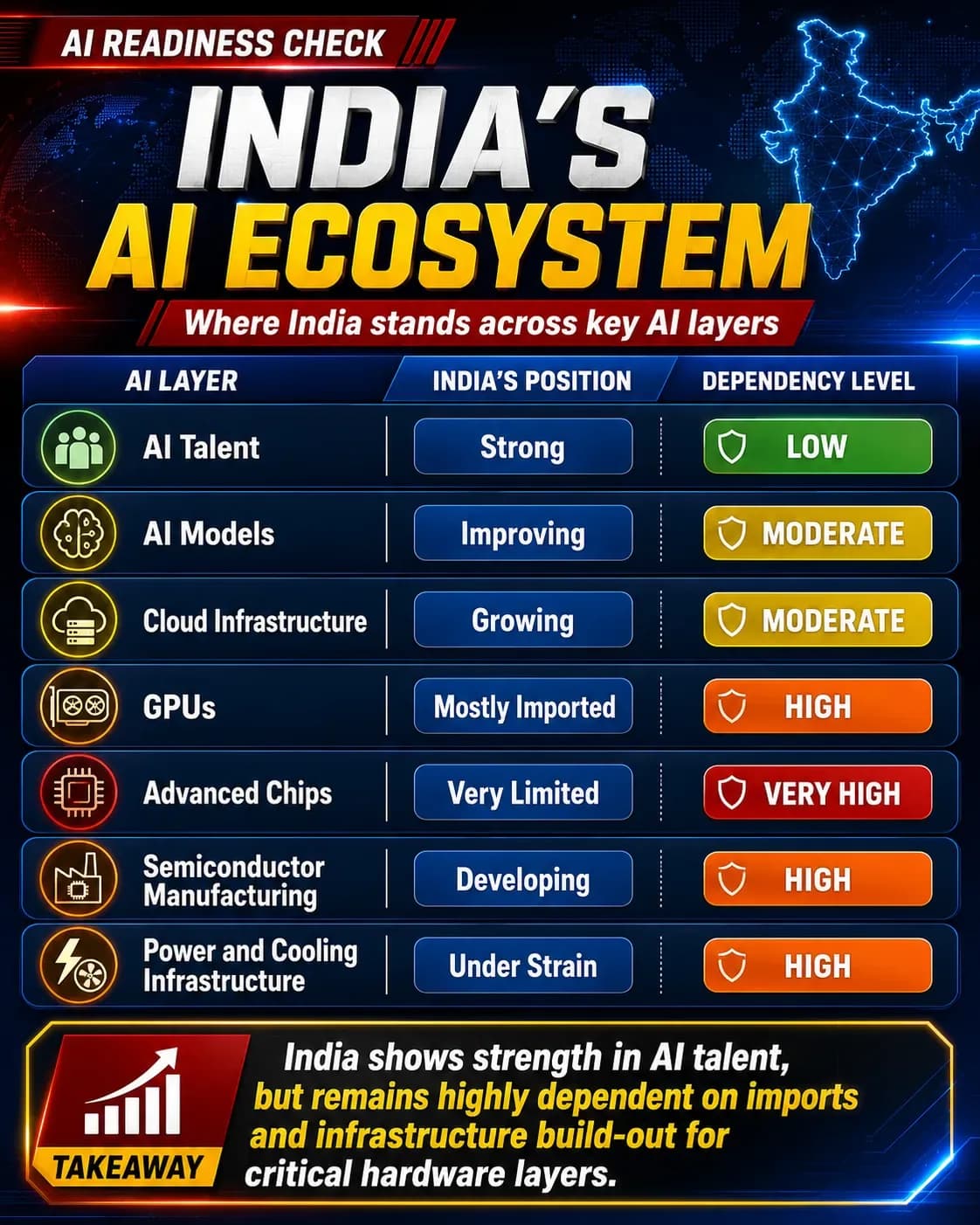
India's strength changes a lot as you move down this stack. Talent is India's best asset.
Engineers here already design chips for Qualcomm, Nvidia, and Intel out of Bengaluru and Hyderabad. But talent alone cannot make India's sovereign AI mission self reliant. One strong layer cannot hold up the rest. Sovereignty only happens once every layer can stand on its own.
Also Read | China's Peking University Builds Neuromorphic Brain Chip; 478x Faster Than Nvidia A100
The Hidden Bottleneck, Why GPUs Alone Cannot Build Sovereign AI
This part gets the least attention. It deserves the most. AI clusters do not act like normal office servers. One Nvidia GB200 rack can pull 120 to 130 kilowatts of power. Each chip inside, like the B200 or GB200, can use up to 1,200 watts on its own. That is far more than older server chips ever needed. Experts say the next generation of racks could need 300 to 600 kilowatts within a year or two.
Most Indian data centres were not built for this. They were made years ago for normal office work, like email and websites. Back then, a rack using 3 to 6 kilowatts was considered high. To fix this, India needs new cooling systems, new transformers, and rebuilt power lines in most existing buildings.
The shift is already happening worldwide. Liquid cooled AI servers made up just 15 % of global setups in 2024. That number could hit 76 % by 2026. This is not a slow change. It is a full rebuild, and it is happening right now.
Call this the compute infrastructure bottleneck. It gets far less attention than a new GPU order or a model launch. Nobody takes a photo of a transformer upgrade. But without it, GPUs sit idle or run slower than they should. Every rupee spent on chips ends up doing less work.
Also Read | Why India’s New Param-2 AI Model Matters for Governance, Language and Data Sovereignty
Following The Money, What India's AI Investment Really Needs To Build
Most people judge India's sovereign AI mission by GPU count or model size. That is only part of the story.
India also needs to invest in AI ready cloud infrastructure, modern data centres, steady power supply, and stronger chip supply chains. New AI data centres need advanced cooling systems, since AI chips run very hot. India also needs more skilled engineers who can build and run these high power facilities.
The government took a step in this direction with the second phase of the India Semiconductor Mission, announced in Budget 2026-27. This phase does not just fund new chip factories. It also supports chip equipment, raw materials, and chip design skills. These are the exact areas where India still depends on other countries.
Sovereign AI is not just about code and models. It needs power lines, cooling pipes, chip factories, research funding, and startup support. Without these basics, India's AI plans could hit real limits down the road.
The Global AI Race Is Becoming A Race For Compute Infrastructure
Look at how the US and China compete, and the pattern is clear. Neither country wins on model quality alone anymore. They are fighting for GPU access, chip factories, power supply, and strong supply chains.
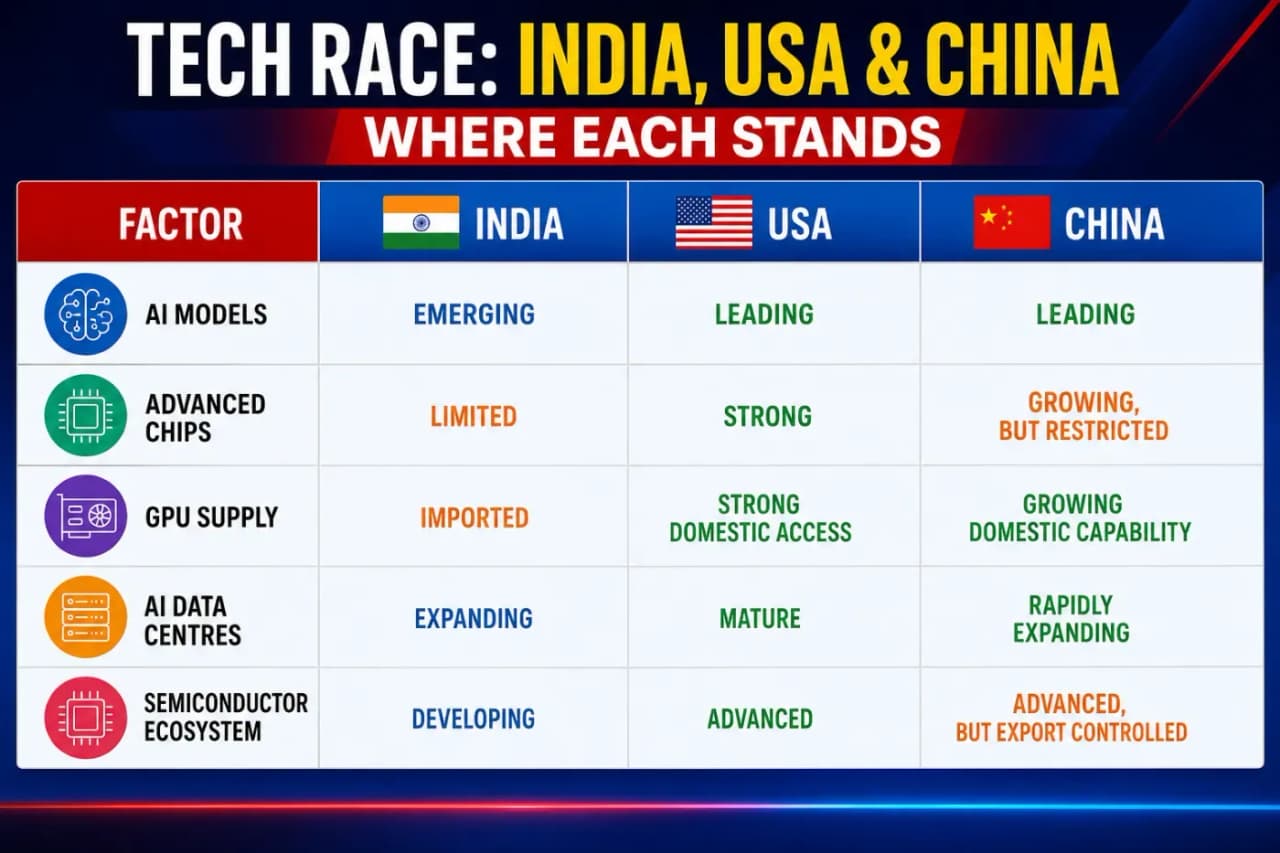
Experts say that even if the US stops sending AI chips to China, America could still have 21 to 49 times more AI computing power in 2026. China's top chipmaker, Huawei, is ramping up output. But it may only reach 4 to 5 % of the AI power that Nvidia alone can supply. This tells us something important.
Both the US and China are pouring money into infrastructure, not just software. India's sovereign AI mission needs to follow the same path. It cannot win by building models alone.
Also Read | Why Small Language Models Are Becoming India’s Smarter AI Bet?
The Business Opportunity Hidden Inside The Infrastructure Challenge
Every problem in this story is also a business chance. Data centre builders who start fresh stand to gain the most, since fixing old buildings costs more than building new ones right. Power equipment makers, the companies building transformers and switchgear, are already seeing more orders as facilities upgrade.
Cooling tech firms are moving from a small niche to a must have service. Renewable energy firms and grid upgrade companies also stand to gain, since AI campuses often need their own power source. Further down the chain, India's growing chip ecosystem, from packaging plants in Sanand to the new fab in Dholera, opens doors for suppliers who were shut out of this industry for years.
Three Things Mainstream Coverage Keeps Missing
Most reports on India's sovereign AI mission talk about GPU numbers or new model launches. They rarely ask if India has the infrastructure to support any of it.
One big gap is power hardware. Only a few companies worldwide are approved to build the power units that Nvidia's newest racks need. India has no certified maker in this space yet. So even a fully funded data centre may sit and wait for imported parts.
 Another gap is chip equipment. India is building new chip plants, including one in Dholera. But these plants still need advanced machines from the Netherlands, the US, Japan, and a few European nations. Most of the world's chip making tools come from these places. So even chips made in India still carry a foreign link somewhere in the chain.
There is also a global shortage of advanced memory chips. Large AI models need huge amounts of high speed memory to train and run. India's new plants, like Micron's facility in Sanand, currently package memory chips. They do not yet make the advanced memory itself. That gap matters more than most headlines admit.
Also Read | BharatGen Joins Hands with IIT Bombay and C-DAC to Build India’s Own Multilingual AI Ecosystem
Sovereign AI Will Be Decided Below The Model Layer
India has made real progress on AI models. Sarvam's work proves Indian teams can build strong, competitive AI models. Talent was never India's weak spot, and data access keeps improving through platforms like AI Kosh.
The bigger test lies beneath the software. It lies in transformers, cooling pipes, chip machines, and power deals, the unglamorous parts of the story that rarely make headlines. Countries may compete through AI models, but they win through compute infrastructure. India's sovereign AI story will be written as much in power grids and cooling systems as in how smart its models are.
News4Bharat POV
News4Bharat's assessment is that India's sovereign AI story is strong on paper. GPU numbers keep rising, Sarvam has built a real model, and the semiconductor mission is finally moving from paperwork to construction. But this does not yet add up to full sovereignty.
The chips, cooling systems, machines, and even the memory packaging still trace back to foreign suppliers. As News4Bharat sees it, once India's power grids, chip fabs, and cooling systems catch up with its GPU count, the sovereign AI label will finally be earned. Right now, the mission has real pace. It just has not reached the finish line yet.