

Every year on July 11, World Population Day draws attention to the demographic changes reshaping societies. In 2026, the world’s population is estimated at approximately 8.3 billion—but the most important population question is no longer simply how many people the planet will contain. It is where they will live, how old they will be and whether cities can provide the housing, water, transport, jobs and public services they need.
The United Nations expects the global population to continue growing for another five to six decades, reaching approximately 10.3 billion in the mid-2080s before gradually declining. At the same time, fertility is falling and population growth is becoming increasingly concentrated in a smaller group of countries.
By 2050, this uneven transformation could redraw the global urban map. African and South Asian cities are expected to absorb much of the coming growth, while several cities in East Asia and Europe confront ageing populations and demographic contraction.
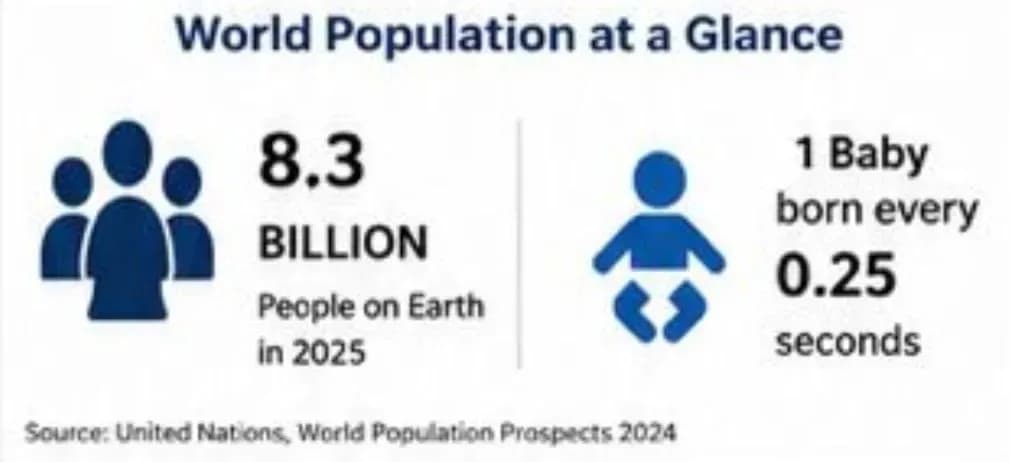
A baby is being born roughly every quarter of a second. By the time you finish reading this article, the planet will have gained a few hundred more people. (Estimated based on United Nations demographic projections) That is the overlooked reality behind a number many of us no longer notice: 8.3 billion - here’s where the world population stands today.
Also Read | The Real Census Story: How India’s Population Has Changed Since 2011
But population growth is no longer just a question of how many people the planet can hold. The bigger question is where those people will call home. In the next 25 years, the geography of human life will change dramatically - redrawing cities, economies, and everyday experiences from Lagos to Tokyo.
The world population is growing more slowly
Global population growth is decelerating, not accelerating. The UN's World Population Prospects 2024 report, the 28th edition of the world's most authoritative demographic dataset puts the probability that the global population will peak sometime this century at 80%, likely in the 2080s at around 10.3 billion. Global fertility has already fallen to roughly 2.3 children per woman, a full child fewer than in 1990, and is projected to slip toward the 2.1 replacement threshold by the late 2040s.
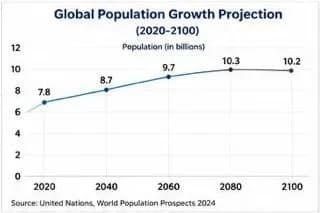
So the population story of 2050 isn't really about more humans. It's about a massive redistribution of the humans we already have pouring out of the countryside and into cities, concentrated overwhelmingly in Asia and Africa.
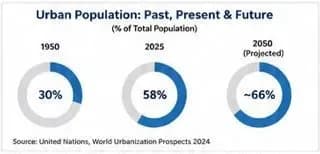
Today, 58% of humanity lives in urban areas, up from about 30% in 1950. By 2050, the UN projects that figure will climb to roughly two-thirds of the world's population adding another 2.5 billion urban residents, with close to 90% of that growth happening in Asia and Africa alone.
The changing of the guard
If you'd asked someone in 2000 to name the world's largest city, they'd have said Tokyo without hesitation. Tokyo still holds that title today. But its reign is a twentieth-century inheritance, not a twenty-first-century forecast. According to the UN Population Division's 2025 World Urbanization Prospects, the ranking is about to flip almost entirely:
- Dhaka, Bangladesh, currently home to roughly 22–23 million people, is on track to become the world's most populous city, crossing 50 million residents by 2050. The capital is absorbing between 300,000 and 500,000 rural migrants every year, many pushed out by rising seas, riverbank erosion, and salt-poisoned farmland.
- Jakarta, Indonesia will likely rank second, also surpassing 50 million.
- Delhi is projected to overtake Tokyo outright, some estimates placing it near 50 million residents, anchoring the world's largest urban agglomeration.
- Tokyo and Osaka are among the rare major cities expected to shrink by as much as 12% as Japan's population ages and its birth rate stays stubbornly low.
- Luanda, Angola may be the single most dramatic case: from just 715,000 residents in 2000 to a projected 20 million by 2050, a roughly 30-fold increase in half a century.
Which will be the world’s largest cities in 2050?
The latest UN assessment has already changed the global city ranking. Under the harmonised methodology used in World Urbanization Prospects 2025, Jakarta is currently the world’s most populous city, with nearly 42 million residents. Dhaka follows with almost 40 million.
Also Read | How an Ancient Indian Practice Became the World's Wellness Language
By 2050, Dhaka is projected to overtake Jakarta and become the largest city in the world. Other cities in Asia—including Shanghai, Delhi and Karachi—are also expected to remain among the largest urban concentrations.
These estimates should be compared cautiously with older rankings. Previous reports often relied on national definitions of cities and urban agglomerations, which varied considerably between countries. The UN’s 2025 methodology applies a more consistent geospatial definition, making cross-country comparisons more uniform but also producing figures that differ sharply from earlier editions.
Two demographic worlds, one planet
This is fundamentally a tale of two trajectories happening simultaneously.
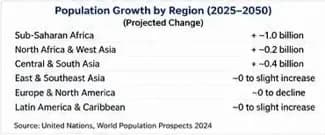
In sub-Saharan Africa, the population is projected to nearly double by 2050. Nigeria alone is expected to add around 340 million people close to the entire current population of the United States overtaking the U.S. to become the world's third most populous country. The UN notes that just eight countries, five of them African, will account for half of all global population growth through mid-century.
In East Asia and Europe, the picture inverts. China's population is expected to fall by hundreds of millions this century. Fertility across nearly all of Europe sits below the 2.1 replacement level, and the continent has been shrinking in net terms since around 2020.
Age structure is shifting everywhere too. The UN projects that by 2080, people aged 65 and older will outnumber children under 18 for the first time in recorded human history and by the mid-2030s, people 80 and older will already outnumber infants globally.
Also Read | Vaping Was Just the Trailer. The Real Nicotine War Has Begun!
What population change will mean for cities
Every year on July 11, World Population Day draws attention to the demographic changes reshaping societies. In 2026, the world’s population is estimated at approximately 8.3 billion—but the most important population question is no longer simply how many people the planet will contain. It is where they will live, how old they will be and whether cities can provide the housing, water, transport, jobs and public services they need.
The United Nations expects the global population to continue growing for another five to six decades, reaching approximately 10.3 billion in the mid-2080s before gradually declining. At the same time, fertility is falling and population growth is becoming increasingly concentrated in a smaller group of countries.
By 2050, this uneven transformation could redraw the global urban map. African and South Asian cities are expected to absorb much of the coming growth, while several cities in East Asia and Europe confront ageing populations and demographic contraction.
Whether your city is racing toward megacity status or quietly greying and shrinking, the underlying test is the same: can infrastructure keep pace with demographic change?
- Fast-growing cities (Lagos, Kinshasa, Dhaka, Karachi) face housing, water, and transit shortfalls that are already visible in sprawling informal settlements expanding faster than the roads, sewers, or power grids meant to serve them.
- Aging, shrinking cities (Tokyo, Osaka, much of Europe) face the mirror problem of a shrinking working-age population supporting a growing share of retirees.
- Migration-driven cities (much of North America, Australia) are threading a middle path, still growing but almost entirely through immigration rather than birth rates.
Lagos offers a warning—and an opportunity
Lagos demonstrates both the economic power and infrastructure pressure associated with rapid urban growth. The city has expanded from a comparatively small coastal settlement into one of Africa’s largest economic centres, but access to basic services has not kept pace.
According to the World Bank’s 2023 Lagos Diagnostic Study and Pathway for Transformation:
- Only 35% of the population has access to the public water supply.
- Only 5% is connected to the public sewerage system.
- Approximately 14% of households receive a reliable electricity supply lasting more than eight hours a day.
- Waste collection reaches only about 20–30% of the city.
- An estimated 50–75% of residents live in informal housing.
- Lagos faces a housing deficit of approximately 3.3 million units.
Together, these figures show why population growth cannot be separated from urban governance. A rapidly expanding city can generate employment, investment and innovation, but those benefits become harder to sustain when housing and essential services fall behind demand.
By 2050, the biggest demographic shift will not simply be an increase in the number of people, but a fundamental rebalancing of where humanity lives. Growing urban hubs in Africa and South Asia will emerge as centres of population and economic activity, while parts of the industrialised world navigate a new era of demographic contraction. A city’s future will be determined not only by global population trends, but by its place within this wider transformation.