

The 73rd Cannes Lions was not just another celebration of global advertising. It was a reset.
After a year of uncomfortable questions around award integrity, the 73rd edition of the festival returned with fewer entries, tougher verification rules and a noticeably sharper standard for what deserved to win. From June 22 to 26, the Croisette became a stage for three big shifts shaping modern marketing: AI is now central to the conversation, human judgment still defines great creativity, and proof of real-world impact is becoming as important as the idea itself.
Claude’s Film Grand Prix, Heineken’s creative dominance, Kenya and Greece’s breakthrough Grand Prix moments, and India’s quieter five-Lion finish all pointed to the same larger truth: Cannes Lions 2026 rewarded work that could do more than impress a jury. It had to prove it existed, prove it worked and prove why it mattered.
At a Glance
The defining story of Cannes Lions 2026 goes beyond the event itself - it reflects a larger shift in global creativity, branding, and the future of marketing ... it's the numbers. A much smaller, more tightly-vetted festival, following last year's fake-entry scandal, changed what winning actually meant this year.
Agencies that once measured Cannes success by volume how many categories they entered, how many shortlists they racked up walked into a festival where fewer, stronger entries mattered far more than a crowded submission list. That shift shaped almost everything else about how the week played out, from which campaigns got airtime on stage to which countries had a breakthrough moment.
History was made for two countries. Kenya and Greece each secured their first-ever Cannes Lions Grand Prix, a milestone that speaks to the festival's steadily widening map of creative influence beyond its traditional Western strongholds.
AI ruled the conversation, not the winners' list. For all the talk of generative tools and AI-craft, juries across the board leaned toward work that was demonstrably human-made and real-world executed a quiet but firm statement on where creative judgment is headed.
India's presence at Cannes contracted sharply. A steep pullback in entries translated into a noticeably thinner haul of Lions compared to the previous year's high, a reversal worth watching heading into 2027.
Grand Prix Winners: Quick Reference
Cannes Lions confers a Grand Prix its highest honour across roughly 30 disciplines each year, spanning long-established categories such as Film, Design and Innovation alongside newer additions like Creative Strategy and Creative Business Transformation. Together, these wins form the clearest signal of where the industry's creative bar was set in 2026.
This year's list was notably global in character, with recognition extending well beyond the usual American and Western European powerhouses to first-time honourees in Africa and Southern Europe, and it reflected a jury-wide preference for ideas grounded in genuine business or social outcomes rather than concept alone. The table below summarises the winners that generated the most discussion across the industry press and on the festival floor itself.
Also Read | ChatGPT Ads Going Global — What Every User Needs to Know in 2026!
 The list underlines a festival that rewarded range: Technology-forward work such as Google's Project Genie sat comfortably alongside deeply human, emotionally driven wins like Moncler's Al Pacino - Robert De Niro campaign, while social-impact entries from Nairobi and São Paulo held their own against blue-chip global brands. It is this breadth, more than any single winner, that industry observers point to as the defining character of Cannes Lions 2026.
Anthropic's Claude: The Buzziest Win
Mother London's two spots "Can I Get a Six Pack Quickly?" and "How Can I Communicate Better With My Mom?" won Film Grand Prix + Titanium.
The pitch: Claude as the AI that won't run ads, jabbing at OpenAI's decision to bring ads to ChatGPT.
Jury president Pelle Sjoenell's take: "An ad about where ads shouldn't exist. An AI making fun of AI... corporate aikido, with wit, nerve and craft in every frame."
Two trends he flagged across Film: AI used to elevate humanity, not replace it and humour is back.
The Real AI Story: Craft > Automation
Every panel and hallway conversation this year seemed to circle back to AI but the winning work told a different story. Here's the gap between the talk and the trophies:
- AI was everywhere in the talk on the Croisette.
- It was not everywhere in the winners' circle.
- Titanium, Grand Prix for Good, and Glass all went to tangible, human-built ideas not AI-generated ones.
- Why: post-scandal verification rules made "we actually built this" a genuine edge this year.
Friction point: Google DeepMind's investment in indie studio A24 sparked real backlash on-site a reminder AI still divides the room.
Also Read | Claude Design Is Here — What Anthropic Just Launched, How It Works, and How It Compares to GPT
Trends at Cannes 2026
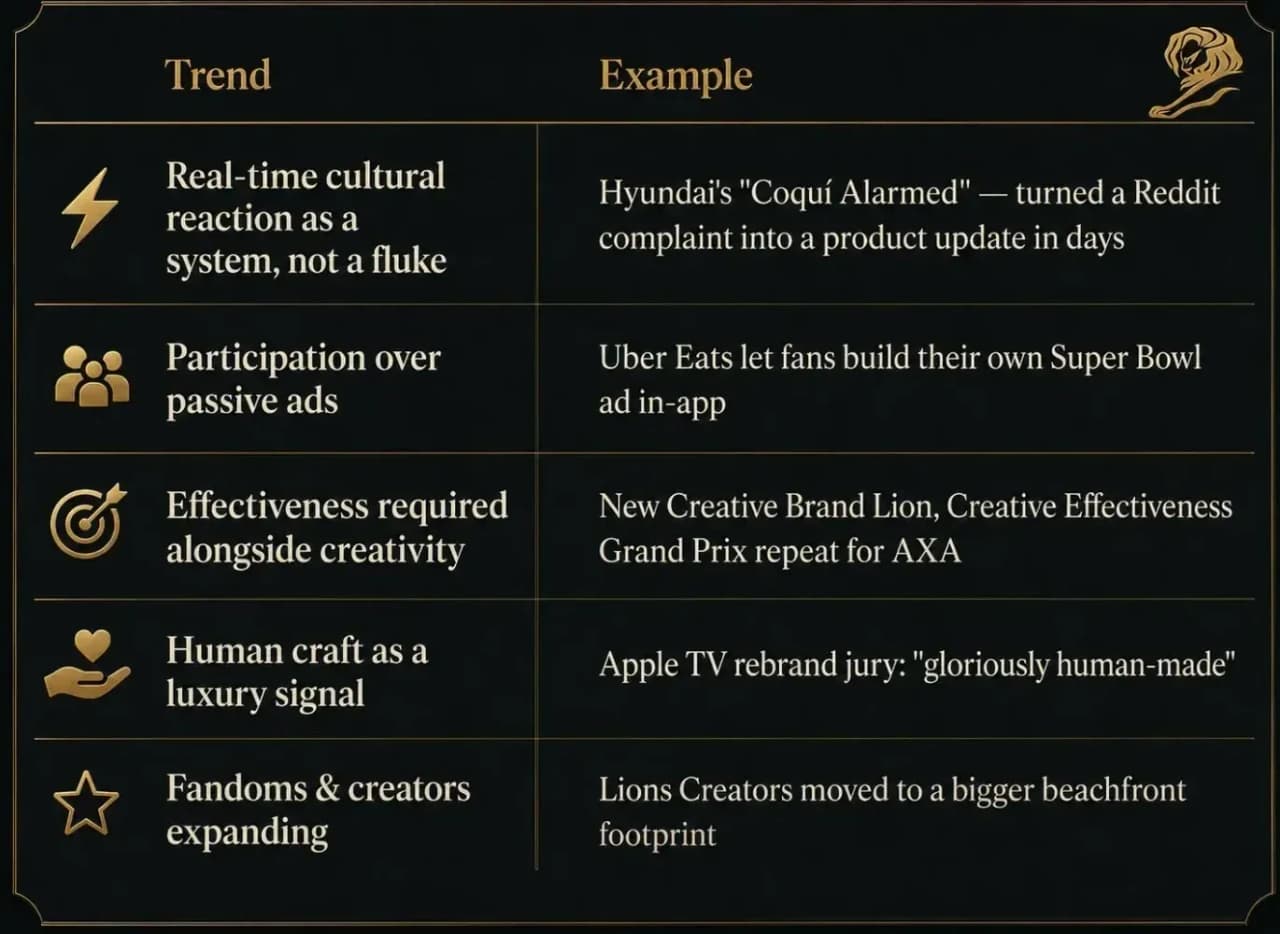
Beyond the trophy count, a handful of patterns kept repeating across the winning work and the festival's talks programme - here's the shortlist:
New Category Report Card: Creative Brand Lion
Our preview flagged this as the year's headline new category built to reward the internal creative capability behind a brand's work, not just one standout campaign. Here's how it played out in its debut year:
- Grand Prix: Anheuser-Busch InBev (talent & workplace culture)
- Lion winner: Mastercard (partnership models)
- Built to reward systems behind repeat award-level work, not a single campaign.
Who Owned the Festival
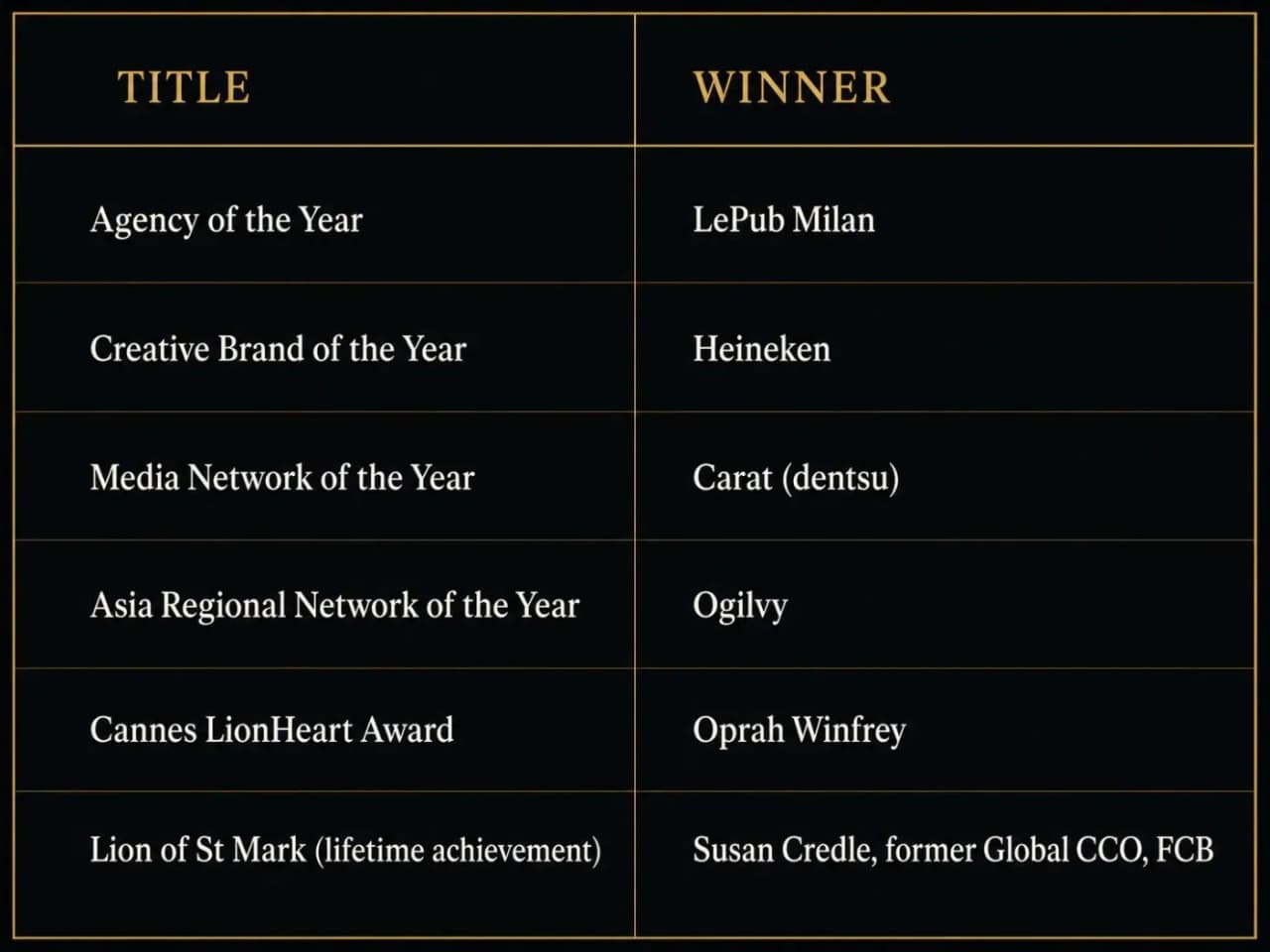
Beyond individual campaigns, Cannes also hands out titles to the agencies, networks and people who defined the week. Here's who took the big honours in 2026:
India Scoreboard: A Quieter Year
- 2025: 32 Lions, including 1 Grand Prix (FCB India's "Lucky Yatra")
- 2026: Sharp pullback - entries down 31.2%, tally down to Silver/Bronze range
Also Read | OpenAI and Broadcom Unveil Jalapeño AI Chip Focusing on Economics of Intelligence
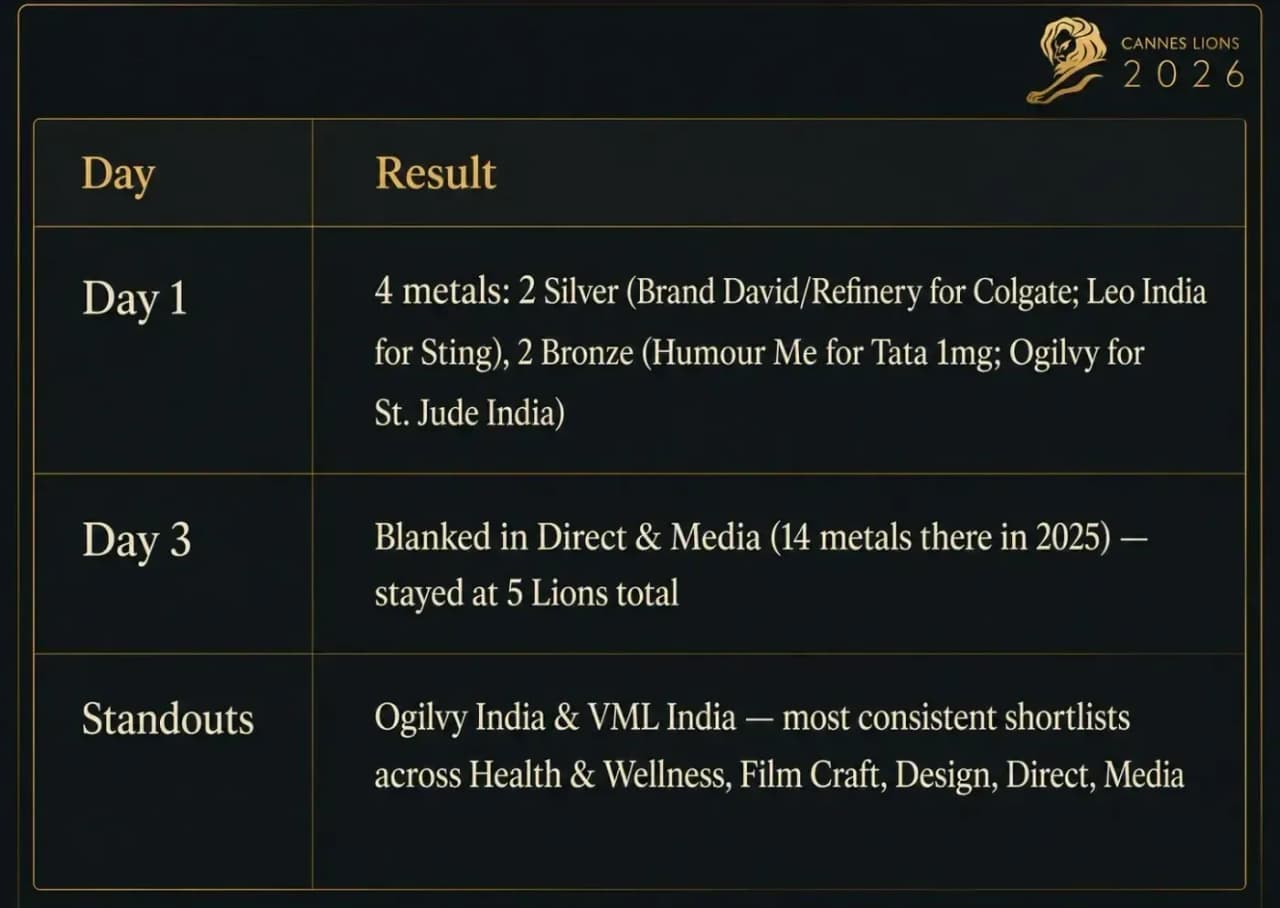
India's run unfolded unevenly day-to-day, with a solid opening followed by a rough patch in some of the festival's biggest categories:
What This Means for 2027
Reading this year's winners together, here's what brands and agencies should take into next year's planning:
- AI helps execute the idea; it's not the idea.
- Build the muscle to react to culture in hours, not weeks.
- Bring proof of business results, not just a good story.
- Expect entry rules to tighten further quality and documentation will matter more than volume.
News4Bharat POV
For years, award shows have rewarded the best-packaged version of creativity. This year, Cannes appeared to reward the most verifiable version of creativity. That difference matters.
The biggest story was not that AI dominated the conversation. It was that AI did not dominate the winners’ list in the way many expected. The work that rose to the top was rooted in trust, culture, utility, humour, public value and measurable impact.
Claude won by turning the debate around ads in AI into a sharp brand position. Heineken won by showing how a brand can build long-term cultural relevance. Suncorp’s “Haven” showed that creativity can move beyond communication and become infrastructure.
For India, the 2026 result should be read less as a setback and more as a strategic signal. A five-Lion finish after last year’s high is not only about fewer entries. It raises a harder question: are Indian agencies building enough globally scalable, evidence-backed, category-defining ideas? Cannes 2027 will not be won by louder case-study films. It will be won by work with stronger proof, sharper positioning and a clearer reason to exist beyond the campaign cycle.