

For years, vaping was seen as the future of nicotine consumption. It disrupted the traditional cigarette market, created billion-dollar companies, and sparked fierce public health debates. But even as countries continue to battle over e-cigarettes, the industry has already begun shifting toward a new generation of nicotine products.
In 2019, the country did something most of the world did not. It did not regulate vaping. It banned the entire category. The Prohibition of Electronic Cigarettes Act, PECA, outlawed the production, import, sale, storage and advertising of e-cigarettes outright, with first-time offenders facing up to a year in jail or a fine of ₹1 lakh.
In February 2026, the government reaffirmed that ban and pushed back against heavy lobbying from tobacco and nicotine companies trying to reopen the market.
On paper, India won the last fight before most countries had even named it.
The numbers say otherwise. A 2023 study found that roughly 10% of young adults still reported current e-cigarette use, sourced through ordinary retail shops and through friends and siblings. Vapes never left. They just moved to the grey market. And while regulators kept their eyes on the vape, the industry built an entirely new product line designed to walk straight through the gap the law left open: tobacco-free nicotine pouches, lab-made synthetic nicotine, dissolving strips that look like quitting aids.
India has 106 million adult smokers, and tobacco already kills close to one million Indians every year, according to the World Health Organization. That is the prize the new nicotine economy is chasing. Here is what it looks like, and why the loophole matters more than the ban.

Also Read | World No Tobacco Day 2026: Why the Fight Against Youth Nicotine Addiction Is More Urgent Than Ever!
The End of the Vape-Centric Era
When vaping products first appeared, they were marketed as a cleaner alternative to smoking. Unlike cigarettes, they did not burn tobacco. Instead, they heated liquid containing nicotine, producing an aerosol that users inhaled.
The idea quickly caught on.
Millions of smokers switched to vaping, and the industry grew into a global market worth tens of billions of dollars. Many public health experts viewed vaping as a potential harm-reduction tool for adult smokers. But the rapid rise of vaping also brought unexpected consequences.

Youth usage surged in several countries. Disposable vapes flooded the market. Concerns emerged about flavors, marketing tactics, and long-term health effects. Today, regulators are no longer focused on vaping alone. Policymakers are increasingly looking at the entire nicotine landscape.

Nicotine Ecosystem
Nicotine no longer means one thing. It's become an entire ecosystem of products, each chasing a different customer and dodging a different rulebook.
- Nicotine pouches: small, white, tobacco-free pouches placed under the lip. No smoke, no vapor, no smell.
- Synthetic nicotine: nicotine made in a lab rather than extracted from a tobacco plant, which let companies argue they weren't "tobacco products" at all.
- Heated tobacco products: devices that heat real tobacco instead of burning it, popular in parts of Asia and Europe.
- Oral nicotine strips and gums: dissolvable, pharmacy-aisle-looking products that blur the line between quitting aid and recreational use.
- Future alternatives: nasal sprays, nicotine-infused drinks, and delivery tech still in development, designed to stay one step ahead of regulation.
Each product was born from the same instinct: find the gap in the law before the lawmakers find you.
What Is a Nicotine Pouch?
Nicotine pouch is a deceptively simple invention: a small white sachet designed to sit quietly between gum and lip. There is no tobacco leaf inside. No fire. No vapor cloud to give it away. It simply dissolves, releasing nicotine straight into the bloodstream while the user goes about their day, undetected.

What sets pouches apart:
- No combustion, no inhalation - nothing is burned, smoked, or vaped, which is exactly why pouches slip past laws written for smoke and aerosol.
- Built for discretion - no smell, no cloud, no visible exhale, making it usable almost anywhere: a boardroom, a flight, a classroom.
- Engineered for appeal - flavors ranging from cool mint to citrus and berry, packaged more like a lifestyle product than a nicotine delivery device.
- A wide nicotine range - strengths vary from mild starter pouches to high-concentration formats marketed toward heavier users.

- Market leaders - brands like ZYN, On!, and Velo have turned this once-niche product into a global category worth billions.
Why Nicotine Pouches are a Real Threat?
Nicotine pouches are the fastest-growing nicotine category on earth. One ResearchAndMarkets estimate puts the global pouch market at USD 8.63 billion in 2026, climbing to USD 23.81 billion by 2030 at a compound growth rate near 29%. In the United States alone, more than 430 million pouch cans sold in 2024, a 34% jump in a single year. Philip Morris International, the company behind ZYN, led the global pouch market with more than 26% share in 2025, the same year the US FDA formally authorized ZYN for sale.
Behind the pouches sits an even quieter disruptor: synthetic nicotine, made in a lab instead of extracted from a tobacco plant. The pitch to regulators was simple. If it does not come from tobacco, the argument went, it is not a tobacco product, so tobacco law does not apply. The US and EU have moved to close that gap. India has not clearly addressed it, which is exactly the kind of definitional hole the WHO has warned about.

The Lab-Made Disruptor
One of the most significant developments in the industry is synthetic nicotine. Unlike conventional nicotine, which comes from tobacco plants, synthetic nicotine is manufactured in laboratories through chemical processes.
At first glance, the difference may seem minor. However, it created a major regulatory challenge.
Many countries originally wrote nicotine laws around tobacco-derived products. Because synthetic nicotine did not come from tobacco, some companies argued that existing regulations did not apply to them.
This loophole allowed certain products to enter markets under different regulatory standards.
Regulators in the United States, Europe, and other regions have since moved to close these gaps, ensuring synthetic nicotine products face similar oversight. Yet the technology continues to attract investment because laboratory production can offer greater consistency and potentially reduce dependence on agricultural supply chains.
Also Read | World Health Day 2026: Why India’s Health Story Needs More Than Bigger Hospitals
The Rise of Nicotine Pouches
If vaping defined the last decade, nicotine pouches may define the next one. These small, tobacco-free pouches are discreet, easy to use, and do not produce smoke or vapor.
Consumers often view them as convenient alternatives because they can be used in places where smoking and vaping may be restricted.
Why Consumers Are Choosing Pouches
- No smoke
- No vapor clouds
- Minimal odor
- Portable and discreet
- Tobacco-free formulations
The category has experienced explosive growth in several markets.
However, health experts have raised concerns about youth access and nicotine addiction. Critics argue that appealing flavors and modern packaging may attract younger users.
Supporters counter that pouches provide adult smokers with another lower-risk alternative to cigarettes.
The Hidden Environmental Cost of Nicotine
Nobody designed disposable vapes to be recycled and it shows:
- Millions of batteries ending up as waste. Each disposable vape contains a small lithium battery, a heating coil, and leftover e-liquid. Multiply that by hundreds of millions of devices sold every year.
- Why disposable vapes became an e-waste problem. Designed to be thrown away after a few hundred puffs, these devices were never built with disposal in mind. Many end up in regular trash, where their batteries pose fire risks and leach chemicals.
- Recycling challenges regulators didn't anticipate. Vape recycling programs are rare, inconsistent, and expensive to run. Lawmakers who focused on flavors and youth access mostly missed the environmental side of the problem until landfills and waste-fire statistics forced the issue.

When Bans Create Black Markets
While health concerns dominate the nicotine conversation, the environmental footprint of modern nicotine products is becoming impossible to ignore.
Disposable vapes became enormously popular because they were cheap and convenient. Unfortunately, millions of them are discarded every year.
Inside each device are:
- Lithium batteries
- Plastic casings
- Electronic components
- Residual chemicals
Many consumers throw them into ordinary trash bins.
China's Outsized Role in the Global Nicotine Supply Chain
A huge share of the world's vaping devices, coils, batteries, pods, and the disposable shells themselves are manufactured in and around Shenzhen, China. This single manufacturing hub supplies brands across the US, Europe, and beyond.
- Supply chain vulnerabilities: When one region makes most of the hardware, any disruption, a regulatory crackdown, a trade dispute, or a factory shutdown can ripple through the entire global market almost overnight.
- The geopolitical dimension: As governments debate tariffs, trade restrictions, and national security concerns around Chinese manufacturing, nicotine products have quietly become part of that larger conversation. A vape isn't just a health issue anymore; it's a supply-chain and trade issue too.
Also Read | India Becomes 6th Nation to Host ASCO Direct GI Cancers Symposium
Big Tobacco's New Strategy: Nicotine Without Tobacco
Cigarette sales have been declining for years in most developed markets, and the major tobacco companies know it. Their response hasn't been to fight the decline it's been to stop relying on tobacco altogether.
- Declining cigarette sales have pushed traditional tobacco giants to diversify or risk shrinking into irrelevance.
- The race toward alternative nicotine products has turned former cigarette makers into pouch companies, heated-tobacco innovators, and even investors in synthetic nicotine startups.
- Billions in investment are flowing into research, acquisitions, and new product lines that often don't contain a single gram of actual tobacco leaf.
The strategy is simple: if the future is "smoke-free," make sure you own the smoke-free future too.
Are We Moving From Anti-Smoking to Anti-Nicotine Policies?
For most of the last century, public health campaigns focused on smoking. Today, some experts argue that the debate is evolving. The central question is becoming:
Should nicotine itself be the target?
Two Competing Views
View 1: Focus on Smoking
Supporters argue that smoking-related diseases come primarily from combustion and toxic smoke.
View 2: Focus on Nicotine
Others believe nicotine addiction itself should remain the primary concern regardless of how it is delivered. This disagreement is shaping new regulatory approaches around the world. The outcome could determine how future nicotine products are treated.
What Comes Next?
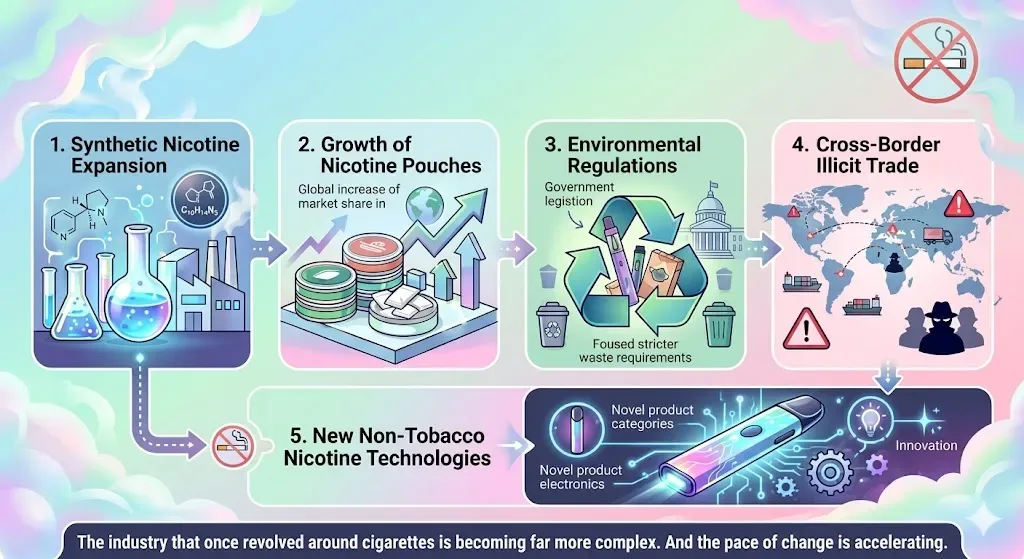
The next decade of nicotine regulation will likely be shaped by five key shifts: the rise of lab-made synthetic nicotine, the continued global growth of nicotine pouches, tighter environmental and recycling rules, growing cross-border illicit trade as restrictions tighten, and entirely new non-tobacco nicotine technologies still taking shape. Together, these trends signal an industry that's moving fast — and growing far more complex than the cigarette-driven market it once was.
The Next Nicotine War Has Already Begun
The future debate is no longer about cigarettes versus vapes.
The real debate has moved to pouches, synthetic nicotine, e-waste, supply chains, and a much bigger philosophical question: should society be regulating smoking, or regulating nicotine itself?
Synthetic nicotine, nicotine pouches, heated tobacco products, and emerging technologies are rewriting the rules of the industry. At the same time, governments are struggling to balance public health goals, consumer choice, environmental concerns, and the risk of illicit markets.
What comes next will shape not only the future of nicotine products but also the future of global health policy. While health concerns dominate the nicotine conversation, the environmental footprint of modern nicotine products is becoming impossible to ignore.