

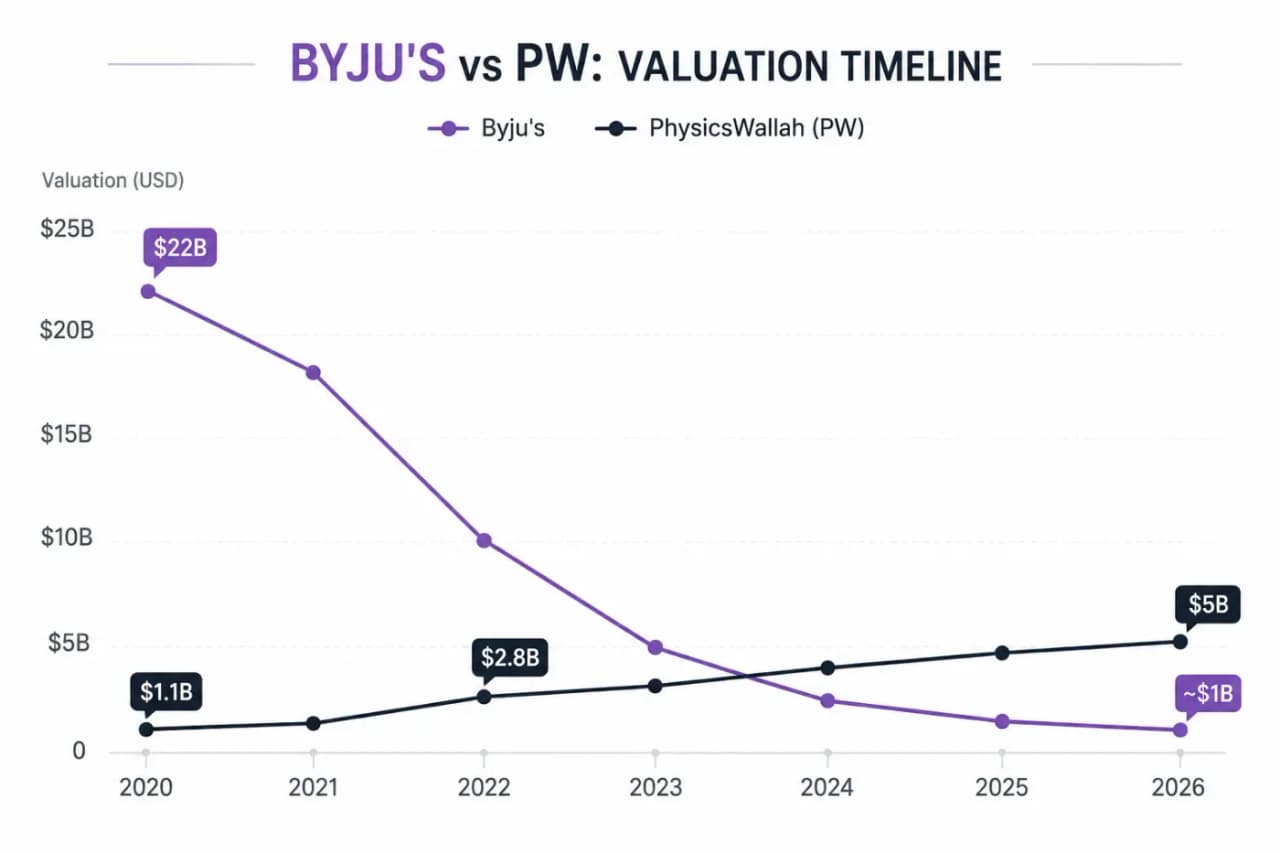
In 2022, two Indian edtech companies looked like they were heading in the same direction. One was already India's most valuable startup. The other had just become a unicorn. Four years later, their stories could not be more different. This is where the Physics Wallah vs Byju's comparison becomes worth paying close attention to, because the gap between them explains a lot about what went wrong and what went right in Indian edtech.
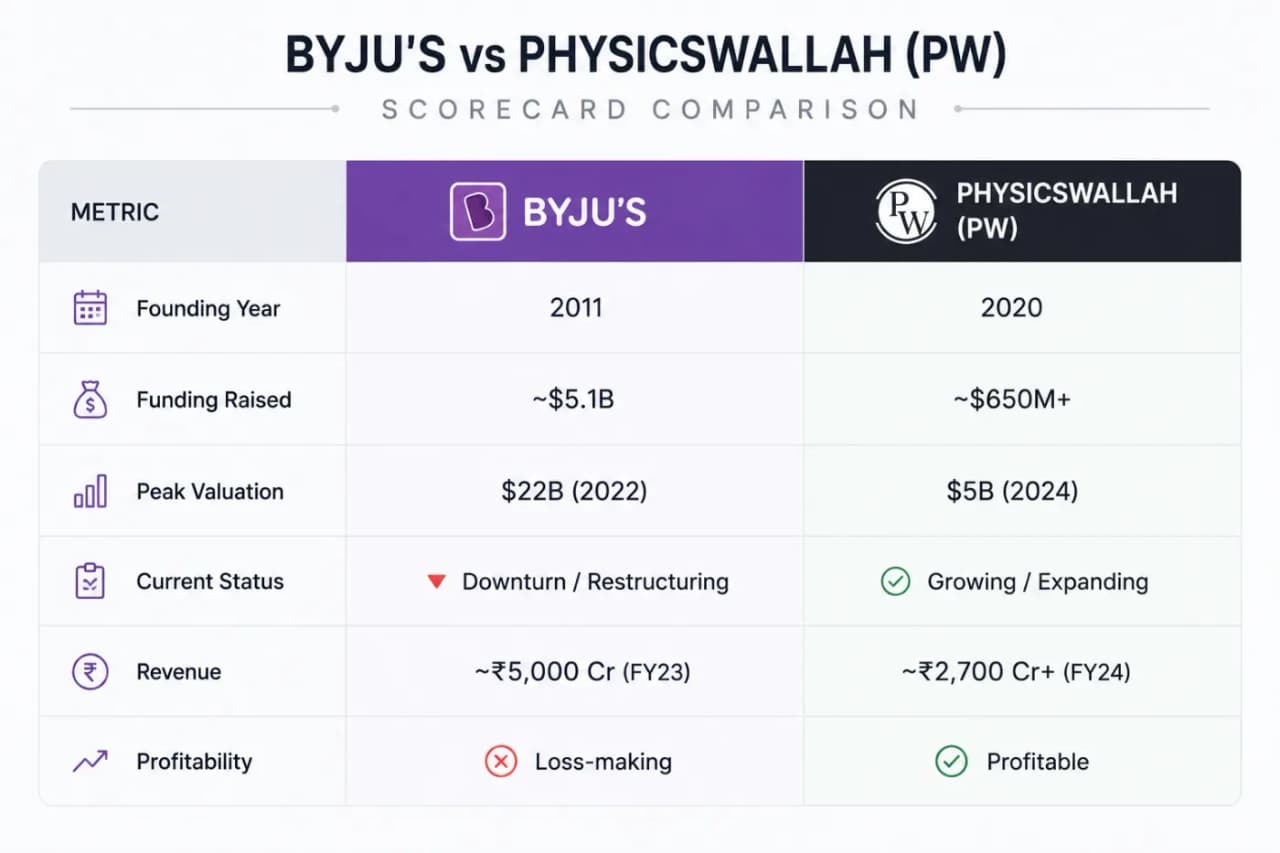
Byju's started in 2011 as Think and Learn, built around Byju Raveendran's own coaching classes for the CAT exam. It grew fast, and during the pandemic it became a household name. Shah Rukh Khan appeared in its ads. Lionel Messi became its brand ambassador. Its logo sat on Indian cricket jerseys. By 2022, the company was valued at 22 billion dollars, making it the most valuable startup in the country.
Physics Wallah had a very different beginning. Alakh Pandey started it as a YouTube channel in 2016, teaching physics to students who could not afford expensive coaching. There was no big funding round behind it in the early years. It grew because students trusted the teaching and could actually pay for it. The company turned into a unicorn only in 2022, when it raised 100 million dollars at a valuation of 1.1 billion dollars, years after Byju's had already reached its peak.
Also Read | PhysicsWallah’s AcadFly Announces ₹2 Crore Scholarship for Study Abroad Aspirants
Where the two companies actually differed
Byju's grew mainly by buying other companies. It acquired Aakash Institute, WhiteHat Jr, Toppr, Epic, Great Learning, and several others in a short span of time. Each acquisition added revenue on paper and pushed the valuation higher, but it also added debt and complexity. Several of these brands have since shut down, been folded into other units, or quietly faded out.
Physics Wallah grew the other way. It built its own courses, added new subjects like UPSC, banking exams, and data science over time, and expanded into 13 education categories using its own teams. It did open physical centres across the country, but this happened gradually and was funded largely by its own operations rather than heavy borrowing.
Pricing was another major difference. Byju's packages often cost tens of thousands of rupees, sold through aggressive sales teams that were later criticised for their tactics. Physics Wallah kept most of its courses priced under ₹1,000 for years. This is the part of the Physics Wallah vs Byju's story that gets missed most often. Cheap pricing was not a marketing trick. It was the actual business model, and it built a level of trust that Byju's aggressive selling never managed to create.
Also Read | PhysicsWallah & Microsoft Launch AI Skilling Courses for Tier 2 & 3 Cities in India
Also Read | Byju’s Founder Byju Raveendran Sentenced to 6 Months in Jail by Singapore Court
The numbers from FY26
Physics Wallah's latest annual numbers show real progress toward profitability. Revenue for the year ending March 2026 rose 35 % to ₹3,900 crore from ₹2,887 crore the year before. EBITDA jumped 184 % to ₹549 crore, with margins improving to 14 % from 7 %.
Its net loss came down to just ₹24 crore, compared to ₹243 crore a year earlier, and the company reported a positive pre tax profit of ₹10 crore for the first time. Operating cash flow rose 64 % to ₹833 crore, and the company had a treasury of over ₹5,000 crore at the end of March 2026, including money raised through the IPO.

Byju's numbers tell the opposite story. The company's valuation, once 22 billion dollars, has been wiped out. Forbes has marked Byju Raveendran's personal net worth at zero. As of 2026, the company had no employees left, according to public filings. Insolvency proceedings, lender disputes with US based Glas Trust over a 1 billion dollar claim, and cross border legal cases are still ongoing.
Also Read | upGrad-Unacademy Deal: CCI Reviews Major EdTech Merger in India!
A wider pattern in Indian edtech
Byju's is not the only cautionary tale in this space. Unacademy, once valued at 3.44 billion dollars in 2021, has scaled back sharply and is reportedly in talks to be acquired by UpGrad for 300 to 400 million dollars. The pattern across the sector is the same. Investors have moved away from rewarding growth at any cost and are now paying closer attention to whether companies can actually turn a profit.
For students and parents, this shift matters more than the valuation headlines. It means the next wave of edtech companies in India will likely be judged on whether their courses work and whether their pricing is fair, not on how many celebrities endorse them or how quickly they can raise money.
The Physics Wallah vs Byju's comparison is really a story about which version of growth actually lasts.