

India is preparing for its first blue-bond issuance, with state-owned Sagarmala Finance Corporation and Vadodara Municipal Corporation both working on issues that could reach the market by the end of September 2026. Blue bonds are debt securities whose proceeds are directed to projects involving water, oceans, coastal systems and related environmental outcomes.
What Is a Blue Bond?
A blue bond is a bond in which money raised from investors is allocated to eligible water, ocean or marine-linked projects only.
The basic structure is the same as other bonds. An issuer borrows money from investors, pays interest according to the terms of the issue and repays the principal at maturity. What makes the bond “blue” is primarily the stated use of the money and the reporting around that use.
Global guidance developed by the International Finance Corporation, International Capital Market Association, Asian Development Bank, United Nations Environment Programme Finance Initiative and UN Global Compact describes blue bonds within the broader sustainable-finance market. The guidance covers project eligibility, measurement, reporting and environmental impact.
Possible uses of Blue Bonds can include water and wastewater infrastructure, marine pollution control, sustainable fisheries and aquaculture, coastal protection, marine ecosystem restoration, low-carbon maritime transport, offshore renewable energy and other projects linked to sustainable use of ocean and water resources.
For India, the concept matters beyond the coastline. A municipal blue bond can finance urban drinking-water or wastewater infrastructure, while a maritime lender can use such funds for qualifying projects connected to ports, shipping, waterways and the marine economy.
Recent Update on Blue Bond
India is moving closer to its first blue-bond sale.
Reuters reported on August 18, 2026 that Sagarmala Finance Corporation and Vadodara Municipal Corporation are both preparing blue-bond issues and could approach investors before the end of September.
Sagarmala Finance Corporation, a state-owned maritime-focused lender, is considering raising as much as ₹1,000 crore. Managing Director L.V.S. Sudhakar Babu told Reuters that the company could tentatively target the final week of September.
The proposed fundraising is not a new idea. Reuters had reported in May that Sagarmala was working on a blue bond of up to ₹1,000 crore, including a possible ₹500 crore greenshoe component, subject to market conditions.
Vadodara Municipal Corporation is working on a smaller ₹200 crore issue.
According to Reuters, the municipal body is awaiting approvals and intends to use the proceeds for capital expenditure on a pump house, a water-treatment plant and a clear-water reservoir. India Ratings has assigned an AA+ rating to the proposed bonds, Reuters reported.
This means the designation of “India's first blue bond” has not yet been settled.
Also Read | https://news4bharat.com/bfsi/rbi-bond-auction-32000-crore-july-10
Has India Issued a Blue Bond Before?
The available regulatory data indicates that it has not, as of the latest SEBI dataset reviewed for this article.
SEBI's ESG Debt Securities database, updated through July 31, 2026, records issuances under categories including green and sustainability-linked securities. The table does not show a completed blue-bond issuance.
That distinction is important.
Announcements, approvals, ratings and proposed transaction dates do not constitute a completed bond issue.
Sagarmala Finance's ₹1,000 Crore Blue Bond Plan
Sagarmala Finance Corporation is considering an issue of up to ₹1,000 crore, or about $105 million at the exchange rate used in Reuters' May report.
The institution finances maritime-related activity, including port connectivity, shipbuilding, inland waterways, coastal road networks and projects connected with India's maritime system.
One reason for entering the bond market is funding structure.
Reuters reported in May that Sagarmala was looking to diversify its borrowing sources and bring the maturity of its liabilities closer to that of its longer-term lending.
Trust Capital, AK Capital and Tipsons were named as advisers to the planned transaction in that report.
The precise coupon and other final transaction terms will depend on the offer documents and market conditions at the time of issuance.
What investors should watch?
The final documents will need to answer five practical questions:
- How much money will actually be raised?
- Which projects will qualify for funding?
- How will proceeds be tracked?
- What environmental indicators will be reported?
- Will an external reviewer verify the blue classification and use of funds?
These points matter because the credibility of a thematic bond depends not merely on the label but on how clearly the money is allocated and reported.
Vadodara's ₹200 Crore Blue Municipal Bond
Vadodara Municipal Corporation's planned transaction could mark two milestones.
It could become India's first blue bond and India's first blue municipal bond, depending on the timing of competing issues.
Reuters reported that the corporation is seeking ₹200 crore and that proceeds would support a pump house, water-treatment plant and clear-water reservoir.
Vadodara is not entering the bond market for the first time.
SEBI's municipal-bond database shows that the city raised ₹100 crore in March 2022 through a five-year municipal bond carrying a 7.15% coupon.
Blue Bond vs Green Bond: What's the Difference?
The difference is mainly in the projects that receive the money.
| Green bond | Blue bond |
|---|---|
| Covers a broad range of environmental projects | Focuses on water, marine and ocean-related projects |
| Can finance solar, wind, clean transport, green buildings and other eligible uses | Can finance water systems, wastewater, coastal infrastructure, marine conservation, sustainable fisheries and related uses |
| Larger and older global market | Smaller and newer market |
| Established market frameworks | Typically aligned with broader green-bond principles plus blue-finance guidance |
| India already has corporate, municipal and sovereign green-bond experience | India is still preparing its first completed blue issue |
Global guidance treats credible blue financing as part of the wider sustainable-bond architecture rather than as a completely separate debt product.
So a simple way of understanding the relationship is:
Every credible blue bond has an environmental purpose, but not every green bond is a blue bond.
India's municipal bond market is also expanding
The blue-bond story is closely linked with another change: cities are using bonds more frequently to finance infrastructure.
SEBI's municipal-bond database records issuances by cities including Pune, Hyderabad, Indore, Bhopal, Ahmedabad, Surat, Lucknow, Ghaziabad, Vadodara, Rajkot, Agra, Prayagraj, Varanasi, Chennai and others.
Reuters reported that 22 cities from seven states had raised around ₹4,500 crore over the previous nine years, including roughly ₹1,750 crore in the last financial year.
Rajkiran Rai, Managing Director of the National Bank for Financing Infrastructure and Development, told Reuters that he expected at least ₹5,000 crore in new municipal-bond issuance through March 2027.
Why does India need blue finance?
India has a large water and maritime economy.
A 2026 Ministry of Earth Sciences publication states that India has:
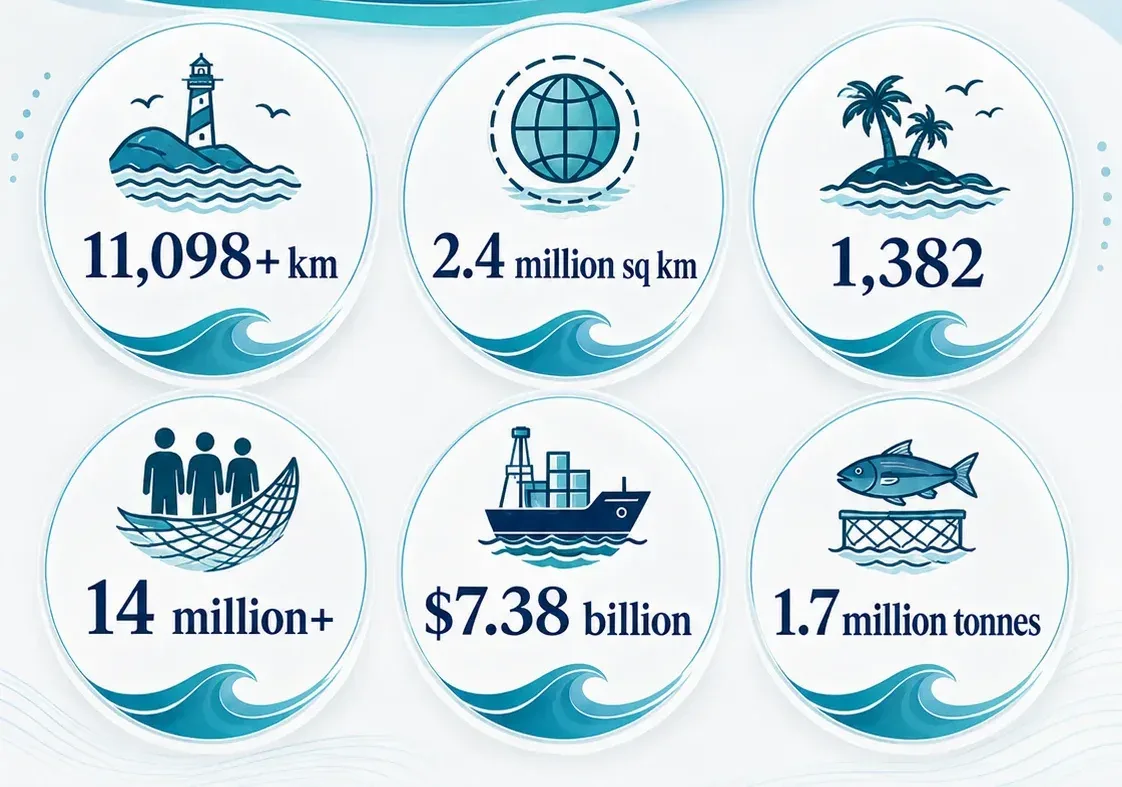
- more than 11,098 km of coastline
- 1,382 islands
- an Exclusive Economic Zone of about 2.4 million sq km.
The same government-backed publication says marine living resources support more than 14 million livelihoods directly and indirectly.
India's seafood exports in FY2024-25 stood at about 1.7 million tonnes valued at $7.38 billion, according to data cited in the Ministry of Earth Sciences report.
What Can Blue Bonds Finance?
There is no single project list that automatically applies to every issuer. Eligibility depends on the bond framework and applicable rules.
Global guidance identifies areas that can include:
Water and wastewater
Drinking-water infrastructure, wastewater collection and treatment, water recycling and pollution reduction can fall within blue-finance frameworks where they meet the required environmental conditions.
Fisheries and aquaculture
Financing can support sustainable fisheries, lower-impact aquaculture, traceability, pollution controls and related infrastructure.
Marine pollution
Projects designed to reduce plastic leakage, untreated wastewater or other pollution entering rivers, coasts and oceans may qualify.
Coastal ecosystems
Mangroves, coral reefs, wetlands and coastal restoration projects can form part of sustainable blue-economy financing.
Maritime transport
Projects linked with reducing emissions or pollution from maritime transport may qualify under appropriate frameworks.
Offshore renewable energy
Offshore renewable-power projects can also form part of the blue-finance universe.
The critical test is not whether a project is merely located near water.
The issuer must establish why it produces the environmental outcome claimed in the bond framework.
Why Blue Bonds Matter for India's Blue Economy?
A major step in standardising the market came in September 2023.
IFC, ICMA, UNEP Finance Initiative, UN Global Compact and the Asian Development Bank released a practitioners' guide for bonds financing the sustainable blue economy.
The guidance was designed to help issuers and investors address four main areas:
- defining eligible blue-economy activities
- selecting appropriate performance indicators
- providing examples from existing transactions
- improving environmental reporting and market credibility.
This matters because one challenge with thematic finance is classification.
If the definition is too loose, almost any water-related spending could be branded “blue”.
Credible frameworks therefore require issuers to explain the project, environmental objective, use of funds and reporting method.
Are Blue Bonds Safe for Investors?
Not automatically.
A blue bond is a classification based largely on the use of proceeds. It is not a separate promise of higher returns.
The coupon on any issue will depend on factors including:
- issuer credit quality
- maturity
- prevailing interest rates
- security structure
- liquidity
- demand from investors
- issue size
- market conditions.
For comparison, Vadodara's March 2024 green municipal bond carried a 7.90% coupon with a five-year maturity.
That does not tell investors what its proposed blue bond will pay.
India's blue-bond opportunity in numbers
India's Blue Bond Timeline
| Date | Development |
|---|---|
| 2017 | India's listed green-debt market begins appearing in SEBI's current ESG debt issuance database, including L&T Infrastructure Finance's June 2017 green issue. |
| June 2017 | Pune Municipal Corporation raises ₹200 crore, marking the start of the recent municipal-bond issuance cycle recorded in SEBI's database. |
| August 2022 | SEBI publishes a consultation paper specifically addressing green and blue bonds as modes of sustainable finance. |
| FY2022-23 | Union government plans ₹16,000 crore of sovereign green-bond borrowing. |
| February 2023 | SEBI revises disclosure requirements for issuance and listing of green debt securities. |
| September 2023 | IFC, ICMA, UNEP FI, UN Global Compact and ADB publish global guidance for bonds financing the sustainable blue economy. |
| March 2024 | Vadodara Municipal Corporation issues a ₹100 crore green bond at 7.90%. |
| June 2025 | SEBI issues its framework for ESG debt securities other than green debt securities, further expanding India's labelled-debt framework. |
| May 29, 2026 | Reuters reports Sagarmala Finance is preparing a blue bond of up to ₹1,000 crore. |
| July 31, 2026 | SEBI's ESG issuance table still shows no completed blue-bond issuance. |
| August 18, 2026 | Reuters reports both Sagarmala Finance and Vadodara Municipal Corporation are aiming for blue-bond transactions by end-September. |
| Late September 2026 | Tentative window for India's first transaction, subject to approvals, documentation and market conditions. |
News4Bharat POV
India's entry into blue bonds should not be judged only by which issuer reaches the market first. The more useful tests will come later.
- Did investors subscribe?
- Was the pricing competitive?
- Were the proceeds used on schedule?
- Did the issuer publish measurable environmental results?
- Did an independent reviewer confirm compliance with the stated framework?
- And most importantly, did other issuers follow?
India already has evidence that themed debt can move beyond a single transaction. SEBI's ESG database contains green bonds from companies, financial institutions and municipal corporations.
Blue finance will need to make the same transition.
If India's first blue bond remains a one-off event, its impact will largely be symbolic.
If cities, maritime lenders, banks and infrastructure companies begin building repeatable blue-finance programmes, the market could develop into a separate funding channel for water and ocean infrastructure.
That is the milestone worth tracking.
Sources:
SEBI ESG Debt Securities database, SEBI Municipal Bonds database, SEBI Consultation Paper on Green and Blue Bonds, August 2022, SEBI revised green-debt disclosure requirements, February 2023, SEBI Framework for ESG Debt Securities other than Green Debt Securities, June 2025, IFC, ICMA, ADB, UNEP FI and UN Global Compact blue-bond guidance, Ministry of Earth Sciences: Unlocking the Potential of India's Marine Living Resources
Methodology
This explainer was prepared using information available through August 19, 2026. The current issuance status was checked against SEBI's ESG and municipal-bond databases and compared with Reuters reporting on the proposed Sagarmala Finance and Vadodara transactions. Definitions and project categories were checked against IFC-led global blue-bond guidance. India-specific maritime data was taken from a Ministry of Earth Sciences publication.