

The narrative surrounding the Uttar Pradesh startup economy has fundamentally shifted. Once viewed strictly as a secondary market for consumer software, the state is actively re-engineering its institutional framework to support deep technology, defense manufacturing, and agriculture-linked supply chains. As of March 31, 2026, official data from the Department for Promotion of Industry and Internal Trade (DPIIT) confirms that Uttar Pradesh houses over 21,960 recognised startups. These entities have collectively generated more than 2,11,580 direct jobs across the state.
Nationally, India crossed the 2.23 lakh recognised startup milestone during the same period. This calculation confirms that Uttar Pradesh now accounts for an impressive 9.85 percent of the country's total recognized startup base. The trajectory is equally notable: government data showed approximately 6,654 DPIIT-recognised startups in UP as of June 2022, representing a staggering 230 percent growth curve leading into early 2026.
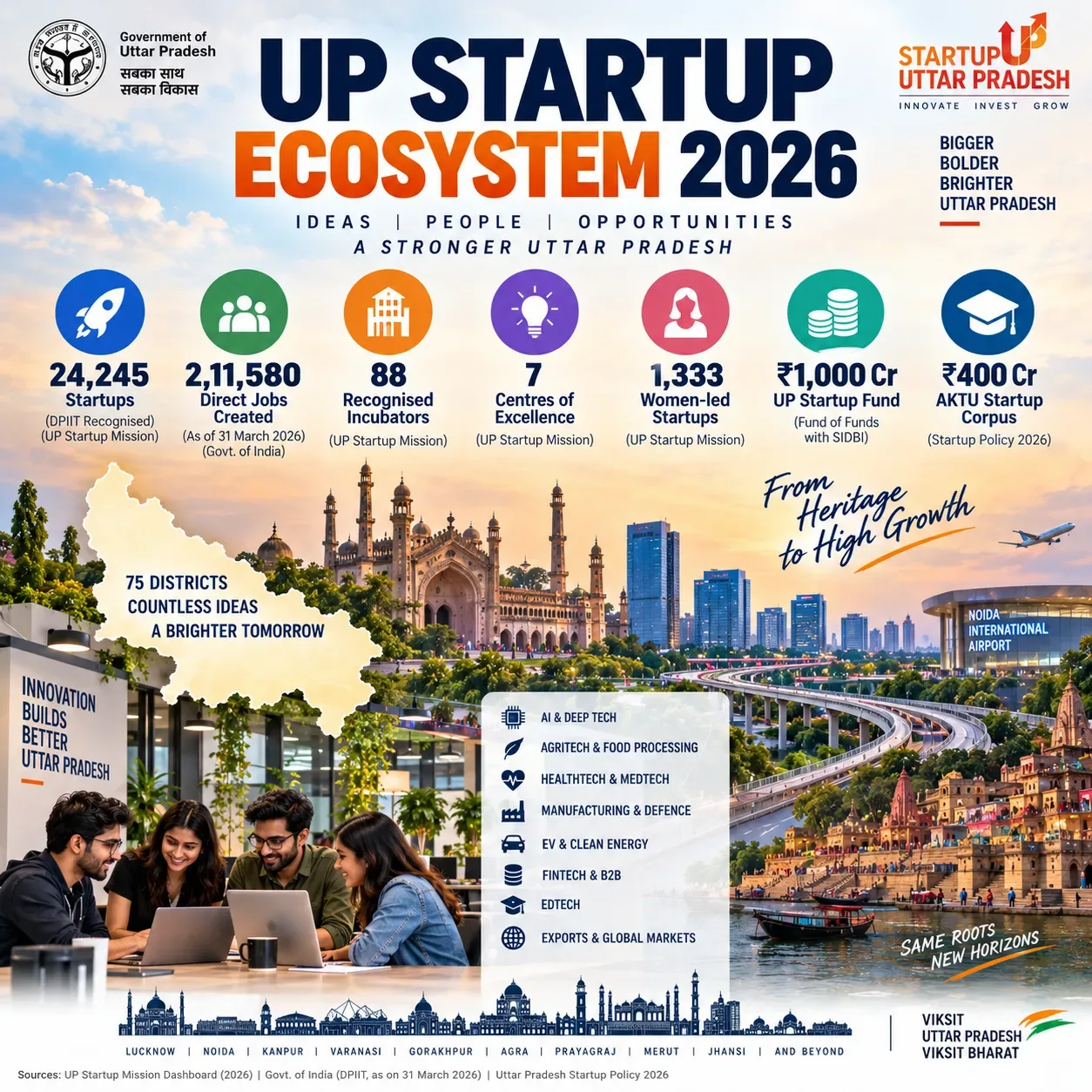
Furthermore, real-time data from the UP Startup Mission dashboard currently tracks 24,245 DPIIT-recognised startups, supported by an expanding infrastructure of 88 recognised incubators, seven dedicated Centres of Excellence (CoEs), and over 15 SIDBI-registered Alternative Investment Funds connected to the ecosystem.

However, ecosystem quality cannot be judged purely by incorporation velocity. The state has matured past the era where mere registration numbers define success. The central question for the UP startup ecosystem post-2026 is commercial conversion: turning registered entities into robust companies that secure institutional capital, file patents, establish manufacturing lines, and execute public procurement contracts.
The UP Startup Policy 2026: Structural Policy Shifts
The state notified its comprehensive UP Startup Policy 2026 in July 2026, overhauling earlier frameworks to aggressively target research-heavy and hardware-centric ventures. The policy bridges critical funding gaps across four distinct stages of startup maturity: ideation, prototype development, commercialization, and deep-tech scaling.
Traditional startup grant programs often succeed with Software-as-a-Service (SaaS) products because prototypes can be iterated cheaply. That model fails for medical devices, industrial robots, semiconductor components, or aerospace platforms. These hardware-heavy ventures require wet labs, extensive certification, and years of runway before generating initial revenue.
Recognizing this, the 2026 policy introduces a highly specific, heavily capitalized deep-tech track.
| Support Category | Standard Provision | Deep-Tech Provision |
|---|---|---|
| Prototype Grant | Up to ₹10 lakh | Up to ₹20 lakh |
| Seed Capital | Up to ₹15 lakh | Up to ₹30 lakh |
| Patient Capital | Not Applicable | Up to ₹40 crore |
| Cloud & Compute Support | General Sustenance | 50% reimbursement (up to ₹2 lakh/year) |
| R&D Expenditure | Standard Incubation | Up to 40% of verified eligible R&D costs |
The policy correctly identifies that deep-tech companies operate on fundamentally different timelines. The provision for patient capital of up to ₹40 crore per eligible startup is a landmark state-level intervention. Furthermore, the policy mandates a royalty mechanism for deep-tech companies scaling via state R&D provisions, instituting a 3 percent revenue-linked royalty once the startup crosses the ₹1 crore revenue threshold.
Inclusivity is also financially engineered into the framework. Eligible startups led by women (requiring at least 51 percent founder equity), persons with disabilities, or founders from the Purvanchal and Bundelkhand regions receive an additional 50 percent enhancement on standard prototype and seed support. The live dashboard already reflects the impact of this, showcasing over 1,333 active women-led startups supported by the platform.
Financial Mechanics: Unpacking the ₹1,000 Crore Fund of Funds
A persistent point of confusion among early-stage founders is the structural nature of the UP Startup Fund. The state government does not directly disburse massive equity cheques to founders from this ₹1,000 crore corpus. Instead, the capital is structured as a "Fund of Funds" managed professionally by the Small Industries Development Bank of India (SIDBI).
Under this architecture, SIDBI allocates capital to registered Alternative Investment Funds (AIFs). These AIFs then deploy the capital, evaluating startups based on commercial viability, unit economics, market sizing, and exit possibilities. According to SIDBI’s FY2024-25 annual reporting, an additional ₹100 crore was released by the Uttar Pradesh government, bringing the cumulative released amount to ₹325 crore. SIDBI also reported commitments of ₹250 crore during FY2025 under the scheme.
To further widen the capital base, the 2026 policy introduces a dedicated ₹400 crore corpus linked with Dr. A.P.J. Abdul Kalam Technical University (AKTU). This capital is specifically earmarked for university-level seed support, matching grants against private capital, and funding regional Centres of Excellence across the state's engineering networks.
Sector-Specific Momentum: Aerospace, Agritech, and B2B Commerce
Uttar Pradesh's scale dictates that its startup strategy must closely align with its broader industrial ambitions, including a massive $50 billion state export target for FY2030.
Aerospace, Defence, and Deep-Tech: The Uttar Pradesh Defence Industrial Corridor—spanning Aligarh, Agra, Kanpur, Lucknow, Chitrakoot, and Jhansi—has created a captive market for defense innovation. Startups are no longer limited to building whole weapon platforms; there is surging demand for sensors, simulation software, embedded electronics, and drone swarming logic. The clearest validation of this ecosystem was Raphe mPhibr, a Noida-based unmanned aerial systems manufacturer, which successfully raised $100 million in a Series B round led by General Catalyst in June 2025.
Artificial Intelligence and Data Infrastructure: Artificial intelligence requires massive compute resources, a major cost center for early-stage companies. Noida and Greater Noida are rapidly evolving into India's premier data center hubs, supported by the UP Data Centre Policy 2026. By reimbursing compute costs and housing advanced cloud infrastructure locally, UP is positioning itself to host AI model-training companies that would previously default to Bengaluru.
Agritech and MSME Supply Chains: Invest UP reports approximately 89.64 lakh micro-enterprises operating within the state. This creates an unparalleled Business-to-Business (B2B) market. Startups focusing on supply chain digitization, export compliance, cross-border e-commerce, and inventory management are critical to integrating the state's One District One Product (ODOP) artisans into the global economy.
EdTech Maturity: Uttar Pradesh has already proven it can scale unicorns to the public markets. PhysicsWallah, which built its massive operations from Noida, completed a highly successful IPO in November 2025, raising approximately ₹3,480 crore. The edtech sector is now pivoting from pandemic-era consumer apps toward enterprise education infrastructure, AI tutoring, and workforce training software.
Regional Decentralization: Breaking the NCR Dependency
If Uttar Pradesh has a vulnerability, it is the historic geographic concentration of its startup economy. Noida and Greater Noida naturally attract capital due to their proximity to Delhi NCR. However, a state with 75 districts cannot build an inclusive startup economy by concentrating programs in a single quadrant. The state operates on multi-nodal regional strategies.
Research-Led Uttar Pradesh (Kanpur & Lucknow): Kanpur is driven by legacy technical institutions. IIT Kanpur’s Startup Incubation and Innovation Centre (SIIC) recently crossed a massive milestone, successfully incubating over 500 startups and generating more than 10,829 jobs from its top portfolio companies alone. Lucknow capitalizes on institutions like the Sanjay Gandhi Postgraduate Institute of Medical Sciences (SGPGI). The MedTech Centre of Excellence in Lucknow has onboarded 53 startups, allowing health-tech founders to bypass theoretical development and test their hardware directly within clinical workflows.
Industrial Corridors (Agra, Aligarh, Meerut, Ghaziabad): These cities are anchored heavily in traditional manufacturing. Meerut’s sports goods, Agra’s footwear, and Aligarh’s hardware sectors require specialized B2B commerce and industrial automation startups. Rather than pushing founders toward consumer tech, incubators in these zones focus on logistics, robotics, and export technology.
Emerging Markets (Varanasi, Prayagraj, Gorakhpur): Eastern UP (Purvanchal) is emerging as a testbed for agricultural technology, rural fintech, and circular economy startups. Varanasi, supported by IIT BHU, is fostering biotechnology and grassroots innovation tailored to the unique economic realities of semi-urban India.
Public Procurement: Government as a Customer
A grant creates a prototype; a purchase order builds a business. Navigating public procurement is notoriously difficult for young companies due to stringent criteria regarding prior turnover and earnest money deposits (EMD).
The Uttar Pradesh government has recognized this friction and actively relaxed procurement norms for eligible, state-registered technology startups. Verified companies can now access critical waivers on prior experience and EMD requirements, allowing them to bid directly on state contracts. This policy shift is particularly vital for startups working in civic technology, waste management, municipal AI administration, and drone surveying.
The News4Bharat Perspective: Bridging the Capital "Valley of Death"
In the fifth edition of the States’ Startup Ecosystem Ranking (SRF 5.0) released by Startup India, Uttar Pradesh secured its position as a Top Performer in Category A1 (states with a population exceeding 5 crore). While the headline categorization is impressive, the underlying percentiles tell a highly nuanced story.
The state achieved a flawless 100th percentile in innovation and sustainability and an 89th percentile in ecosystem capacity building. These metrics prove the state's early-stage incubator network and university integration are functioning at a premier level. However, Uttar Pradesh scored at the 46th percentile in funding opportunities. This discrepancy exposes the central vulnerability of the UP startup ecosystem: the funding "valley of death."
Uttar Pradesh excels at the top of the funnel. Ideation workshops and initial ₹10 lakh prototype grants are easily accessible. However, founders face severe friction when seeking Series A and Series B institutional capital. A hardware startup that successfully validates a prototype ultimately needs ₹50 crore to establish manufacturing capacity. Because the private venture capital network remains heavily concentrated in traditional metros, UP startups often struggle to secure follow-on growth equity.
The SIDBI Fund of Funds and the newly codified ₹40 crore deep-tech patient capital provisions in the 2026 policy are direct legislative responses to this 46th-percentile funding gap. The ecosystem's ultimate success will depend entirely on how rapidly and efficiently SIDBI-backed AIFs and state evaluation committees deploy this capital into mid-stage companies without bureaucratic delay.
Editorial Closing: Measuring Success Towards 2030
The UP startup ecosystem has matured definitively beyond its foundational phase. With robust data center investments, the commercial operationalization of the Noida International Airport in June 2026, and a rapidly digitizing MSME base, the state's physical and digital infrastructure is largely integrated.
Looking toward 2030, the ecosystem will be judged strictly by commercial metrics rather than gross registration counts. Success will be determined by the survival rate of companies post-incubation, the volume of university patents successfully commercialized, and the total value of public procurement contracts executed by startups. Founders and investors must closely monitor the deployment velocity of the AKTU corpus and upcoming SIDBI fund disbursements to gauge the actual institutional liquidity entering the market. If Uttar Pradesh can seamlessly transition founders from seed grants to major venture capital rounds, it will fundamentally redefine the geography of Indian innovation.
Frequently Asked Questions (FAQ)
How many recognized startups are currently operating in Uttar Pradesh?
As of March 31, 2026, the Government of India reported over 21,960 DPIIT-recognised startups in UP, capturing roughly 9.85% of the national ecosystem. The state's live UP Startup Mission dashboard currently tracks over 24,245 entities.
What is the maximum prototype funding available under the UP Startup Policy 2026?
Standard eligible startups can receive prototype support of up to ₹10 lakh. Qualifying deep-tech startups can access an enhanced prototype grant of up to ₹20 lakh, alongside seed capital of up to ₹30 lakh.
How does the ₹1,000 crore UP Startup Fund operate?
The fund operates as a professional Fund of Funds managed by SIDBI. It does not issue direct government grants to founders; instead, it invests in SIDBI-registered Alternative Investment Funds (AIFs), which subsequently evaluate and invest in startups based on commercial viability.
How did Uttar Pradesh perform in the latest States' Startup Ecosystem Ranking?
In the fifth edition (SRF 5.0), Uttar Pradesh was rated as a Top Performer in Category A1 (population over 5 crore). It scored in the 100th percentile for innovation and sustainability, though it scored lower (46th percentile) in mid-stage funding opportunities.
Do startups receive special benefits for public procurement in UP?
Yes. Eligible, state-registered technology startups receive critical relaxations regarding prior turnover, previous commercial experience, and Earnest Money Deposit (EMD) requirements during government procurement processes.
Does Uttar Pradesh offer specific incentives for women founders?
Yes. Qualifying women-led startups—defined by the state portal as having at least 51 percent founder equity—are eligible for an additional 50 percent enhancement on prototype and seed funding support compared to standard baseline grants.