

Quick Take
- The Income Tax Bill 2026 is no longer a pending Bill—it is now the Income-tax Act, 2025.
- The new law became effective from April 1, 2026.
- Tax Year replaces the terms Previous Year and Assessment Year for future income-tax compliance.
- The Financial Year (FY) has not been abolished and continues for accounting, budgeting, GST, payroll, and corporate reporting purposes.
- Taxpayers will not file two income tax returns because of the new Act.
- AY 2026-27 returns for FY 2025-26 will continue under the Income-tax Act, 1961.
- Income earned from April 1, 2026 onwards is governed by the Income-tax Act, 2025 and falls under Tax Year 2026-27.
- Existing tax rates, deductions and exemptions continue to be governed by the applicable Finance Act, not merely because the Income-tax Act has been replaced.
The Income Tax Bill 2026 has become one of India's most searched tax-related topics, but there is an important fact every taxpayer should know—the legislation is no longer a Bill. It has already become the Income-tax Act, 2025, received Presidential assent in August 2025, and came into force on April 1, 2026.
The biggest reform is the introduction of a single Tax Year, replacing the long-used Previous Year and Assessment Year terminology under the Income-tax Act, 1961. While this simplifies tax compliance, it has also created confusion during the transition, as taxpayers are filing returns under the old law while earning income under the new one.
The real challenge in 2026 is the transition: taxpayers are earning income under the new Act while filing returns for the last year governed by the old Act.
First, the Correct Government Timeline
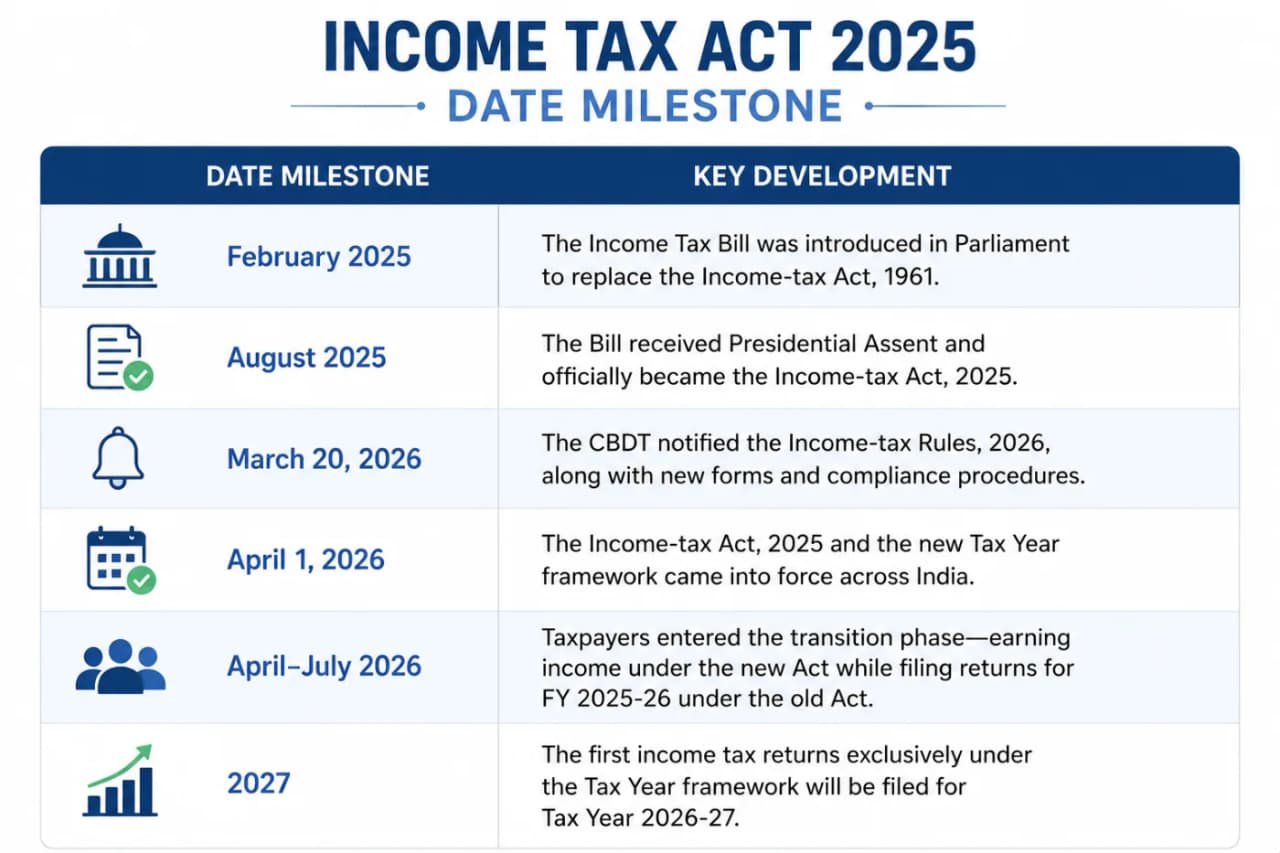
The original Income-tax Bill was introduced in Parliament in February 2025 as part of the government’s effort to replace the six-decade-old Income-tax Act, 1961. Following examination and revisions, the new legislation received presidential assent in August 2025.
The Income-tax Act, 2025 and Income-tax Rules, 2026 became effective on April 1, 2026. CBDT notified the new Rules on March 20, 2026, and new challans and several statutory forms have since been made available on the e-filing portal.
Therefore, reports suggesting that the law is still expected during the 2026 Monsoon Session are outdated. The new framework is already operational. The Income Tax Department has also been conducting outreach programmes for taxpayers, employers, non-profit organisations and professionals since its implementation.
Also Read | New Financial Year, New Rules: How TDS & Compliance Changes Will Impact Salaries and Cash Flows | Exclusive Article
Timeline: Evolution of the New Income-tax Law
What Is the New Tax Year Concept in India?
Under the old system, two different expressions were used for one income cycle:
- Previous Year: The year in which income was earned.
- Assessment Year: The following year in which that income was reported and assessed.
For example, salary earned between April 1, 2024 and March 31, 2025 belonged to Financial Year or Previous Year 2024-25. Its return was filed for Assessment Year 2025-26.
For ordinary taxpayers, this distinction was often more confusing than useful. People regularly selected the wrong assessment year while paying self-assessment tax or filing a return.
The Income-tax Act, 2025 removes this two-label structure and uses one expression: Tax Year.
A Tax Year will normally be the 12-month period beginning on April 1 and ending on March 31. Thus, income earned from April 1, 2026 to March 31, 2027 belongs to Tax Year 2026-27. The return for this income will generally be filed in 2027, but the income will continue to be identified as belonging to Tax Year 2026-27.
For a newly established business or profession, the first Tax Year may be shorter than 12 months. It begins from the date the business is set up or the new source of income comes into existence and ends on March 31.
Has the Financial Year Been Abolished?
No. This is one of the most important distinctions missing from many explanations of the new law.
The “Tax Year” replaces “Previous Year” and “Assessment Year” for income-tax purposes. It does not erase the financial year from accounting, corporate reporting, government budgeting, GST administration or other laws.
Companies may still prepare financial statements for a financial year. Employers may continue to refer to FY 2026-27 in payroll records, while income-tax challans and compliance documents use Tax Year 2026-27.
In practice, both expressions may remain visible for some time. Taxpayers should focus on the period to which a payment or return relates instead of relying only on the label displayed by software.
The Two-Law Problem Every Taxpayer Must Understand
The transition produces an unusual situation in 2026.
During July 2026, a salaried taxpayer may be:
- Filing a return for income earned in FY 2025-26 under the Income-tax Act, 1961; and
- Earning salary and paying tax for Tax Year 2026-27 under the Income-tax Act, 2025.
The return for income earned up to March 31, 2026 remains an AY 2026-27 return under the old Act. It must be filed using the forms prescribed under the 1961 law. Self-assessment tax for that return must also be paid by selecting the Income-tax Act, 1961 and AY 2026-27.
Income earned from April 1, 2026 falls under Tax Year 2026-27 and the new Act. Its return will become due in 2027.
The Income Tax Department has confirmed that its portal will support both laws simultaneously during the transition. Notices, reassessments, appeals and rectification proceedings concerning earlier years will continue under the 1961 Act.
Practical Case Study 1: A Salaried Employee
Consider Neha, who works for a private company in Noida.
She earned ₹11 lakh between April 1, 2025 and March 31, 2026. That income belongs to FY 2025-26 and must be reported in her return for AY 2026-27 under the old Act.
Her salary received from April 1, 2026 onwards belongs to Tax Year 2026-27 and is governed by the new Act.
Neha does not file two returns now. She files only her AY 2026-27 return for the completed year. At the same time, her employer deducts TDS from her current salary under the new law.
This distinction is particularly important if she pays self-assessment tax for the earlier year. Selecting “Tax Year 2026-27” instead of “AY 2026-27” could attach the payment to the wrong legal period.
Practical Case Study 2: A Freelancer Starting Mid-Year
Suppose Arjun begins providing consulting services on September 10, 2026.
His first Tax Year will run from September 10, 2026 to March 31, 2027, rather than for a complete 12-month period. He must maintain invoices, expenses, TDS certificates and advance-tax records for this shorter period.
The concept is not a new tax burden. It simply gives the year in which his new source of income started a single, clearer label.
Did Tax Slabs and Deductions Change Because of the New Act?
The Tax Year concept itself does not create a new slab system. Tax rates and yearly concessions continue to be determined through the relevant Finance Act.
This distinction matters because taxpayers often mix three separate developments:
- Replacement of the Income-tax Act, 1961;
- Annual Union Budget changes in tax rates or deductions; and
- Renumbering and restructuring of legal provisions.
A provision may have a new section number without its core tax treatment changing. Tax professionals, employers and accounting teams should therefore maintain a reliable mapping between the sections of the old and new Acts.
The Income Tax Department has published a form-mapping guide, and statutory forms under the new framework are being rolled out on the portal in stages.
Income Tax Act 2026 Changes for VDA and Crypto Tax
The new Act expressly carries the Virtual Digital Asset framework into the reorganised law. VDAs include cryptocurrencies and certain other digital or tokenised assets covered by the statutory definition.
The change to the Tax Year does not, by itself, provide a fresh crypto exemption. The established framework broadly continues: income from transferring a VDA attracts a special 30% tax rate, plus applicable surcharge and cess. Except for the permitted cost of acquisition, other expenditure is generally not deductible. A loss from one VDA transfer cannot ordinarily be set off against other income or carried forward.
The 1% TDS mechanism on qualifying VDA transfers also continues through the corresponding provisions of the new Act. Investors should reconcile exchange statements, wallet transactions, bank entries and TDS records instead of depending only on a platform-generated profit figure.
A frequently overlooked issue is transaction-level documentation. Swapping one crypto asset for another, using tokens to make a purchase or transferring assets between identifiable beneficial owners may create reporting questions even when no rupees are withdrawn into a bank account.
News4Bharat POV
The most immediate 2026 compliance risk may not come from a complicated interpretation. It may come from selecting the wrong option on a portal, payroll system or challan.
For several months, taxpayers and accountants will encounter AY 2026-27 and Tax Year 2026-27 on the same platform. The numbers look identical even though they relate to different income periods and different Acts.
A useful internal control is to add three fields to every tax working paper:
- Period in which the income was earned;
- Applicable Act—1961 or 2025; and
- Portal label—Assessment Year or Tax Year.
This simple three-point check can prevent payment-mapping errors that may otherwise lead to a tax demand, a correction request or delayed credit. This is an editorially derived compliance recommendation, not a new statutory requirement.
What Taxpayers Should Do Now
Taxpayers do not need to panic, but they should keep the transition clean.
Retain separate folders for FY 2025-26/AY 2026-27 and Tax Year 2026-27. Confirm the applicable Act before generating any challan. Reconcile Form 26AS, AIS and TDS entries independently for each period. Businesses should update accounting and payroll software so the new terminology does not overwrite historical records.
Most importantly, do not relabel old-year documents as “Tax Year” merely for consistency. An earlier assessment, notice or return remains governed by the terminology and provisions of the 1961 Act.
Editorial Note: This article is based on the Income-tax Act, 2025, notified rules, official CBDT notifications and publicly available government guidance. It is intended for informational purposes and should not be treated as legal or professional tax advice.