

Key Highlights
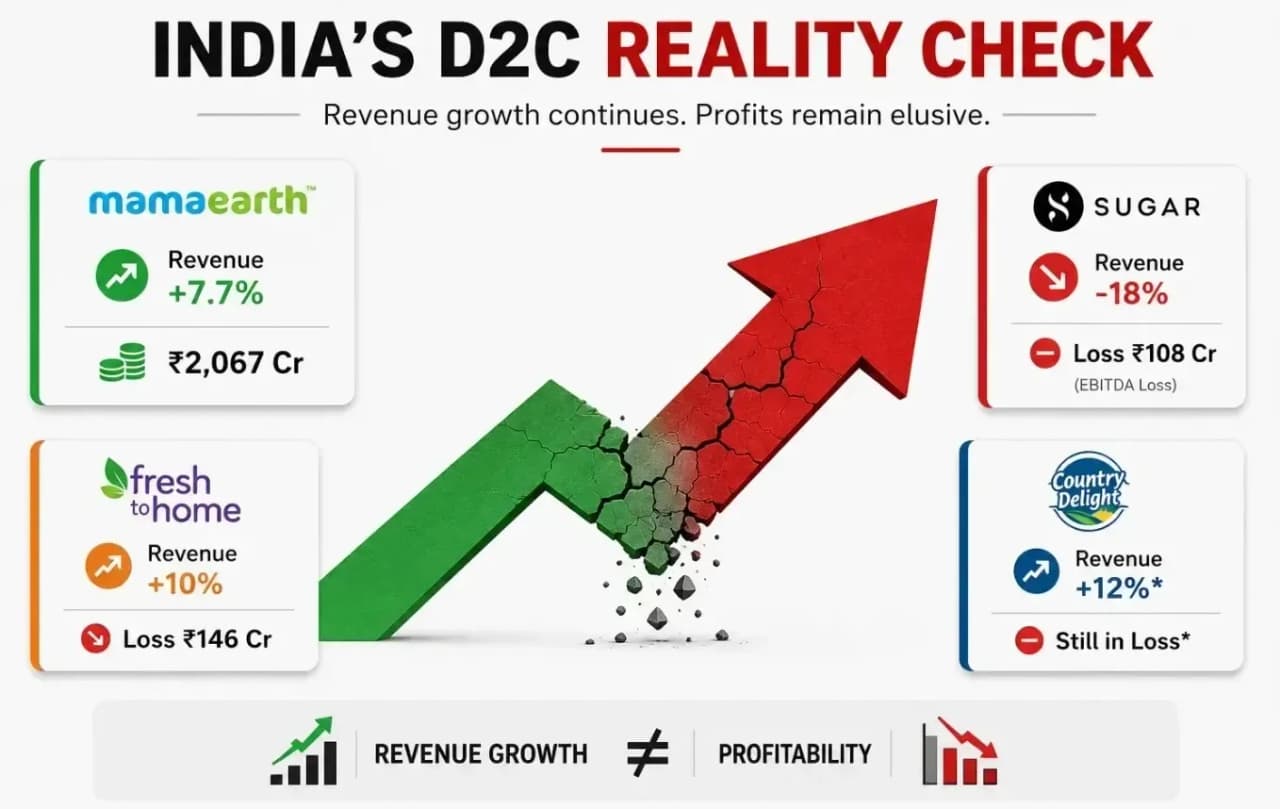
- Sugar Cosmetics lost Rs 134.3 crore in FY25, its highest ever, as revenue fell 17.8 percent to Rs 415 crore.
- Mamaearth parent Honasa Consumer posted its first ever loss of Rs 18.5 crore in Q2 FY25, before staging a recovery.
- India's D2C funding dropped to just $757 million in 2024, down 54 percent from the 2022 peak of $1.6 billion.
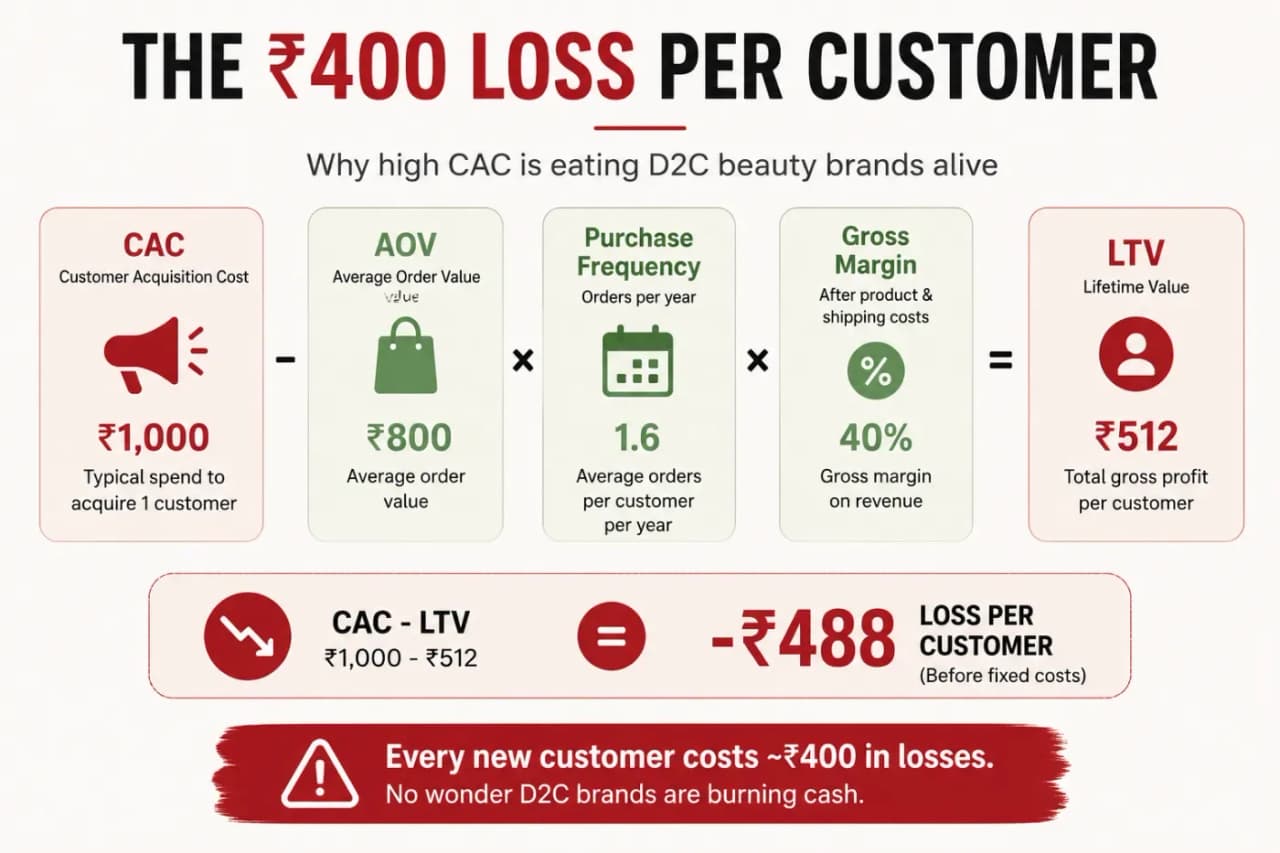
- The average customer acquisition cost for beauty D2C brands now runs Rs 800 to Rs 1,200, often more than the profit per sale.
- Pet care and jewellery D2C brands like Supertails and GIVA are raising fresh funding even as older names struggle.
Indian D2C brands once looked unstoppable. Instagram ads, quick delivery and a young founder story were enough to raise crores in funding. That era is over now. A new phase has begun, and it rewards brands that make money, not just brands that grow fast.
Several Indian D2C brands are now going through a quiet reckoning. Some of this shows up in headlines. Much of it does not. This article looks at both, with real numbers from company filings and verified news reports.
The Funding Boom That Turned Into a Warning
Indian D2C startups raised $1.6 billion in 2022 alone. Investors were funding almost anyone with a Shopify store and a social media following. Valuations touched 10 to 15 times revenue, a level most traditional businesses never see.
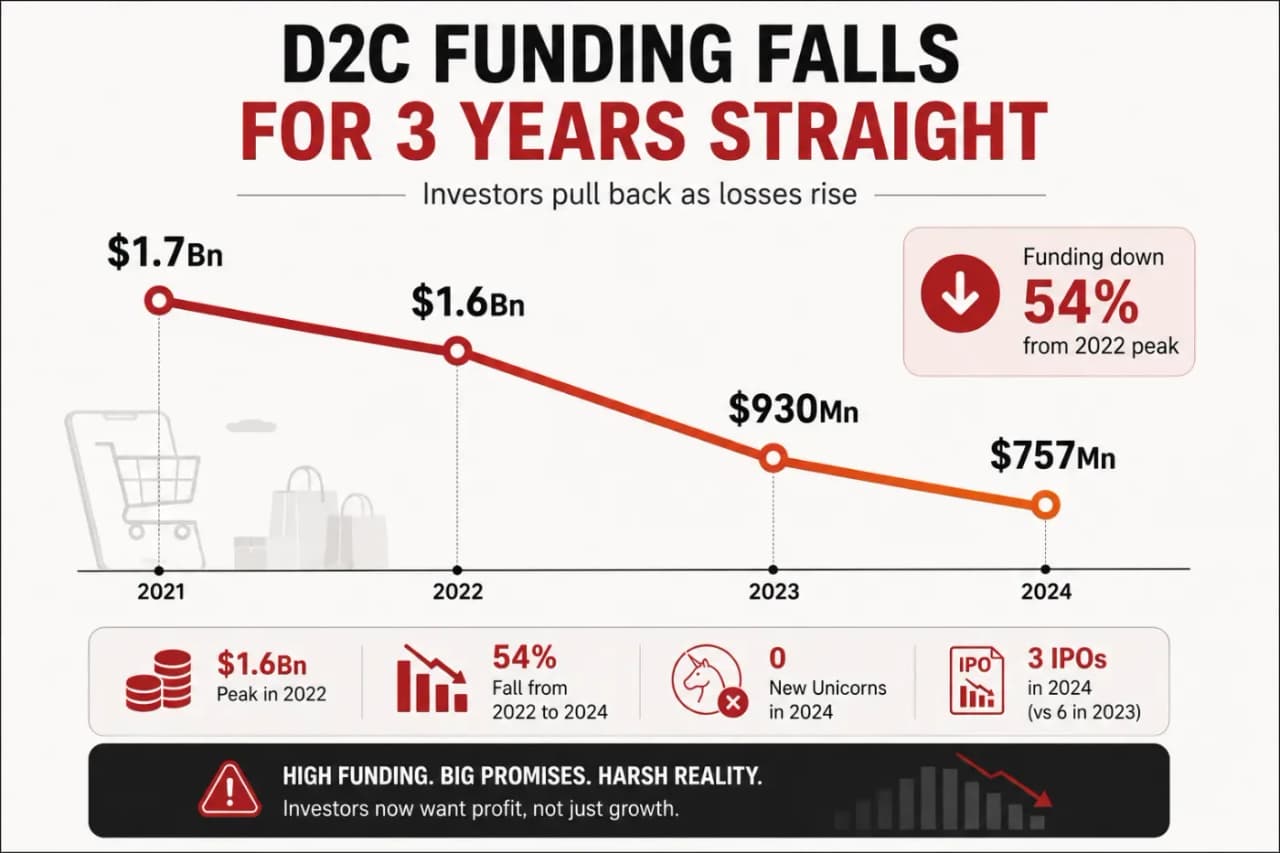
That funding has been falling every year since. It dropped to $929.7 million in 2023, then to just $756.6 million in 2024, according to Tracxn's Geo Annual Funding Report. That is a 54 percent fall from the 2022 peak. 2024 also recorded zero new unicorns and only three IPOs, down from six the year before.
This funding drop is not random. Investors pulled back because too many D2C brands were burning cash without a clear path to profit.
Sugar Cosmetics FY25 Loss Crosses Rs 134 Crore
Sugar Cosmetics built its name through Shark Tank India and a strong online following. But its last two years tell a different story.
Revenue fell to Rs 415 crore in FY25, down 17.8 percent from Rs 505 crore the year before. This was the company's first ever revenue decline since it started. Losses jumped to Rs 134.3 crore, nearly double the Rs 67.6 crore loss in FY24, based on filings reported by The Arc and Storyboard18.
The slide has continued into FY26, with revenue falling further to around Rs 380 crore, as reported by Mint in May 2026. The company's total losses over five years now stand near Rs 375 crore.
Sugar has been dealing with a cash crunch for the past six months. Founders Vineeta Singh and Kaushik Mukherjee have reportedly paid employee salaries from their own accounts during this period. The company is now seeking Rs 100 to 150 crore in rescue funding, at a valuation of Rs 1,400 to 1,500 crore, roughly half its 2022 peak valuation of Rs 3,000 crore.
Mamaearth Fell Into Loss, Then Fought Back
Mamaearth's parent company Honasa Consumer had a rough middle stretch of FY25. In Q2 FY25, the company posted its first loss since going public, at Rs 18.5 crore, compared to a profit of Rs 29.4 crore in the same quarter the year before. Revenue also fell 6.9 percent to Rs 461.8 crore.
The stock reacted badly. Shares fell 20 percent in a single day and dropped below the company's IPO price. Brokerages like JPMorgan and Kotak Securities turned cautious on the stock.
For the full year, FY25 revenue still grew 8 percent to Rs 2,066.9 crore, but profit fell 32 percent to Rs 72.6 crore. The company also saw leadership exits, including its chief business officer and chief product officer, during this period.
Unlike Sugar Cosmetics, Honasa has shown signs of recovery. In Q1 FY26, the company sharpened its focus on six core brands that make up 80 percent of its revenue, leaning more on quick commerce and direct distribution. This shows that a bad year does not always mean a broken brand, if the correction comes fast enough.
The Real Problem Behind the Losses
Behind both these stories sits one number that mainstream coverage rarely explains clearly. It is the cost of getting a new customer, compared to what that customer actually spends.
For beauty and personal care D2C brands in India, the average cost to acquire one customer is Rs 800 to Rs 1,200 in 2026. If that customer buys a single product worth Rs 1,200 at a 50 percent margin, the brand earns Rs 600 in gross profit. That is a loss of Rs 400 before any shipping or operational cost is added.
Nearly 55 percent of Indian D2C brands underinvest in retention and customer relationship systems, according to industry data from Decode Growth. Digital ad costs have also risen 40 to 60 percent over the last three years, making this gap even harder to close.
This is the real disease behind most D2C reckoning stories. Sugar Cosmetics and Mamaearth are simply the most visible cases of a much wider pattern across the sector.
Some D2C Brands Are Winning the Same Game
Not every Indian D2C brand is struggling. Some categories are still attracting strong funding, and the difference comes down to repeat purchases.
Jewellery brand GIVA raised Rs 530 crore in one of the largest D2C funding rounds of 2025. BlueStone went public in August 2025 with Rs 1,770 crore in revenue. Pet care brand Supertails raised $30 million in February 2026, and the pet care category alone has pulled in $124 million across 64 funding rounds since 2022, based on The D2C Pulse data.
Subscription driven food brands are also investor favourites. The Whole Truth raised $51 million, Farmley raised $40 million and Country Delight raised $25 million. These brands share one trait. Their customers keep coming back, which lowers the real cost of every sale over time.
What Mainstream Media Missed
Most coverage of India's D2C slowdown treats it as one company's problem. It rarely connects the funding data, the CAC numbers and the case studies into one picture.
Few reports have pointed out that Sugar Cosmetics and Mamaearth followed a similar early pattern before their losses became public. Both saw slowing revenue growth a few quarters before losses appeared. Both saw senior leadership exits around the same time. Both used the phrase course correction in official statements. This pattern is worth watching in other D2C brands that have not yet made headlines.
Another point most coverage skips is that India's D2C funding drop is not unique to India. Global D2C funding outside India crashed 97 percent from its 2021 peak. India's fall, while sharp, has actually been milder than the rest of the world.
Finally, few articles mention that this slowdown may be healthy for the sector in the long run. Industry voices like Devangshu Dutta of Third Eyesight describe this phase as a structural correction, not a collapse, where brands are finally being judged on repeat rates and real profit instead of just visibility.
How to Spot the Next Brand in Trouble
Based on the patterns from Sugar Cosmetics and Mamaearth, a few early signs tend to appear before a D2C brand's troubles become public.
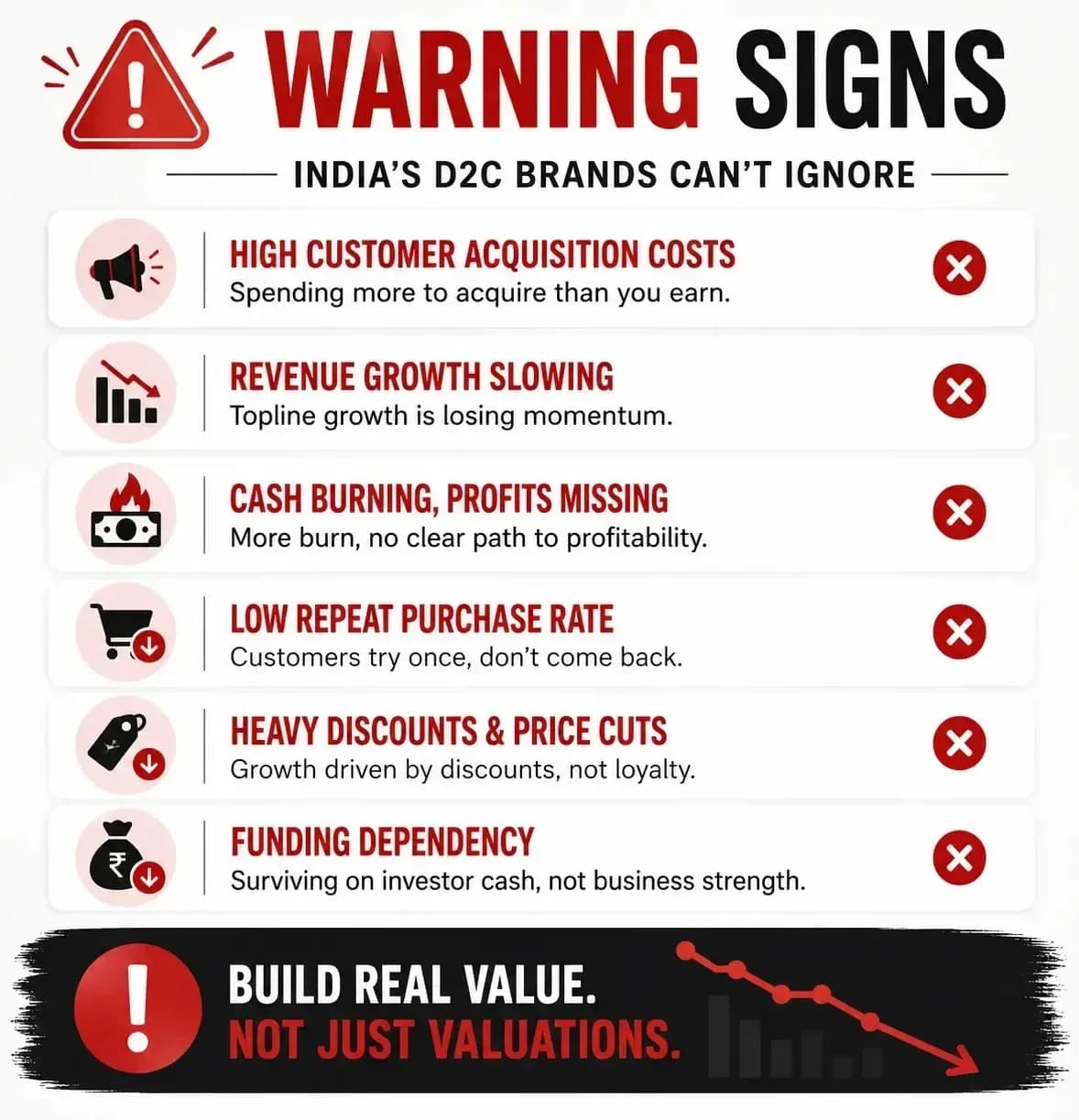
Revenue growth slows for two or more quarters in a row, well before losses show up in filings. Senior leadership, especially in business or product roles, exits quietly around the same time. Public statements start using terms like course correction or strategic reset. Funding rounds get delayed, downsized, or renamed as bridge or rescue rounds.
Indian D2C brands are not disappearing. But the ones that survive this phase will be the ones solving the customer acquisition and retention math, not just the ones raising the most money.
Why It Matters
This is not just a story about a few companies losing money. Millions of Indian shoppers now buy directly from D2C brands for skincare, food and daily needs. When a brand runs out of cash quietly, customers lose access to products, refunds get delayed and warranty support disappears overnight.
There is also a jobs angle. D2C brands employ thousands of people across marketing, logistics and customer support. A funding crunch at the top often means layoffs lower down, well before any news report catches it.
For anyone thinking of buying from a newer D2C brand, or working at one, this pattern is worth watching closely. The next quiet reckoning could already be underway.
News4Bharat POV
The Indian D2C story is not ending, but the easy years are clearly behind it. For a long time, brands could raise money on growth alone. That path is closed now. The brands that survive from here will be the ones that treat repeat customers as their real business, not the ones chasing the next funding round.
Sugar Cosmetics and Mamaearth show two different paths from the same problem. One is still searching for stability. The other corrected fast and came back stronger within a year. That difference matters more than the losses themselves.