

Union Housing and Urban Affairs Minister Manohar Lal has announced that the area associated with the Central Vista redevelopment project should henceforth be called the “Kartavya Bhawan Complex” or “Kartavya Bhawan Area”.
Speaking during the 172nd Annual Day celebrations of the Central Public Works Department at Vigyan Bhawan on July 12, 2026, the minister said the earlier name should no longer be used in official documents and references.
According to reports of his address, Manohar Lal asked officials to adopt the new nomenclature in all future communication. As of publication, however, a separate gazette notification or publicly available government order formally recording the change has not been cited.
What Did Manohar Lal Announce?
Manohar Lal was direct and unambiguous. "Until now, we have been repeatedly referring to it as 'Central Vista'," he said. "From now on, please call it the 'Kartavya Bhawan Complex' or 'Kartavya Bhawan Area'. The name Central Vista has now been changed. It should not be used going forward."
Also Read | PM Modi Releases ₹2,400 Crore Under PM-VBRY: Who Gets The Money And Why It Matters
He added that all official documents and references must reflect the new name.
The minister also placed the construction in historical context. "A nation's Capital is not built repeatedly in quick succession," he said. "We remember those who built the iconic buildings 100 years ago. Generations will remember those who built these Kartavya Bhawans. That is our good fortune."
From Rajpath to Kartavya Bhawan Area
The announcement is the latest in a series of naming changes involving New Delhi’s central administrative district.
In 2022, Rajpath was renamed Kartavya Path. The government presented the change as a shift from the idea of a royal processional road to the concept of duty, or “kartavya”.
The new Common Central Secretariat office buildings were subsequently named Kartavya Bhavans. Kartavya Bhavan-3 was inaugurated in August 2025, while Kartavya Bhavan-1 and Kartavya Bhavan-2 were inaugurated in February 2026.
In February 2026, the new complex housing the Prime Minister’s Office, National Security Council Secretariat and Cabinet Secretariat was inaugurated as Seva Teerth.
What the Kartavya Bhawan Area Covers
The Kartavya Bhawan Area is not just a single building. It is the entire precinct. It includes:
- All Kartavya Bhawan buildings the new government office complexes along Kartavya Path
- Kartavya Marg formerly Rajpath, renamed in 2022
- Seva Teerth the new complex housing the Prime Minister's Office, Cabinet Secretariat and the NSA's office
- Any future government buildings constructed in this zone
The entire zone from Rashtrapati Bhavan to India Gate and beyond now falls under the Kartavya Bhawan Area umbrella.
The Renaming Timeline: A Pattern of Change
This is not the first name change in this precinct. It is the latest in a deliberate and consistent pattern of renaming colonial era landmarks.
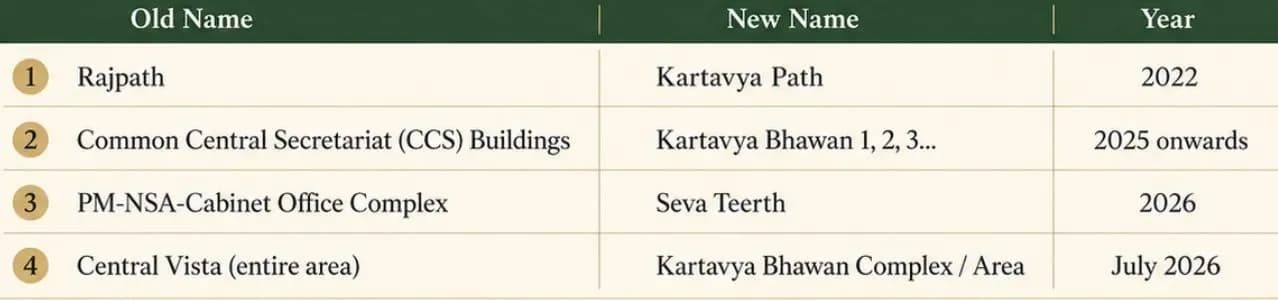
In 2022, Prime Minister Narendra Modi renamed Rajpath the iconic two-kilometre stretch from Rashtrapati Bhavan to India Gate as Kartavya Path. The government said the move removed symbols of the colonial past. The focus shifted from a royal processional route to citizens' duties, or kartavya.
The new government office buildings along that stretch were then named Kartavya Bhawans. The complex housing the Prime Minister's Office, Cabinet Secretariat, and the office of the National Security Advisor was named Seva Teerth.
Now, the entire precinct has been brought under one name: Kartavya Bhawan Area.
The Buildings Being Constructed: Status Update
The Kartavya Bhawan Area's centrepiece is the Common Central Secretariat a cluster of ten new office buildings that will house all central government ministries under one roof.
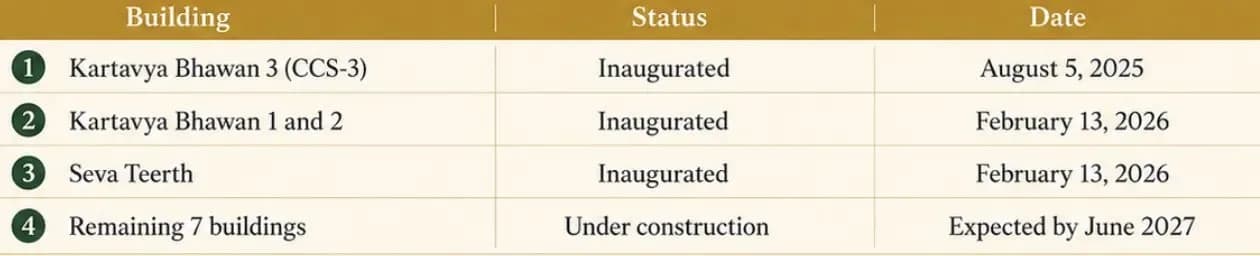
Three buildings are now operational. Seven more are under construction. The entire ten-building Common Central Secretariat is expected to be complete by June 2027.
The Ministry of Home Affairs was the first to move into Kartavya Bhawan 3. The Petroleum and Natural Gas and Rural Development ministries are next in line.
Why the Consolidation Matters: The Cost Angle
The shift from scattered ministry offices to the Kartavya Bhawan Area is not just symbolic. It makes financial and operational sense.
Central government ministries were previously spread across multiple ageing buildings - Shastri Bhawan, Nirman Bhawan, Krishi Bhawan, Udyog Bhawan, and others. Several departments even operated from rented private premises. This reportedly cost the government close to ₹1,500 crore every year in rent alone.
Once all ten Kartavya Bhawan buildings are operational, all ministries will sit under one modern, integrated complex. The rent cost disappears. Coordination improves. Infrastructure is modernised.
What the Buildings Look Like Inside
The Kartavya Bhawan buildings are a significant departure from India's old ministry infrastructure. Key features include:
- Access-controlled offices and entry points
- Digital interface systems on every floor
- Open floor work halls and modern conference rooms
- CCTV cameras across all floors
- Double-glazed glass windows for thermal insulation and noise reduction
- Energy-efficient LED lighting with occupancy and daylight sensors
- 30% energy savings compared to older government buildings
- Green building design across all ten structures
Each building is limited to a maximum height of 42 metres lower than the height of India Gate to maintain the visual harmony of the Central Vista Avenue.
North and South Block: What Happens to Them
North Block and South Block the colonial-era sandstone buildings that currently house the Finance Ministry and Home Ministry respectively will not be demolished. They will be converted into public museums once the ministries move out to the Kartavya Bhawan buildings. The conversion is part of the original Central Vista Redevelopment Project plan.
Also Read | Not Just AI, Not Just Sanskrit: PM Modi Backs a Course That Could Build India’s Next Knowledge Engineers
Other buildings in the broader precinct that will be retained include the National Museum and Ambedkar Auditorium. Buildings like Vanijya Bhawan (Commerce Ministry) and Jawaharlal Nehru Bhawan (External Affairs Ministry) will also continue.
The Tree Controversy
The Central Vista Redevelopment Project has not been without criticism. In April 2026, Union Minister of State for Housing and Urban Affairs Tokhan Sahu revealed in Parliament that 43% of the trees transplanted to make way for the project's structures had died. The disclosure drew criticism from environmental groups and opposition parties.
The government has not yet addressed what steps will be taken to compensate for the tree loss.
CPWD's New Transfer Policy
Speaking at the CPWD foundation day, Minister Manohar Lal announced an internal policy change. Employees can now request a posting of their choice. He acknowledged receiving several such requests. But he urged employees to think beyond personal convenience. Postings, he said, should serve the collective good not just individual preference.