

For decades, a rocket flew once. Then it was gone. Engines that took years to build burned up in the ocean. Or they turned to scrap after a single flight. Every satellite, every mission, every dream of going to space carried the price tag of a brand new rocket. That is the story reusable rockets are now rewriting.
A reusable rocket is built to come back. Engineers do not throw away the first stage. That is the most expensive part of any launch. It lands upright on a pad or a floating ship. Or it glides down like a plane and touches a runway.
Once it is checked, refuelled and fixed up, it flies again. "Fly it again instead of throwing it away". That one idea is now shaping the space plans of India, the United States, China and Europe.
The Falcon 9 Moment That Changed Everything
On December 21, 2015, SpaceX made history. Its Falcon 9 booster landed safely at Cape Canaveral after a launch. It was the first time a rocket had returned and landed upright for reuse. That single moment changed the future of space travel. By July 2026, SpaceX had landed a Falcon 9 booster 598 times. One booster alone has flown 36 missions. That is proof, rockets can be reused, again and again.
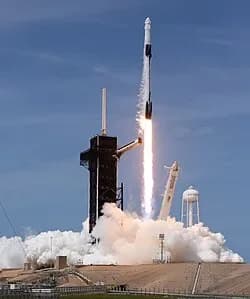
This has cut costs sharply. In the Space Shuttle era, one kilogram of cargo cost around $54,000 to launch. Today, a reused Falcon 9 does the same job for $1,500 to $2,700 per kilogram. That is a 95 % drop. Because of this, SpaceX now launches most of the world's commercial satellites.
SpaceX is not stopping there. Its next rocket, Starship, is built to carry more than 100 tonnes. It is designed to be fully reusable. SpaceX wants Starship to bring launch cost below $200 per kilogram. If that happens, sending cargo to space could become as routine as air cargo today.
Also Read | SpaceX's $75B IPO: What Marketers Can Learn From Elon Musk's Brand Hype Machine?
Why Reusable Rockets Matter So Much
Rockets have always been expensive for one simple reason - Fuel. A rocket needs huge amounts of it just to reach space. That fuel is heavy. So most of a rocket's weight is fuel, not cargo. Building a new rocket for every mission made this worse.
Reusable rockets fix this problem directly. Instead of scrapping a booster after one flight, companies like SpaceX fly it again. Each booster is worth tens of millions of dollars. Reusing it saves a huge amount of money. A reused Falcon 9 mission now costs close to $15 to $20 million. Its listed price is $74 million. The saving is real.
Lower cost opens doors. SpaceX's Starlink network has more than 7,000 satellites in orbit. That would not exist without cheap, reusable rockets. Weather forecasting gets better. Farm monitoring gets cheaper. Disaster response gets faster. Even space tourism starts to look possible. As launch cost falls, more industries get access to space.
Also Read | SpaceX IPO Creates History; Elon Musk Becomes First Trillionaire on Paper
Where India Stands Today
India is not watching from the sidelines. ISRO is running two major reusable programmes at once.
The first is Pushpak, a reusable spaceplane. It has already passed three landing tests. An Indian Air Force Chinook helicopter dropped it mid-air each time. Pushpak landed on its own, every time. The next big step is an orbital mission. Pushpak will travel through space and return to Earth on its own.
The second project is the Next Generation Launch Vehicle, called Soorya. The Union Cabinet approved it with a budget of 8,240 crore rupees. ISRO wants to cut launch cost sharply through reuse. Soorya will also carry India's space station plans, targeted for 2035. It will support India's crewed Moon mission too, aimed for 2040.
India's private space sector is moving fast as well. Skyroot Aerospace became India's first space tech unicorn in May 2026. It raised $60 million at a $1.1 billion valuation. The company is now preparing Vikram-1, its first orbital rocket. Agnikul Cosmos is close behind. It is building Agnibaan, a rocket powered by a 3D printed engine. Agnikul is also targeting its first orbital launch in 2026.
Also Read | SpaceX IPO Buzz Grows as Elon Musk’s Space Company Nears Public Listing
The Quiet Details Every Newsroom Overlooked
Reusable rockets are not just a cost story. They are creating new jobs across India's space industry. Many young engineers are leaving high-paying tech jobs. They are building rocket engines in Hyderabad and Bengaluru instead. This shift in talent matters as much as any funding round. Heat protection is another problem most reports skip.
A reusable rocket must survive re-entry heat above 1,200 degrees Celsius. It cannot fall apart under that stress. ISRO is building its own heat shield technology for Pushpak. This is a quiet but important step for India's self reliance goals under Aatmanirbhar Bharat.
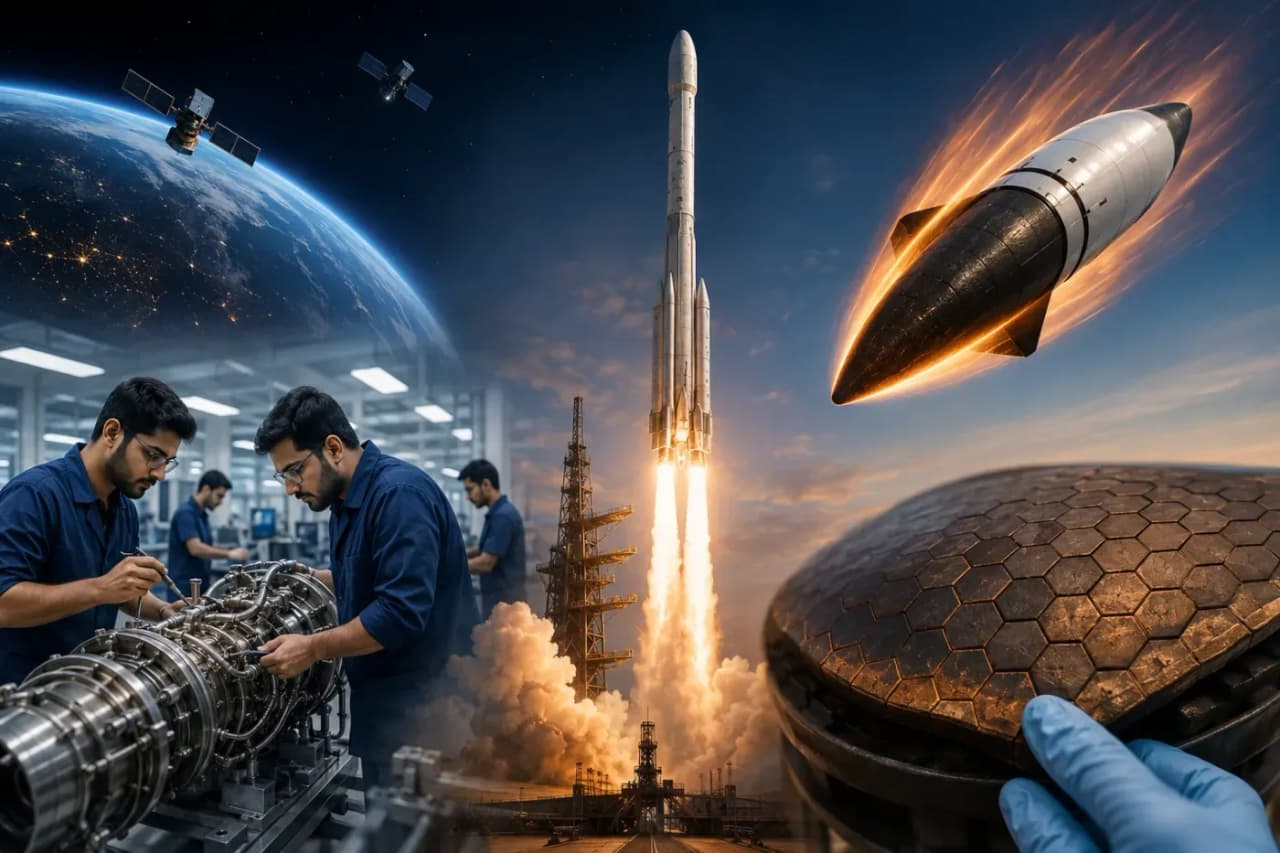
Reusing rockets is not free of trouble either. After every flight, engineers must check it closely. They repair what needs fixing. This takes time. It costs money too. It remains one of the hardest problems for every country chasing reusable rockets, including India and China.
There is a bigger prize behind all this. India's space economy is worth close to $8.4 billion today. It is expected to grow to $44 billion by 2033. Lower launch cost is the reason why. It lets Indian companies compete for satellite launch contracts from around the world, not just from home.
Also Read | From Tokyo To Orbit, Japan's Reusable Rocket Dream Just Got Closer
Why It Matters for Bharat
For citizens, this means cheaper satellite internet in remote villages. It means better cyclone warnings. It means sharper crop monitoring for farmers. For the government, it means a cheaper path to building India's own space station. It also supports the 2040 Moon mission target. For India's economy, it means Indian companies can chase a global launch market. That market is set to triple past $1.8 trillion by 2030. For India's security, it means less dependence on other nations for critical satellite launches.
The race for reusable rockets is no longer just about landing a booster. It is about who controls the cost of reaching space. And that decides who gets to use space the most in the years ahead. India has Pushpak, Soorya, Vikram-1 and Agnibaan all moving forward together. The country is trying to make sure it is not left behind in that race.