

Key Highlights
- Project KAL is being developed by IG Defence as a long-range one-way attack drone and loitering munition for deep-strike missions.
- The company claims a range of up to 1,000 km, along with seven-to-eight-hour endurance, a 50-kg warhead and a maximum speed of around 200 kmph.
- Project KAL has not been officially selected by the Indian Army. The Army’s separate 1,000-km Long-Range Loitering Munition requirement has different specifications.
- The Indian Army wants GPS-denied and AI-enabled capabilities, including a minimum speed of 400 kmph, a 25-kg warhead and the ability to operate in electronically contested environments.
- Major challenges remain before induction, including military testing, navigation without GPS, electronic-warfare resistance, terminal accuracy, airworthiness certification and large-scale production.
India is expanding its focus on unmanned weapons that can conduct long-range missions without placing pilots directly in danger. The shift reflects lessons from recent conflicts, where relatively inexpensive drones and loitering munitions have been used for surveillance, precision strikes, electronic warfare and the saturation of air-defence networks.
The Indian Army has initiated a Make-II acquisition process for an indigenous Long-Range Loitering Munition, or LRLM. According to the reported requirement, the system must be capable of accurately engaging targets at a distance of 1,000 km while operating in GPS-denied and electronically contested environments.
The Army is also seeking AI-enabled targeting, a 25-kg warhead, a flight altitude above 5,000 metres and a minimum speed of 400 kmph.
The procurement process should not, however, be confused with Project KAL, a separate platform developed by IG Defence. No official announcement has confirmed that KAL has been selected, shortlisted or ordered by the Indian Army under the LRLM programme.
What Is Project KAL?
KAL is described by IG Defence as a long-endurance loitering munition and one-way attack drone designed for autonomous deep-penetration missions.
According to the company’s published specifications, KAL can carry a 50-kg high-explosive warhead. It has a stated cruise speed of approximately 160 kmph and a maximum speed of 200 kmph.
These are manufacturer-stated specifications. Publicly available information does not establish whether the complete system has undergone Army trials, met military airworthiness standards or been approved for induction.
Project KAL began receiving wider public attention in March 2026. It is being developed by IG Defence, a private Indian defence technology company led by founder and chief executive Bodhisattwa Sanghapriya.
Indian Army Plans Indigenous 1,000 km Attack Drones
Project KAL was first shown to the public in March 2026. IG Defence was founded in Odisha. It is now based in New Delhi. The company shared early details and images of the drone. It says the drone is built for deep strikes. It can fly 1,000 km into enemy land and hit targets with precision.
Founder Bodhisattwa Sanghapriya says long range drones are now shaping how militaries fight.
The timing matters. During Operation Sindoor in 2025, the Indian Armed Forces tested many of their drone systems. That operation showed a clear need. India needs drones that can fly farther and work on their own. So in April 2026, the Indian Army released a new roadmap.
It lists 30 types of drones and loitering munitions. These are spread across five categories, with nearly 80 variants in total. The goal is simple. It helps Indian companies and researchers build what the military actually needs.
Also Read | India’s 5th Generation Fighter Jet AMCA Moves Ahead with Private Sector Push
What Is a One-Way Attack Drone?
A one way attack drone is also called a loitering munition. It does not come back after its mission. It carries a warhead built into its own body. It flies straight into the target and blows up on impact. This makes it very different from a normal surveillance drone, which flies back to base after taking pictures.
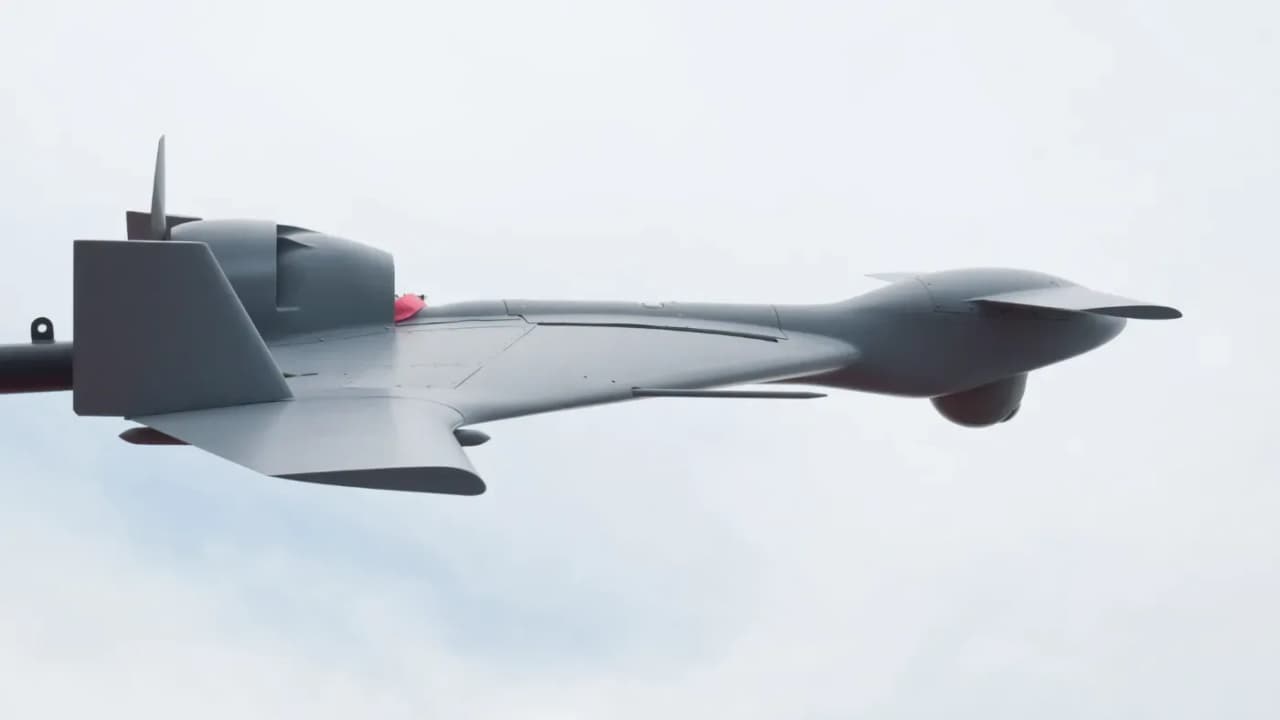
This idea is not new. Iran's Shahed-136 drone became famous for this style of attack. It was used in the Middle East and in Ukraine. These drones are cheap and easy to build in large numbers. They can wear down costly air defence systems over time. Project KAL follows the same idea. But it is built fully on Indian soil.
Also Read | India and Thailand Deepen Defence Ties: The Underreported Maritime Angle Behind the Bangkok Dialogue
Why India Needs Long-Range Attack Drones
For years, hitting a target deep inside enemy land meant using fighter jets or cruise missiles. Both options put pilots at risk. Both also cost a lot per strike, often several crores. A 1,000 km attack drone changes this math. It keeps the pilot safe on the ground. It costs a fraction of a missile strike. Yet it can still reach airbases, radar stations, and supply lines far behind enemy lines.
India shares tense borders with China and Pakistan. Both countries have spent heavily on their own strike drones. An Indian-made drone cuts India's need to import weapons. It also builds a supply chain at home. This chain cannot be cut off during a crisis. That lesson became clear to defence planners after the 2020 Galwan standoff.
Indian Army’s New Drone Roadmap
In April 2026, the Indian Army released the “Indian Army’s Technology Roadmap for Unmanned Aerial Systems and Loitering Munitions”.
The nearly 50-page document outlines 30 types of unmanned systems across five categories, translating into almost 80 possible variants.
The five categories are:
- Surveillance unmanned aerial systems
- Loitering munitions
- Unmanned systems for air-defence roles
- Logistics drones
- Special-purpose unmanned systems
The roadmap is intended to give defence companies, startups, academic institutions and research organisations a clearer understanding of the Army’s future requirements.
It is separate from the individual Make-II acquisition process for the 1,000-km Long-Range Loitering Munition.
Why a 1,000 km Range Is a Strategic Advantage
A 1,000 km range allows the Indian Armed Forces to launch attacks from deep inside their own territory. This reduces the need to set up bases close to the border, keeping soldiers and equipment safer while still being able to reach important enemy military targets.
IG Defence says Project KAL can stay airborne for three to five hours. That gives it time to fly long distances. It can also watch the target area first. This helps confirm the target before it strikes. The result is a more accurate hit.
Also Read | Made in India Airbus C295: India's Historic Leap in Defence Manufacturing
Can KAL Operate Without GPS?
The Indian Army’s reported LRLM requirement specifies operation in a GPS-denied environment.
Military drones can reduce their dependence on satellite navigation by combining inertial navigation systems, visual navigation, terrain matching, stored digital maps and signals from multiple satellite constellations.
However, the precise navigation architecture of Project KAL has not been publicly disclosed in sufficient detail.
It would therefore be speculative to claim that KAL already uses terrain-matching navigation or can complete a 1,000-km strike after all external navigation signals have been jammed.
Such capabilities would need to be demonstrated through flight testing under realistic electronic-warfare conditions.
Can Indian Companies Build These Advanced Drones?
India's private drone industry has grown fast. Solar Industries builds the Nagastra-1 loitering munition. IdeaForge makes tactical surveillance drones. Both firms have already delivered hundreds of units to the armed forces. Nagastra-1 alone has crossed 480 units in service. It carries a 1 kg warhead over about 30 km. It uses GPS and NavIC to guide itself.
Adani Defence works with Israel's Elbit Systems. Together, they have supplied over 120 units of the SkyStriker drone. It has a 100 km range. It was used during Operation Sindoor against armoured and infrastructure targets. Tata Advanced Systems built the ALS-50.
It has a 50 km range and a 5 kg warhead. These track records prove Indian firms can scale up fast. But a full 1,000 km platform like Project KAL is still an early stage effort.
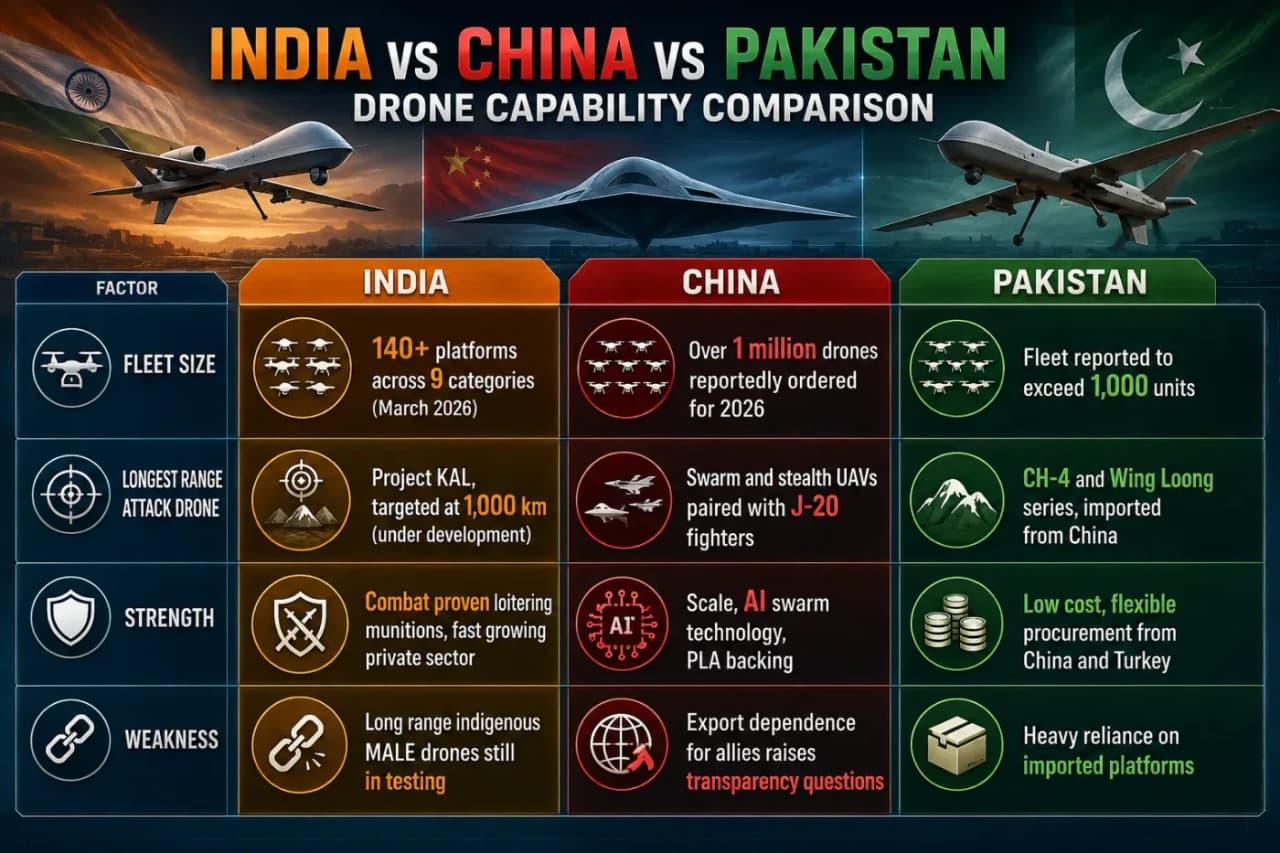
**China's approach leans on massive scale and AI enabled swarms, while Pakistan leans on a mixed fleet built through Chinese and Turkish imports rather than home grown design. India's advantage from Operation Sindoor was not fleet size but accuracy and combat proven systems, something analysts at the Observer Research Foundation have pointed out while comparing the two sides.
Also Read | From AI to Defence: India's Deeptech Startups Are Finally Building Things That Are Hard to Copy
India, China and Pakistan: Different Drone Strategies
China possesses a large and diverse military unmanned-aircraft industry covering reconnaissance drones, armed medium-altitude systems, swarm technologies and expendable attack platforms.
Pakistan operates a combination of domestically assembled systems and imported or jointly produced platforms, particularly those linked to Chinese and Turkish defence suppliers.
India has a growing private and public-sector drone ecosystem, but it continues to work on challenges involving engines, sensors, secure data links, electronic-warfare resilience and the domestic production of advanced components.
Operation Sindoor demonstrated the importance of precision unmanned systems and effective counter-drone networks. It did not by itself establish that India holds an overall numerical or technological advantage over China’s much larger drone-industrial base.
Attack Drone Versus Cruise Missile
A cruise missile generally flies faster and carries a larger warhead than a propeller-driven one-way attack drone. It is designed to reach a target rapidly using a pre-planned or updated flight path.
A loitering munition can remain in a designated area before receiving or confirming an engagement command. It may also be cheaper and easier to manufacture in large quantities.
The comparison is not absolute. Costs, speeds, guidance systems and mission profiles vary considerably between platforms.
One strategic concern is the cost exchange created when a defender uses an expensive surface-to-air missile to destroy a much cheaper drone. Modern air-defence planning therefore combines missiles with electronic warfare, guns, lasers and other lower-cost counter-drone systems.
What This Means for India's Defence Future
A working 1,000 km attack drone would give India a low cost, low risk way to strike deep without needing a pilot in the cockpit or a missile worth crores. It would also reduce dependence on imported systems at a time when both China and Pakistan are scaling their own unmanned fleets.
The technology is still being tested, and history shows Indian drone programmes can face long delays, but the direction is clear. India wants an unmanned strike option that is built at home, guided without relying only on satellites, and smart enough to find its own target.
Whether Project KAL becomes that drone, or whether another Indian company gets there first, the push toward long range indigenous attack drones is now a permanent part of India's defence roadmap.