

The Supreme Court has stayed a Madras High Court order that had imposed a blanket ban on the slaughter of cow or calf anywhere in Tamil Nadu, whether for Bakrid or on any other day. The interim relief came on a Special Leave Petition filed by the State of Tamil Nadu challenging the High Court's ruling.
What the Supreme Court Said on the Cow Slaughter Ban
A bench comprising Justice Vikram Nath and Justice Sandeep Mehta passed the interim stay order while issuing notice on the State's plea. The bench observed that the last paragraph of the High Court's order the part imposing the state-wide ban prima facie required "correction."
Also Read | Supreme Court Says No New Hate Speech Guidelines Needed, Calls Existing Laws Sufficient
Senior Advocate Dr Abhishek Manu Singhvi, along with Additional Advocate General Prashanto Sen, appeared for the State of Tamil Nadu before the Supreme Court. The petition itself was filed through the State's standing counsel, Advocate-on-Record Jayashree Narasimhan.
Background: What the Madras High Court Had Ordered
The Madras High Court bench of Justice GR Swaminathan and Justice V. Lakshminarayanan passed the original order on May 27, 2026 on the eve of Bakrid while hearing a Public Interest Litigation filed by K Surya Prasanth, General Secretary of Hindu Makkal Katchi.
Although the petitioner had only sought a direction confining slaughter to designated places, the High Court went further and passed a blanket order banning cow and calf slaughter anywhere, on any day. The High Court had directed Tamil Nadu to ensure no cow or calf was slaughtered on Bakrid eve or any other day.
The High Court had relied on a 1976 government order (referred to in the State's petition as GO No. 1715), which stated that a ban on cow slaughter was necessary to improve milk production and the rural economy, along with Supreme Court precedents holding that cow slaughter is not an essential practice for Bakrid celebrations.
Tamil Nadu first approached the Supreme Court against this order on July 9, 2026; the matter came up for hearing today, July 13, when the interim stay was granted and notice issued.
The State's Case Before the Supreme Court
Tamil Nadu's petition raised several grounds against the High Court's order:
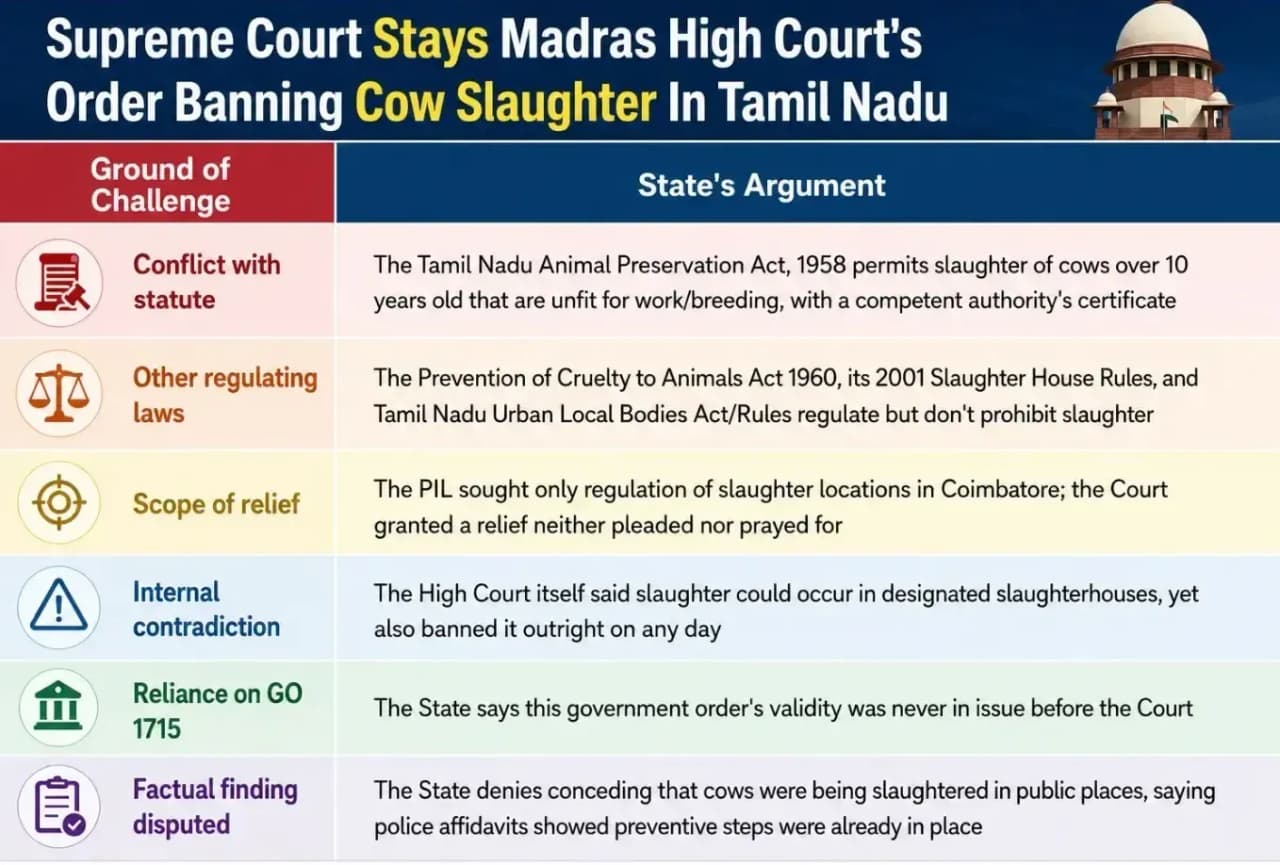
The State argued that by imposing a total prohibition where the legislature had only permitted regulated slaughter, the High Court effectively substituted judicial legislation for statutory law.
Also Read | Sabarimala Supreme Court 9-Judge Bench Hearing April 2026: Women's Entry Case Explained
Tamil Nadu has asked the Supreme Court to set aside the Madras High Court's ruling altogether and restore the legal position under the existing statutes governing animal slaughter today's interim stay is a step toward that final relief, with the matter still to be heard on merits.
Case Details
Case: The Secretary to the Government v. K Surya alias K Surya Prasanth | Diary No. 36054/2026
Disclaimer: This is a developing legal matter. The Supreme Court has passed only an interim order staying the Madras High Court's ruling and issuing notice; the case remains pending and sub judice. This report reflects facts available at the time of publication and may be updated as further developments occur.