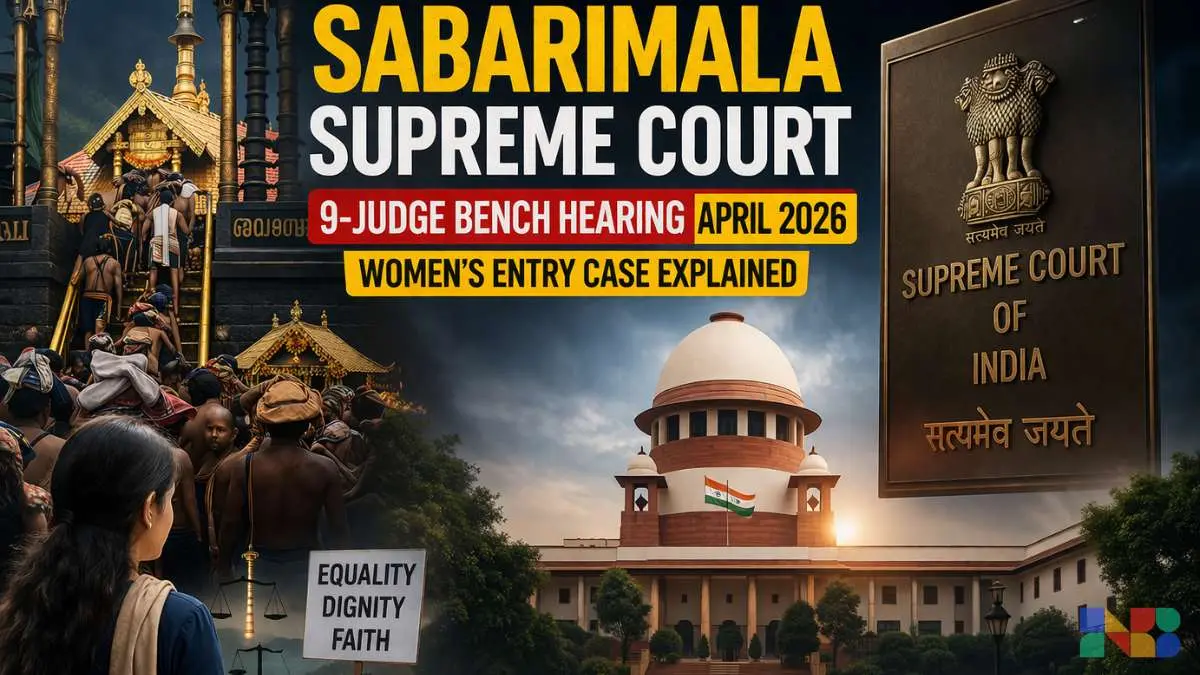
The Sabarimala temple entry case came back to life this week in a way nobody expected — not with one judge, not with five, but with nine. India's Supreme Court assembled its largest Constitution Bench in recent memory to re-examine whether women between the ages of 10 and 50 have a constitutional right to enter the Sabarimala Sree Dharma Sastha Temple in Kerala's Pathanamthitta district. The hearings started on April 7, 2026. Today, April 9, they continue. And the stakes, both legally and politically, could not be higher.
To understand why this matters, you need to go back to September 2018. A five-judge Constitution Bench had then ruled — by a 4:1 majority — that the centuries-old practice of barring women of menstruating age from the hill shrine was unconstitutional. It went against Articles 14 and 15 of the Constitution, the judges reasoned. The order made global headlines. But the celebrations were short-lived. Thousands of protesters blocked roads in Kerala. Women who attempted to climb the hill were turned back. The few who did make it in faced chaos. The judgment, for all its legal weight, never really translated into access on the ground.
Then in November 2019, a five-judge bench said the matter needed to be heard by a larger bench. The legal tangle deepened. The Sabarimala case got clubbed with several other faith-versus-rights disputes — whether Muslim women can be excluded from mosques, whether the Dawoodi Bohra community's practice of female genital mutilation can be shielded as religious custom, and whether Parsi women who marry outside their community can enter Fire Temples. All of these, the court said, raised the same core constitutional questions about religious freedom and individual rights. So the nine-judge bench was born.
On April 7, when Solicitor General Tushar Mehta stood up to argue for the central government, he set the tone bluntly. India, he told the bench, is not "that patriarchal or gender-stereotyped society as the West understands." The restriction on women of a certain age entering Sabarimala, he argued, has nothing to do with impurity or discrimination. It exists to protect the "Naishtika Brahmachari" (lifelong celibate) tradition of Lord Ayyappa. The government's position, filed in written submissions just days before the hearing, is that allowing women of that age group could alter the very character of worship at the shrine. Religious pluralism, the government says, protects this kind of denominational practice under Articles 25 and 26 of the Constitution.
But not everyone on the bench was buying it without pushback. Justice B.V. Nagarathna, the only woman among the nine judges, questioned whether the concept of untouchability could really be equated with menstruation in this debate. The questions from the bench were pointed, measured, and sometimes sharp. The hearing is expected to run through April 21, when rejoinder submissions are due, and conclude by April 22.
There is one more reason this case is burning hot right now. Kerala goes to the polls today — April 9, 2026. All 140 assembly constituencies vote in a single phase. Results come on May 4. The BJP, in its election manifesto, has promised to restructure the Devaswom Board, the body that manages Sabarimala. The Congress has its own position. The CPI(M)-led LDF government in Kerala has long maintained that tradition should be respected while the matter is before courts. Every word spoken in the Supreme Court this week carries an electoral echo.
The Sabarimala temple draws crores of pilgrims every year. The Meenam festival that concluded on April 1 with the Arattu ritual at Pamba River saw its usual surge of devotees. The annual Mandala season remains the biggest draw, pulling millions from across South India. Whatever the Supreme Court eventually decides, it will set a precedent not just for Sabarimala but for every faith community in India that draws lines around who can worship where and why. That is why nine judges sat down. That is why the country is watching.