

KEY HIGHLIGHTS
- Vivo Bio Tech posted a net profit of Rs 18.76 lakh in Q1 FY27, against a net loss of Rs 5.16 crore in Q4 FY26.
- Revenue stayed nearly flat at Rs 14.28 crore, up only slightly from Rs 14.20 crore in the previous quarter.
- Employee costs fell to Rs 4.73 crore from Rs 4.88 crore, a drop of over 3 percent quarter on quarter.
- Depreciation charges jumped to Rs 3.53 crore from Rs 2.75 crore, showing the cost of new lab investments.
- Earnings per share moved from a negative Rs 2.52 in Q4 FY26 to a positive Rs 0.08 in Q1 FY27.
Three months back, Vivo Bio Tech shocked its shareholders. The Hyderabad based preclinical research company had just posted its highest ever quarterly revenue, yet it still ended up with a net loss of Rs 5.16 crore in Q4 FY26. Now the Vivo Bio Tech Q1 FY27 results tell a different story. The company is back in profit, and investors want to know what actually changed.
Vivo Bio Tech reported a consolidated net profit of Rs 18.76 lakh for the quarter ended June 30, 2026, reversing the Rs 5.16 crore net loss recorded in the March 2026 quarter. On a year on year basis, however, profit was sharply lower than the Rs 1.34 crore reported in Q1 FY26, a gap that shows the recovery is still incomplete.
Revenue from operations stood at Rs 14.28 crore for the quarter, almost flat against the Rs 14.20 crore reported in Q4 FY26. This works out to sequential growth of less than one percent, a big slowdown from the pace the company had shown through most of FY26, when revenue rose for seven straight quarters. The company's decision to keep costs tight even as topline growth cooled is the real reason profit returned this quarter, and that trade off is worth a closer look.
The Rs 5.16 Crore Shock That Started It All
To understand this turnaround, you first need to understand the fall. In Q4 FY26, the quarter ending March 2026, Vivo Bio Tech reported revenue of Rs 14.20 crore, its best quarterly sales figure in years. Operating performance was already softening, with margins slipping from over 40 % to around 31 %. But the real damage came from an exceptional tax charge of Rs 5.41 crore, which pushed the effective tax rate to a staggering 2,164 %. A company that should have posted a modest profit on a pre tax basis of just Rs 0.25 crore instead reported a steep net loss. The stock fell over 10 % in a single session after the news broke.
Also Read | HCLTech Q1 FY27 Profit Jumps 20% to ₹4,624 Crore; Record $2.4 Billion Deal Wins Drive AI Momentum
Vivo Bio Tech Q1 FY27 Results: The Numbers That Changed Everything
Total expenses for the quarter stood at close to Rs 14 crore. Profit before tax came in at Rs 33.86 lakh. Basic earnings per share moved from a negative Rs 2.52 in the March quarter to a positive Rs 0.08 now, the clearest sign that the balance sheet has stabilised.
What Actually Fixed The Balance Sheet
Numbers alone do not explain a turnaround. What matters is where the improvement came from. Employee costs, the company's biggest expense line, dropped to Rs 4.73 crore from Rs 4.88 crore in the previous quarter. That is a real cost control move, not an accounting adjustment. Finance costs also eased, falling to Rs 1.24 crore from Rs 1.48 crore, which suggests the company is managing its debt servicing better. Depreciation, on the other hand, rose sharply to Rs 3.53 crore from Rs 2.75 crore. This points to continued investment in lab infrastructure, since Vivo Bio Tech runs a 125,000 square foot GLP accredited preclinical testing facility and remains one of India's largest suppliers of specific pathogen free lab rodents. The absence of any one time tax shock this quarter is the single biggest reason profit returned. Last quarter's loss was never really about the business itself. It was about a tax provision that overshadowed steady operations.
Also Read | Aviva Takes Full Control of Its India Life Insurance Business After Dabur Exit
The Part Mainstream Media Got Wrong
Most coverage of the Vivo Bio Tech Q1 FY27 results has stopped at the headline profit number. Few reports have pointed out that revenue growth has almost completely stalled. After seven straight quarters of sequential revenue increases through FY26, growth has now slowed to less than one percent quarter on quarter. That is a meaningful shift for a company whose entire investment case rested on rising client demand for preclinical testing.
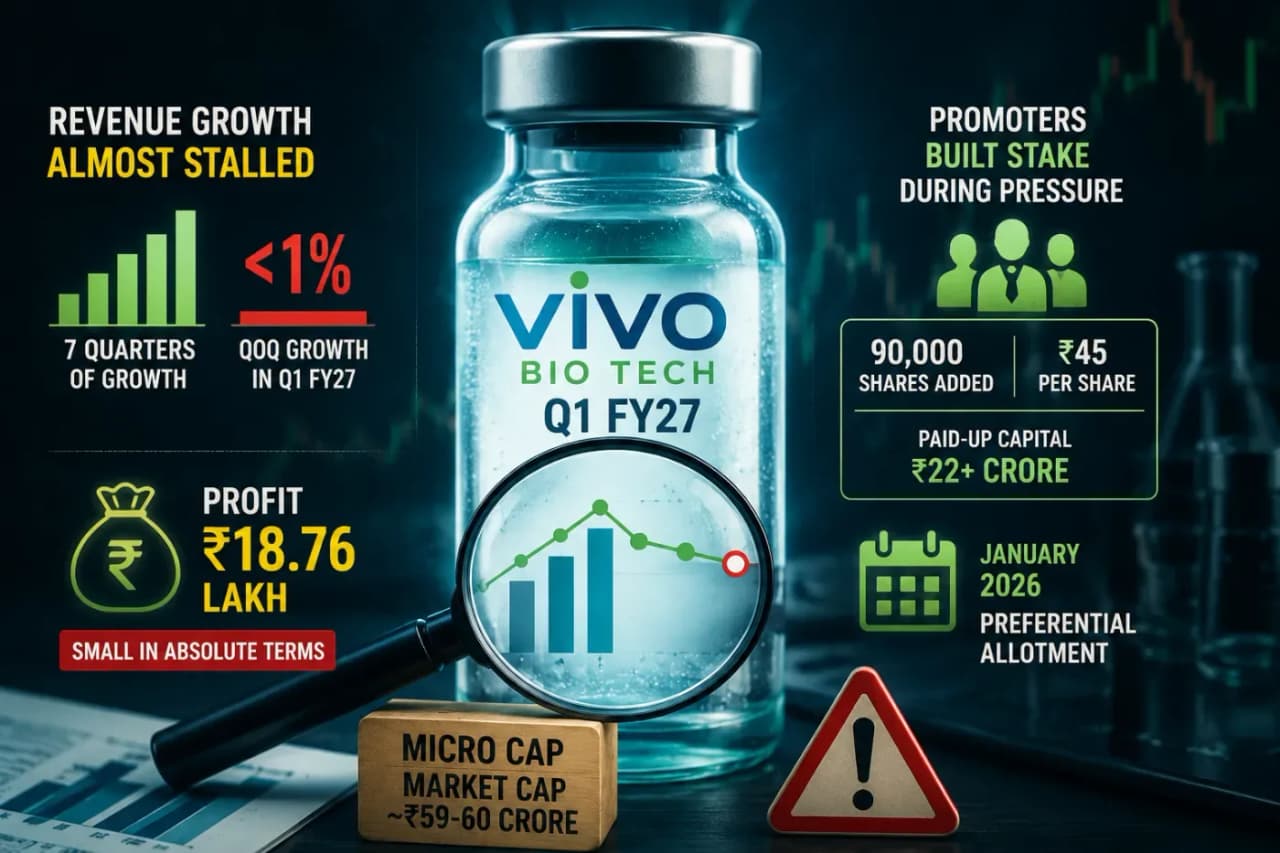
Another detail that got buried is the scale involved. Vivo Bio Tech is a micro cap stock with a market capitalisation of around Rs 59 to 60 crore. A profit of Rs 18.76 lakh, while directionally positive, is small in absolute terms. Retail investors reading only the headline could easily overestimate how strong this recovery really is.
Coverage has also skipped the promoter action from earlier this year. In January 2026, the promoter group added 90,000 shares through a preferential allotment at Rs 45 each, raising paid up capital to over Rs 22 crore. This came months before the tax led loss, and it shows promoters were building their stake even as the business faced margin pressure, a detail that adds useful context to the current recovery story.
Also Read | SK Finance Q4 Results: Reports ₹431 Crore PAT in FY26, AUM Rises to ₹15,755 Crore
What Investors Should Still Watch
The company's profit margins are still lower than they were in late 2024. Investors should not only look at profits on paper but also check if the company is generating strong cash from its business. They should also watch whether depreciation remains high because it reduces future profits. One good quarter does not mean the company has fully recovered from a year of weak margins.
News4Bharat Verdict: Recovery or Just Relief?
News4Bharat has tracked the Vivo Bio Tech Q1 FY27 results closely, and the picture is mixed rather than fully positive. The return to profit is real and the cost control on employee and finance expenses deserves credit. But this is not the strong turnaround some headlines are suggesting. Revenue has barely moved and depreciation is climbing fast, which means the core business still has work to do. News4Bharat's view is that investors should treat this as a stabilisation quarter, not a breakout one. The company has stopped the bleeding. Whether it can grow again will only become clear when the September quarter numbers arrive.