

You take a personal loan from an NBFC. Does RBI watch that lender the same way it watches a giant like Bajaj Finance?
Not anymore.
RBI has introduced a new system to decide how closely it monitors NBFCs (Non-Banking Financial Companies). The idea is simple: Bigger, riskier NBFCs will face stricter rules. Smaller ones will get lighter regulations.
This explainer breaks down the RBI's NBFC Scale-Based Regulation in simple way. No complex financial terms. Just clear facts that help you understand what the new framework means and why it matters.
Also Read | Dark Patterns in Indian Apps: Why RBI and CCPA Are Cracking Down on Manipulative Design
Previous Highlights: How It All Started
The RBI did not introduce this framework overnight. RBI announced the Scale-Based Regulation (SBR) framework in October 2021. The new rules took effect in October 2022. This replaced the old method of classifying NBFCs as simply "systemically important" or "non-systemically important.
The framework divides NBFCs into four layers. Rules get stricter as size and risk increase.
- Base Layer – Smaller NBFCs with basic regulations.
- Middle Layer – Medium-sized NBFCs that follow tighter rules.
- Upper Layer – Large and riskier NBFCs that face much stricter supervision.
- Top Layer – Kept empty by RBI for now. It's reserved for NBFCs that could pose a very high risk to India's financial system.
The change is important because NBFCs now play a major role in the economy. They account for around 15% of India's GDP by providing loans and other financial services.
Also Read | RBI’s New NBFC Rules 2026: Type I, Type II and Unregistered NBFC Explained
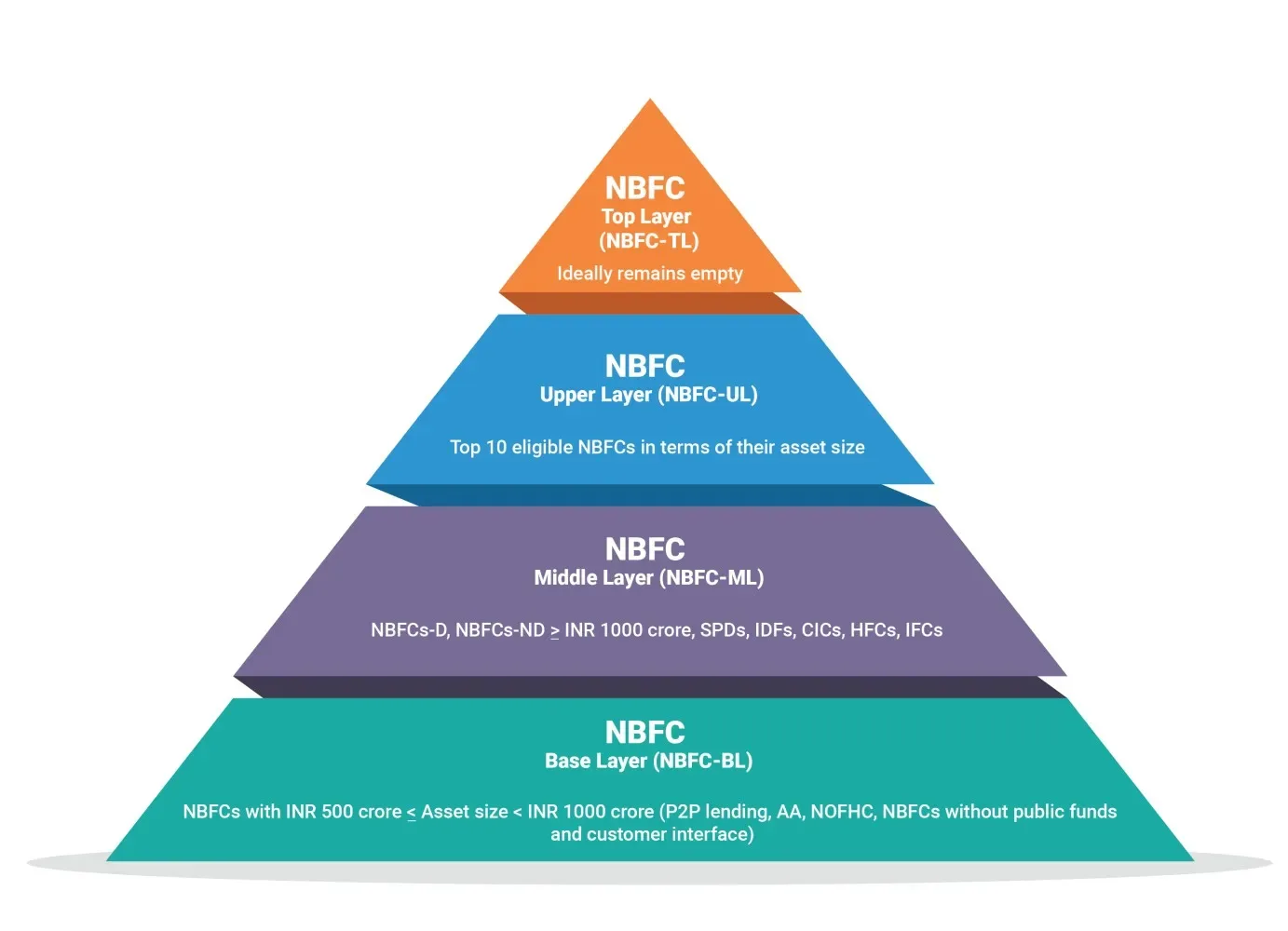 Source: Linkedln, Vivriti Capital
So, why did the RBI make this change?
- NBFCs have grown rapidly over the years and now lend almost like banks.
- Many were taking higher risks without following bank-level safeguards.
- Unsecured lending increased, raising concerns about financial stability.
- The old system applied similar rules to very different types of NBFCs, making regulation less effective.
The new framework lets RBI monitor NBFCs by size, risk, and impact. It no longer treats every NBFC the same way.
Present Highlights of NBFCs
Fast forward to 2026. The RBI NBFC framework just got a fresh coat of paint.
1. Upper Layer classification gets simpler
RBI has updated the rules for identifying Upper Layer NBFCs. The process is now simpler. Bank-owned NBFCs also face stricter governance norms. The aim is to strengthen financial stability and improve oversight across the sector.
Earlier, RBI used a complex scoring system to decide Upper Layer status. That has now changed.
- Any NBFC with assets of ₹1 lakh crore or more will now be automatically classified as Upper Layer. This is based on audited financial statements.
- This replaces the earlier multi-step evaluation process, making the classification more straightforward.
- Bank-owned NBFCs must also follow stricter governance standards. These include stronger risk management, greater transparency, and better accountability.
The new approach gives NBFCs a clear benchmark. This reduces confusion and helps companies comply with RBI rules more easily.
Also Read | Bank of India Hands Over ₹1,553.50 Crore Dividend Cheque to Government for FY26
2. A brand-new exemption category
Here's where things get interesting for smaller players.
RBI introduced major amendments to NBFC registration on April 29, 2026. The move offers relief to NBFCs that skip public funds and direct customer contact.
A fresh category was born: Unregistered Type I NBFC.
- This applies to NBFCs with no public funds and no customer interface, subject to prescribed conditions.
- Such entities must have a total asset size below ₹1,000 crore to qualify.
- Existing Type I NBFCs meeting this test can apply for deregistration through the PRAVAAH portal.
This mainly helps family offices and investment holding firms. These entities are internally funded and pose low systemic risk. Why burden them with bank-level compliance?

Also Read | HDFC Bank's New Chairman Isn't a Banker — Here's Why That Matters
3. Deregistration comes with a deadline
Getting relief from the old rules is not automatic. Eligible NBFCs must apply to the RBI for deregistration within six months of the new rules taking effect. If they miss the deadline, the existing regulations will continue to apply.
To complete the process, NBFCs need to submit:
- The original Certificate of Registration (CoR) to the RBI in physical form.
- Audited financial statements for the last three financial years.
- Details of their public funds and customer interface for the past three years.
4. Exemption does not Mean Escape
Some may think exempt NBFCs no longer have to follow RBI rules. That is not the case. Even exempt NBFCs must continue to meet certain compliance requirements every year.
They must:
- Pass an annual board resolution confirming they still qualify for the exemption.
- Disclose their exempt status in their financial statements.
- Obtain an auditor's certificate to verify they meet the required conditions.
If an NBFC fails to follow these requirements, the RBI can take action under the RBI Act, 1934. In other words, the rules have become simpler for some companies, but regulatory oversight still remains.

Also Read | NPCI Is Changing How You See a UPI Recipient Before You Pay
5. Group-level rules still apply
Trying to stay below the registration limit by splitting assets across multiple companies will not work. RBI has made this clear: if a group runs several Unregistered Type I NBFCs, their assets get added together. If combined assets cross ₹1,000 crore, all of them must register as Type I NBFCs
6. Infrastructure lending gets a boost
RBI has also eased risk-weight rules for NBFC loans funding operational infrastructure. This frees up capital, making it easier to finance roads, highways, and power plants over the long term.
Why This Matters to You?
Think this is only for bankers and lawyers? Think again.
They matter to millions of people who depend on NBFCs for personal loans, vehicle loans, business finance, and microfinance. NBFCs play a key role in providing credit, especially in areas where traditional banks may not lend as easily.
Here's why the new rules matter:
- Stricter rules for large NBFCs aim to make the financial system safer for borrowers and investors.
- Simpler rules for smaller, low-risk NBFCs reduce unnecessary paperwork and help them make faster business decisions.
- A clearer framework lets RBI focus on companies with the biggest impact on financial stability.
RBI calls this a balanced approach — close watch on large, systemically important NBFCs, and lighter compliance for smaller, low-risk firms.

The Bigger Picture
The RBI's work on NBFC regulation is still evolving. The central bank first introduced this framework. It keeps refining the rules as the sector grows and new challenges appear.
RBI no longer follows the same rules for every NBFC. It now uses a risk-based approach. Bigger, riskier companies face stricter regulations. Smaller, low-risk firms get simpler compliance rules.
This change is shaping the future of India's non-bank lending sector. It will influence how NBFCs lend money, expand their businesses, and meet regulatory standards.
One thing is clear: as India's financial system grows, these rules will keep changing too. Staying updated helps you follow more than the news. It shows you where India's lending industry is headed.