

RBI rules now give customers clearer rights on loan prepayment, recovery calls, gold-loan collateral, digital lending, account claims, payment checks, credit reports and complaints, but each rule has its own start date and coverage.
The RBI circular tracker is a working guide to rules that can change what a bank, finance company, payment provider or credit bureau must do for a customer. A circular can affect a fee, a deadline, a complaint, a loan app, a recovery call or the return of pledged gold. The date on the document is not always the date on which the rule starts. Some rules apply only to loans sanctioned or renewed after a set date. Others give firms time to change systems. A draft is not a final rule.
This page tracks final RBI documents with a direct customer impact. It starts with rules in force, then lists changes that start later. Each entry answers five points: what the RBI said, who is covered, what was different before, what a customer can do and which date matters. Direct links go to the RBI source so readers can check the text.
What happened: latest developments
RBI customer rules changed in stages during 2025 and 2026. The changes did not come through one circular. They came through separate directions on digital lending, gold and silver collateral, prepayment charges, payment authentication, deceased depositor claims, KYC, cheque clearing, credit reporting, complaints and recovery conduct.
Several changes are now part of routine banking. Digital lenders must show comparable loan offers. Certain borrowers cannot be charged for prepaying a floating-rate loan. Gold-loan borrowers must receive a detailed collateral certificate and can claim daily compensation for a lender-caused return delay. Banks have a 15-day claim deadline in deceased depositor cases.
Digital payments need two separate checks, with at least one check changing for each transaction. RBI complaints now follow the 2026 Ombudsman Scheme.
The next date is 1 October 2026 for added controls on some cross-border card payments. The next rule change after that is 1 January 2027, when the recovery-agent conduct directions take effect.
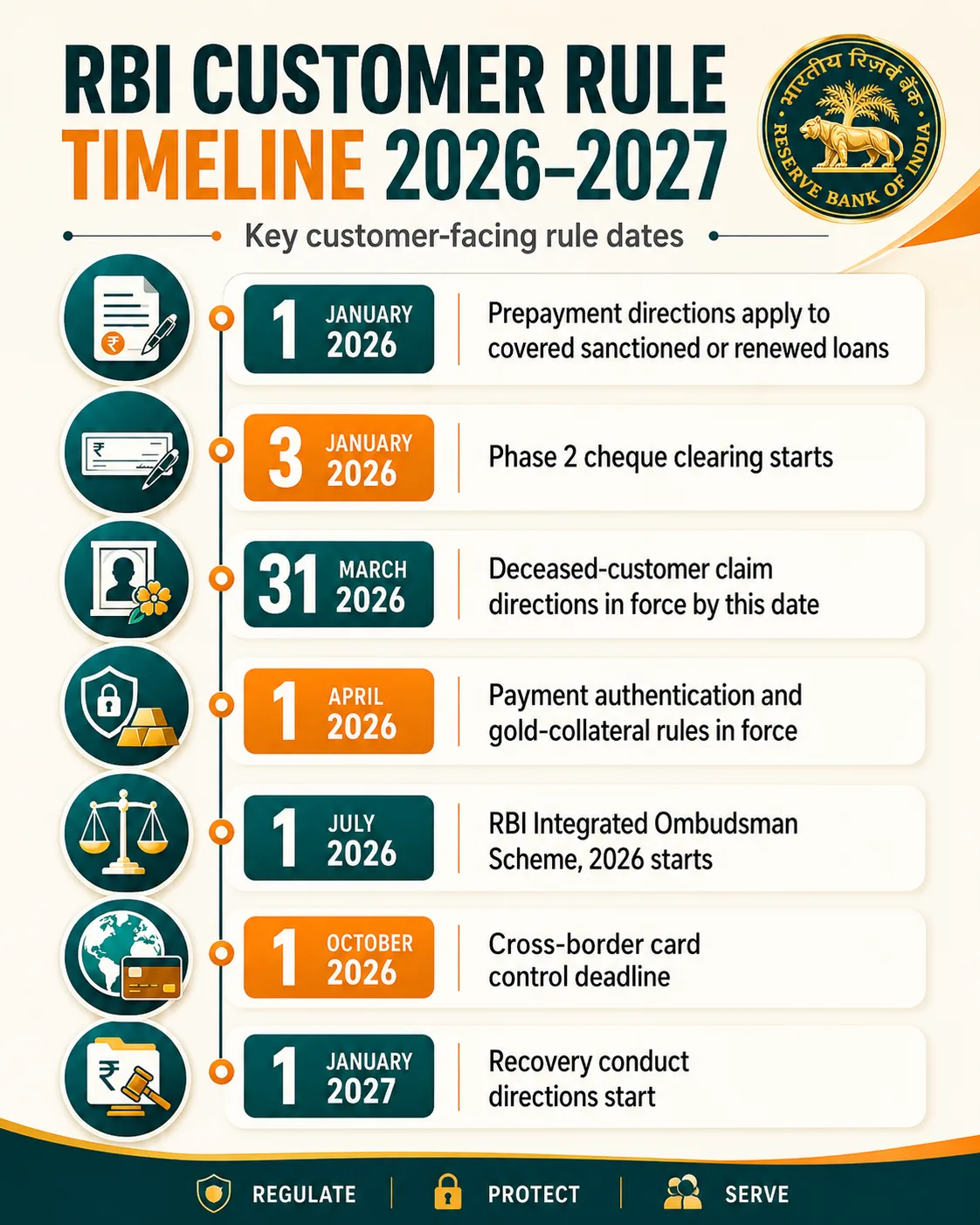
For loan, KYC, complaint and card-payment changes beyond UPI, see the News4Bharat RBI circular tracker.
RBI circular timeline and regulation tracker
| RBI document | Issued | Start date | Status on 10 August 2026 | Customer result | Primary source |
|---|---|---|---|---|---|
| Credit information reporting frequency | 8 Aug 2024 | 1 Jan 2025 | In force | Lenders report credit data twice a month instead of once a month. | RBI notification |
| Digital Lending Directions, 2025 | 8 May 2025 | Most rules at once; offer display from 1 Nov 2025 | In force | Loan apps must show comparable offers, send documents and limit phone-data access. | RBI directions |
| Lending Against Gold and Silver Collateral Directions, 2025 | 6 Jun 2025 | No later than 1 Apr 2026 | In force for covered new or renewed loans after lender adoption | Loan-to-value caps, collateral records, return deadlines and delay compensation apply. | RBI directions |
| Pre-payment Charges on Loans Directions, 2025 | 2 Jul 2025 | 1 Jan 2026 | In force for loans sanctioned or renewed from the start date | No prepayment charge on covered floating-rate loans. | RBI directions |
| KYC amendment | 12 Jun 2025; consolidated text updated 14 Aug 2025 | Notice rules no later than 1 Jan 2026 | In force | Banks must send advance notices and reminders for periodic KYC updates. | RBI KYC directions |
| Authentication for Digital Payment Transactions Directions, 2025 | 25 Sep 2025 | 1 Apr 2026 | In force | Domestic digital payments need two separate authentication factors. | RBI directions |
| Settlement of Claims in Respect of Deceased Customers | 26 Sep 2025 | No later than 31 Mar 2026 | In force | Standard forms, a 15-day deadline and delay compensation apply. | RBI directions |
| Continuous Clearing and Settlement on Realisation in CTS | 13 Aug 2025 | Phase 2 from 3 Jan 2026 | In force | Cheque confirmation and settlement can occur during the day. | RBI circular |
| RBI Integrated Ombudsman Scheme, 2026 | 1 Jul 2026 | 1 Jul 2026 | In force | A single RBI complaint scheme replaces the 2021 scheme. | RBI FAQ and scheme guide |
| Responsible Business Conduct Directions, 2026 | 6 Aug 2026 | 1 Jan 2027 | Issued, not yet in force | Time limits, notice, call records, device-lock rules and compensation will apply to recovery work. | RBI circular for commercial banks |
How to read an RBI circular
A circular has six fields that decide whether it helps in a customer dispute.
- Issue date: When RBI published the document.
- Start date: When the requirement becomes binding.
- Covered firm: The banks, cooperative banks, finance companies, payment firms or credit bureaus named in the text.
- Covered product: The loan, deposit, payment, card, cheque or service named in the rule.
- Transition condition: Whether the rule applies to an old account, only a new loan, or a loan renewed after a set date.
- Customer remedy: The correction, refund, compensation or complaint route available if the firm fails to comply.
The words “draft”, “discussion paper” and “directions” matter. A draft invites views. It does not create a customer right. A final direction creates a duty from its stated start date. An FAQ can explain a rule, but the linked scheme or direction remains the controlling text.
Before filing a complaint, save the circular link and the paragraph that applies. Match it with the account number, loan date, charge date and complaint number. Do not rely on a screenshot without the source URL.
For the current periodic KYC notice and update rules, see the RBI circular tracker.
Loans and recovery
1. Prepayment charges on floating-rate loans
For a floating-rate loan sanctioned or renewed on or after 1 January 2026, a lender cannot charge an individual for part or full prepayment when the loan is for a non-business purpose. The protection applies regardless of the source of the repayment and has no lock-in period.
For business loans to individuals and micro or small enterprises, coverage depends on the lender. Commercial banks, apart from small finance banks, regional rural banks and local area banks, cannot levy the charge at any loan size. The same rule applies to larger finance companies and All India Financial Institutions. For small finance banks, regional rural banks, specified cooperative banks and middle-layer finance companies, the protection covers loans up to ₹50 lakh.
If a loan switches between fixed and floating rates, its rate type on the prepayment date decides the rule. Any allowed charge must appear in the sanction letter, loan agreement and Key Facts Statement. A lender cannot add an undisclosed charge later. Read the RBI prepayment directions.
Practical impact
Check whether the loan was sanctioned or renewed on or after 1 January 2026. Then check whether the rate is floating on the proposed prepayment date. Ask the lender for a written breakup if any fee appears. For the effect of RBI rate decisions on loan instalments and deposits, read RBI repo rate unchanged at 5.25%: what it means for EMI and FD.
2. Digital loan apps and online loan offers
When a loan app works with more than one lender, it must show all offers that match the borrower's request. The screen must include the lender's name, amount, term, annual percentage rate, monthly repayment, penalty terms and a link to the Key Facts Statement. Annual percentage rate means the yearly cost of the loan, including listed charges. The app must also name lenders that did not match. It cannot use a ranking that hides the basis of comparison.
The lender must send the Key Facts Statement, sanction letter, terms, account statements and privacy policies to the borrower's verified email or phone. Loan money normally goes from the lender to the borrower's bank account. Repayment goes from the borrower to the lender. A service provider cannot use a pool account in between, apart from listed exceptions.
The borrower must receive a cooling-off period of at least one day. During it, the borrower may leave the loan by paying the principal and the proportionate cost for the days used, without a penalty. A disclosed one-time processing fee may be retained.
An app cannot read contacts, call logs, files or media. One-time access to camera, microphone or location is allowed only where needed for identity checks or onboarding, with consent. The borrower must be able to deny access, withdraw consent and seek deletion of data, subject to legal retention duties. Read the RBI digital lending directions.
Practical impact
Compare the annual percentage rate, not only the monthly instalment. Download the Key Facts Statement before accepting. If the app asks for contacts or call logs, stop and record the permission screen. Confirm that the lender named in the agreement is the firm receiving repayment.
3. Gold and silver loans
For a consumption loan backed by gold or silver, the maximum loan as a share of collateral value is 85% for a loan up to ₹2.5 lakh, 80% for a loan above ₹2.5 lakh and up to ₹5 lakh, and 75% for a loan above ₹5 lakh. This share is called the loan-to-value ratio.
The borrower must be present when the collateral is tested. The lender must issue a certificate that records purity, gross and net weight, deductions, damage, value and an image of the pledged items.
After full repayment or settlement, the lender must return the same collateral on the same day or within seven working days. If a delay is the lender's fault, compensation is ₹5,000 for each day of delay. If an auction is required, the first auction should take place in the same district. The reserve price is at least 90% of current value. It may fall to 85% after two failed auctions. Any surplus must reach the borrower within seven working days. Read the RBI gold and silver collateral directions.
Who is affected?
The rules cover loans by commercial banks, cooperative banks, finance companies and housing finance companies named in the directions. Loans completed before a lender adopted the directions continue under the earlier rules.
Practical impact
Do not leave the branch without the collateral certificate. Match the number, weight, purity and image to the items. After repayment, ask for a dated release receipt. Count working days, not calendar days, before calculating delay compensation.
4. Recovery calls, visits and device locks
From 1 January 2027, a lender must list its approved recovery agencies on its website and update the list within seven calendar days of a change. A borrower or guarantor must receive notice at least one day before the first in-person visit.
Recovery contact and visits are limited to 8 am to 7 pm unless the borrower has given permission for another time. The lender or agent cannot use abuse, threats, public humiliation, social media posts or repeated calls. It cannot intrude on the privacy of family members, referees or friends. Calls and messages must be recorded and kept for at least six months, or until a court case ends when the matter is before a court.
A phone or other financed device cannot face software restrictions until the payment is 30 days overdue. Full restrictions cannot apply until 60 days overdue. A lock cannot block incoming calls, text messages or emergency access, and it cannot deny access needed for work. The lender cannot use the lock to read contacts, messages, call logs, photos or location. After payment, the device must be unlocked within one hour. A wrong or late unlock can bring ₹250 an hour in compensation, capped at the loan amount disbursed. Read the RBI commercial bank circular.
Credit reports
Credit data updates twice a month
Since 1 January 2025, banks and lenders have had to report credit information as of the 15th and the last day of each month. They must send it to credit bureaus within seven calendar days of each cut-off. A bureau must process the data within five calendar days after receipt.
The previous position used monthly reporting. The change can show a paid balance or missed payment sooner, but an update is not instant. A clean repayment made just after a cut-off may wait for the next reporting cycle. Keep the payment receipt and check the next report. If the entry remains wrong, dispute it with both the lender and the credit bureau. Read the RBI credit reporting circular.
Complaints and compensation
RBI Integrated Ombudsman Scheme, 2026
The 2026 scheme took effect on 1 July 2026 and replaced the 2021 scheme. Filing is free.
The customer must first complain to the bank, finance company, payment firm or other firm covered by the scheme and keep proof. A complaint can move to RBI when the response is not satisfactory, or when the firm has not replied or resolved it within 30 days or a longer period set by RBI, NPCI or a card network for that type of case.
The RBI complaint must be filed within 90 days after that response period ends or after the firm's last communication, whichever is later. It can be filed through the RBI Complaint Management System, by email at crpc@rbi.org.in, or by post to the Centralised Receipt and Processing Centre, Reserve Bank of India, Central Vista, Sector 17, Chandigarh 160017.
The Ombudsman may award up to ₹3 lakh for time, costs, harassment and mental anguish, apart from any amount directed for the underlying loss under the scheme. An appeal against an Award must normally be filed within 30 days. RBI's contact centre is 14448. The automated line works all day. Staff support is listed from 8 am to 10 pm, Monday to Saturday, excluding holidays. Read RBI's Ombudsman FAQ.
Customer complaint checklist
Before filing, keep:
- The account, loan, card or transaction reference.
- The date and amount in dispute.
- A copy of the first complaint sent to the firm.
- The complaint or service-request number.
- The firm's reply, if any.
- Statements, receipts, screenshots and call records that support the case.
- The RBI circular or direction and the paragraph relied on.
- A short statement of the correction or compensation sought.
- Do not pay an agent to file an RBI complaint. The process is free.
RBI complaint data for 2024-25
| Measure | RBI figure | What it shows |
|---|---|---|
| Total complaints received under the system | 13,34,244 | Volume rose 13.55% in a year. |
| Complaints received by Ombudsman offices | 2,96,321 | These are the cases sent to the 24 offices. |
| Complaints per lakh accounts | 7.7 | Down from 8.9 in 2023-24. |
| Complaints filed through digital channels | 91.22% | The portal and email were the main routes. |
| Complaints filed by individuals | 2,58,365 | Individuals made up 87.19% of office receipts. |
| Complaints against banks | 2,41,601 | Banks made up 81.53% of office receipts. |
| Complaints against finance companies | 43,864 | Their share was 14.80%. |
| Loan and advance complaints | 29.25% | This was the largest product group. |
| Change in credit-card complaints | 20.04% increase | Credit cards were the second product group by volume. |
| Share of top five complaint groups | 86.20% | A small set of products drove most office receipts. |
| Cases disposed by Ombudsman offices | 2,90,567 | The disposal rate was 93.07%. |
| Cases treated as maintainable | 1,80,621 | This was 62.16% of disposed cases. |
| Maintainable cases settled through agreement, conciliation or mediation | 51.91% | More than half ended without a formal Award. |
Source: RBI Annual Report of the Ombudsman Scheme, 2024-25.
Data and research
RBI's annual report on the Ombudsman Scheme shows why complaint procedure matters. In 2024-25, the RBI complaint system received 13,34,244 complaints, up 13.55% from 11,75,075 in 2023-24. This total includes complaints handled through Ombudsman offices, the central receipt centre and cases closed through the system process. It should not be read as 13.34 lakh complaints admitted by an Ombudsman.
News4Bharat analysis
The change across these documents is a move from a broad duty to a timed, record-based duty. A bank must not merely process a deceased customer's claim. It has a 15-day period after receiving the documents. A gold lender must not merely return collateral. It faces a seven-working-day outer limit and ₹5,000 a day for a delay caused by the lender. A recovery lender must not merely act fairly. From 1 January 2027, it must give notice, preserve records and meet a one-hour device-unlock target after payment.
This changes the evidence needed in a dispute. The useful proof is a dated acknowledgement, a Key Facts Statement, a payment receipt, an email, a call record or a screenshot tied to the account. Customers should ask for written reasons when a charge, delay or document demand does not match the RBI text.
The tracker also shows a limit of headline-based reporting. An issue date is not an effective date. A direction for loans sanctioned after 1 January 2026 does not automatically rewrite every older contract. A draft does not create a remedy. The customer test is therefore three-part: does the rule cover the firm, does it cover this product, and had it started on the date of the event?