

Key Highlights
- NPCI is introducing a new UPI feature that will display the recipient's verified bank-registered name whenever users scan a QR code or enter a mobile number for a transfer.
- The update aims to replace custom display names and aliases that fraudsters often misuse to deceive users into sending money to wrong accounts.
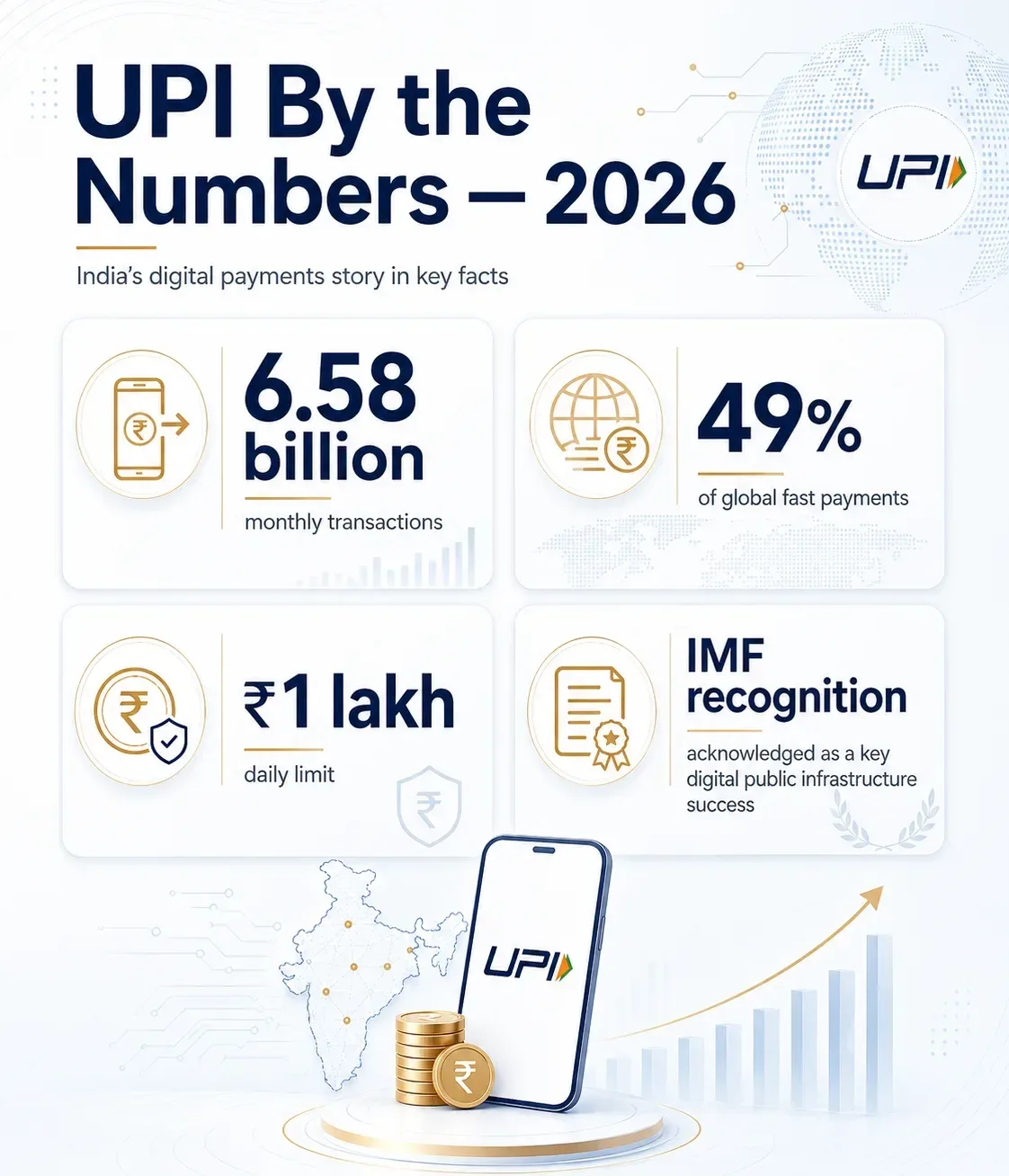
- India's UPI has been recognised by the International Monetary Fund as the world's largest retail real-time payment system, accounting for 49% of global fast payment transactions.
- UPI crossed 6.58 billion financial transactions in a single month at its recent peak, reflecting the scale of the system and the urgency of safety improvements.
- The daily transaction limit for most UPI users stands at Rs 1 lakh, as set by NPCI, though the new name verification feature applies across all transaction values.
The next time you scan a QR code or type a phone number into a UPI app, you may notice something new. Instead of seeing a custom name or shop alias, the screen will show the name exactly as registered with the recipient's bank.
This is a deliberate safety change being introduced by the National Payments Corporation of India, the body that runs UPI in India. The shift addresses one of the most common tactics used in digital payment fraud.
UPI Rules 2026: What RBI and NPCI Changed
Why UPI Apps Will Show Bank-Registered Names
Right now, when someone sets up a UPI ID or a QR code, they can choose a display name. A merchant may go by "Sharma Kirana" or "Fashion Zone." An individual might show up as a nickname. These custom names have no verification process tied to them.
Fraudsters have used this gap to create accounts with names that look similar to legitimate businesses or individuals. A user may think they are paying a known contact or a trusted vendor, but the display name is deceptive. By the time the transfer goes through, the money is gone.
The new NPCI rule addresses this directly. Before a payment, users will now see the name linked to the recipient's actual bank account record. This name goes through a verification step and cannot be freely customised by the recipient without documentation.
How the Feature Can Help Prevent UPI Fraud
UPI is not a small-scale payment system. The IMF recently confirmed it as the largest retail real-time payment system in the world by transaction volume. It accounts for 49% of all global fast payment transactions. UPI has scaled far beyond earlier monthly milestones, with NPCI data showing more than 23 billion transactions in May 2026, underlining the urgency of stronger safety and verification mechanisms..
At that scale, even a small percentage of fraudulent or misdirected transactions represents millions of people. The stakes for getting safety right are high.
Will UPI Payments Become Chargeable? What Users Should Know Before Worrying
What Changes for UPI Users?
When you open a UPI app and scan a QR code at a shop or enter a phone number to send money, the app will now display the bank-registered name of the account holder before you confirm the payment. You will be able to see whether the name matches who you intend to pay.
If the name is unfamiliar or does not match your expectation, you can choose not to proceed. The decision is still in the hands of the user, but the information provided is now more accurate and harder to fake.
What Changes for Merchants and Businesses
Merchants who use custom QR codes or UPI-based payment systems will need to ensure their bank account details are properly maintained and linked correctly. Businesses running on third-party payment aggregators may also see their names displayed differently based on how they are registered in banking records.
This could cause some temporary confusion during the transition, particularly for small vendors who have been using informal names on their QR codes for years.
What UPI Users Should Do?
Small merchants should check whether their UPI-linked bank account reflects the correct name. Businesses using personal bank accounts may need to inform customers if the verified name differs from the shop name. Merchants should also update QR code displays, payment counters and customer communication wherever necessary to avoid confusion.
What this means for the backend infrastructure of the UPI ecosystem
For a payment app to show a verified bank name in real time, it has to check the banking system at the moment a user scans a QR code or enters a UPI ID. That may sound routine, but at UPI’s massive scale, even a small delay matters. With billions of transactions taking place every month, adding another verification layer without slowing down the payment experience will be a serious backend challenge.
News4Bharat POV
UPI’s biggest strength has always been its speed and simplicity. Users scan, confirm and pay within seconds. If the new name-verification process adds even a fraction of a second to each transaction, it could affect the smooth experience that made UPI popular in the first place. How NPCI and payment apps manage this micro-latency issue will be worth watching closely.
There is also a financial inclusion concern that has not received enough attention. Across rural and semi-urban India, many small shopkeepers, street vendors and local service providers use QR codes linked to personal bank accounts or informal business names. A tea seller may be known locally by the name of his shop, but the bank account may display his personal name. A small tailoring unit may operate under one name, while the UPI-linked account shows another.
For customers, this mismatch could create confusion. Some may hesitate to pay if the verified name does not match the shop board, QR sticker or business identity they recognise. This is not necessarily a fraud issue; it is often just how small businesses operate. NPCI may therefore need to think beyond technology and support awareness, correction and migration mechanisms for such merchants.
NPCI’s move should therefore not be seen only as a user-interface update. It is a test of how India’s digital payment infrastructure balances speed, trust, inclusion and accountability at national scale.