

India's insurance sector started FY2026-27 with life insurers collecting ₹1.09 lakh crore in new business premium, up 16.6% year on year, while non-life insurers recorded ₹87,825 crore in gross direct premiums, up 10.7%. Health insurance was the main driver of non-life growth, with premiums rising 19.9% to ₹38,804 crore, while private life insurers grew much faster than LIC.
India Insurance Industry Q1 FY27: Key Numbers
| Indicator | Q1 FY27 | YoY change |
|---|---|---|
| Life insurance new business premium | ₹1,09,071.8 crore | +16.6% |
| Private life insurers NBP | ₹43,522.9 crore | +27.5% |
| LIC NBP | ₹65,548.9 crore | +10.3% |
| Life insurance APE | ₹39,764.6 crore | +23.4% |
| Individual non-single life policies | 51.1 lakh | +6.1% |
| Non-life gross direct premium | ₹87,825.4 crore | +10.7% |
| Health insurance premium | ₹38,804.2 crore | +19.9% |
| Retail health premium | ₹14,440.2 crore | +31.6% |
| Group health premium | ₹22,462 crore | +14.0% |
| Standalone health insurer premium | ₹12,161.2 crore | +32.9% |
| Motor insurance premium | ₹26,425.7 crore | +13.9% |
| Fire insurance premium | ₹8,109.9 crore | -27.8% |
| Crop insurance premium | ₹106.5 crore | -88.8% |
Life insurance data is based on IRDAI and Life Insurance Council figures compiled by CareEdge. Non-life data is based on General Insurance Council and IRDAI figures.
For a company-level view, News4Bharat has separately ranked India's largest insurers by assets, premiums and FY26 growth.
How Big Is India's Insurance Industry in 2026?
Quarterly sales data shows where the market is moving. Annual data gives the larger picture.
The latest complete government-wide market baseline shows that India's insurance industry collected ₹11.93 lakh crore in premiums in FY2024-25, paid ₹8.36 lakh crore in claims, issued 41.84 crore policies and managed ₹74.44 lakh crore in assets as of March 31, 2025. India's reinsurance market stood at ₹1.12 lakh crore.
India was the world's 10th-largest insurance market by nominal premium volume in 2024, accounting for about 1.8% of the global market. Yet insurance penetration remained at 3.7% of GDP, split between 2.7% for life insurance and 1% for non-life insurance. Insurance density stood at $97 per person.
These numbers explain the basic contradiction in the Indian insurance market.
India already has a large insurance industry in absolute rupee terms. At the same time, insurance spending relative to the size of the economy remains low.

What Changed in India's Insurance Market in Q1 FY27?
This distinction is important for any report on the insurance sector.
The quarterly ₹1.09 lakh crore life insurance figure is new business premium, or premium from new business written during the period.
The ₹87,825 crore non-life figure is gross direct premium underwritten, covering the applicable premium written by general and health insurers.
They are different measures.
For that reason, News4Bharat does not add the two numbers and call the result India's total Q1 insurance premium.
Annual total premium data, which includes renewal business, is a separate measure.
Also Read | Subhransu Pattnayak Named Zurich Kotak's New Underwriting Chief: Why It Matters for Customers?
Life Insurance Market in India Q1 FY27
Three developments defined India's insurance market between April and June 2026.
- First, life insurance new business premium increased by 16.6%, with private insurers growing 27.5% compared with LIC's 10.3%.
- Second, non-life premiums rose 10.7%, but the growth was uneven. Health and motor expanded while fire and crop insurance contracted.
- Third, health insurance became even more important to the non-life market. Health premiums reached ₹38,804 crore in the quarter and accounted for about 44.2% of all non-life premium.
The 44.2% figure is a News4Bharat calculation based on General Insurance Council and IRDAI premium data.
Premium growth should be read alongside claim performance. News4Bharat has compared insurer-level settlement times using IRDAI data.
Life insurance premium reaches ₹1.09 lakh crore
Life insurers collected ₹1,09,071.8 crore in new business premium during April to June 2026, compared with ₹93,544.7 crore in the same quarter a year earlier.
That represents growth of 16.6%.
The monthly pattern shows that June remained the largest month of the quarter.
| Month | FY26 NBP | FY27 NBP | Growth |
|---|---|---|---|
| April | ₹21,965.7 crore | ₹30,550.4 crore | +39.1% |
| May | ₹30,463.2 crore | ₹32,030.9 crore | +5.1% |
| June | ₹41,117.1 crore | ₹46,490.5 crore | +13.1% |
Source: Life Insurance Council and IRDAI data compiled by CareEdge.
April's 39.1% increase created a strong start to the year. Growth moderated in May before moving back into double digits in June.
The figures also show why reading one month in isolation can be misleading. Life insurance premium collections can move sharply based on large group policies, single-premium business, financial-year-end sales and institutional transactions.
The full-quarter figure gives a better view of the direction.
LIC vs private insurers: Who gained market share?
The biggest competitive story in life insurance is not that LIC has lost its lead. It has not.
LIC collected ₹65,548.9 crore in new business premium during Q1 FY27, compared with ₹43,522.9 crore for all private life insurers combined.
The difference is growth.
Private insurers increased new business premium by 27.5%, while LIC grew by 10.3%.
Also Read | Sandeep Rathi Joins Generali Central: Why His Underwriting Role Matters?

News4Bharat calculation; Why APE tells a different story from total premium
Private insurers accounted for about 62.7% of industry APE in Q1 FY27, even though they accounted for only 39.9% of total new business premium.
LIC accounted for around 37.3% of APE while holding 60.1% of NBP.
The difference reflects the much larger role of group and single-premium business in LIC's premium base and the stronger contribution of regular premium business among private insurers.
This is one of the quarter's most important life insurance signals.
Premium market share alone does not tell the full story of new sales.
Regular premium vs single-premium business
Life insurance single-premium business reached ₹77,008 crore in Q1 FY27, up 13%.
Non-single premium business reached ₹32,063.8 crore, up 26.1%.
That means non-single premium grew twice as fast as single-premium business during the quarter.
However, single premiums still accounted for about 70.6% of total new business premium.
Non-single premium contributed around 29.4%.
These are News4Bharat calculations based on IRDAI and Life Insurance Council figures.
The faster growth in recurring premium business matters because regular premiums usually create a longer relationship between the insurer and policyholder.
Non-life insurance: Premium reaches ₹87,825 crore
India's non-life insurance industry collected ₹87,825.4 crore in gross direct premium during Q1 FY27, up 10.7% from ₹79,324.4 crore in Q1 FY26.
Monthly premium was:
| Month | FY26 | FY27 | Growth |
|---|---|---|---|
| April | ₹33,688.5 crore | ₹36,417.7 crore | +8.4% |
| May | ₹22,268.2 crore | ₹24,195.0 crore | +8.7% |
| June | ₹23,458.4 crore | ₹27,196.3 crore | +15.9% |
Source: General Insurance Council and IRDAI data compiled by CareEdge.
Unlike life insurance, where June contributed the highest Q1 premium, April was the largest month for non-life insurance.
June, however, recorded the fastest year-on-year growth of the quarter.
General Insurance Market in India Q1 FY27
| Insurer category | Q1 FY27 premium | YoY growth |
|---|---|---|
| Private general insurers | ₹46,696.3 crore | +11.3% |
| Public general insurers | ₹28,770.7 crore | +3.6% |
| Standalone health insurers | ₹12,161.2 crore | +32.9% |
| Specialised PSU insurers | ₹197.1 crore | -53.4% |
| Industry | ₹87,825.4 crore | +10.7% |
Private general insurers and standalone health insurers together wrote ₹58,857.5 crore of premium.
That is approximately 67% of all non-life premium written during Q1 FY27.
Health Insurance Market India Q1 FY27Motor Insurance Market Q1 FY27
Health insurance premiums increased from ₹32,360 crore in Q1 FY26 to ₹38,804.2 crore in Q1 FY27.
Growth was 19.9%.
Health alone represented about 44.2% of India's non-life premium during the quarter.
That is more than motor, fire and several other major categories individually.
The ₹6,444 crore increase in health premium also accounted for roughly 75.8% of the entire ₹8,501 crore year-on-year increase in non-life premium.

Standalone health insurers are gaining market share
Standalone health insurance companies, or SAHIs, collected ₹12,161.2 crore in Q1 FY27, up 32.9% year on year.
In June alone, SAHI premium reached ₹4,373.3 crore.
Standalone health insurers accounted for 37.9% of total health premium in June 2026, compared with 35.7% in June 2025 and 26.4% in June 2024.
The change over two years is significant.
Dedicated health insurers have moved from just over one-quarter of June health premium to almost two-fifths.
That increases competition with diversified general insurers in one of India's fastest-growing insurance segments.
Motor Insurance Market Q1 FY27
- Motor insurance collected ₹26,425.7 crore in Q1 FY27, up 13.9%.
- Motor own-damage premium rose 16.4% to ₹11,006.6 crore.
- Motor third-party premium increased 12.2% to ₹15,419.1 crore.
Motor therefore accounted for about 30.1% of total non-life premium during Q1, based on News4Bharat calculations.
Health and motor together represented about 74% of the non-life market during the quarter.
That concentration explains why changes in hospital costs, health pricing, car sales, two-wheeler sales and motor insurance regulation have an outsized effect on industry growth.
EV adoption and motor insurance
The link between vehicle sales and insurance is also beginning to change with electric vehicles.
CareEdge reported that EV penetration in new vehicle sales increased from 4.8% in June 2025 to 7.75% in June 2026.
Higher EV adoption does not automatically mean proportionately higher motor insurance premium.
Vehicle value, battery replacement costs, repair networks, claim experience and underwriting prices all affect the eventual premium pool.
Fire insurance recorded a sharp fall
Not every insurance category grew.
Fire premium declined 27.8% year on year to ₹8,109.9 crore in Q1 FY27, compared with ₹11,238.9 crore in the previous-year quarter.
That represents a reduction of approximately ₹3,129 crore.
CareEdge points to pricing competition and the previous year's higher base as factors behind the contraction.
The fall matters because it offsets some of the growth generated by health and motor.
Crop insurance premium fell almost 89%
Crop insurance recorded the largest percentage decline among major non-life categories.
Premium fell from ₹951.8 crore in Q1 FY26 to ₹106.5 crore in Q1 FY27, a decline of 88.8%.
The figures need context.
Crop insurance premium recognition depends on agricultural cycles and the timing of government and scheme-related premium bookings.
CareEdge noted that the Kharif enrolment window remained open beyond the quarter, making Q1 premium a poor measure of the full-year direction.
The tax change that is reshaping individual insurance
One of the largest consumer-facing insurance changes preceding Q1 was the removal of GST from individual life and health insurance.
From September 22, 2025, individual health insurance, family floater plans and senior citizen health policies became GST-exempt.
Individual term plans, endowment policies and ULIPs were also covered.
The previous 18% tax increased the amount paid by a customer above the base premium.
Its removal lowered the tax component for individual policies.
The first-quarter data does not by itself prove how much incremental demand came from GST removal. But retail health's 31.6% growth and the strength in individual life regular-premium business make affordability one of the factors that should be followed over the next several quarters.
What happened immediately after the quarter ended?
The Q1 reporting period ended on June 30, but several major regulatory changes arrived in July.
On July 30, 2026, IRDAI notified regulations covering insurer registration and capital, intermediaries, actuarial and investment functions, health third-party administrators, surveyors, the Policyholders' Education and Protection Fund, and the procedure for imposing regulatory penalties.
The policyholder fund is intended to support insurance awareness and inclusion, grievance redressal, systems for recovering unclaimed insurance money and technology-based policyholder services.
These developments belong to Q2 FY27 rather than Q1.
Q1 scorecard: Where India's insurance market stands
| Area | Q1 assessment | Data signal |
|---|---|---|
| Life premium growth | Up | NBP +16.6% |
| Private life competition | Increasing | Private NBP +27.5% |
| LIC market leadership | Maintained | 60.1% NBP share |
| Regular life premium momentum | Up | Non-single premium +26.1% |
| Life policy volume | Up moderately | +6.1% |
| Non-life premium | Up | +10.7% |
| Health insurance | Main growth engine | +19.9% |
| Retail health | Fastest large consumer segment | +31.6% |
| Standalone health insurers | Gaining share | +32.9% premium |
| Motor insurance | Up | +13.9% |
| Fire insurance | Down | -27.8% |
| Private non-life share | Increasing | Private + SAHI around 67% |
| Insurance penetration | Still low | 3.7% of GDP |
| Regulatory competition | Increasing | 100% FDI framework |
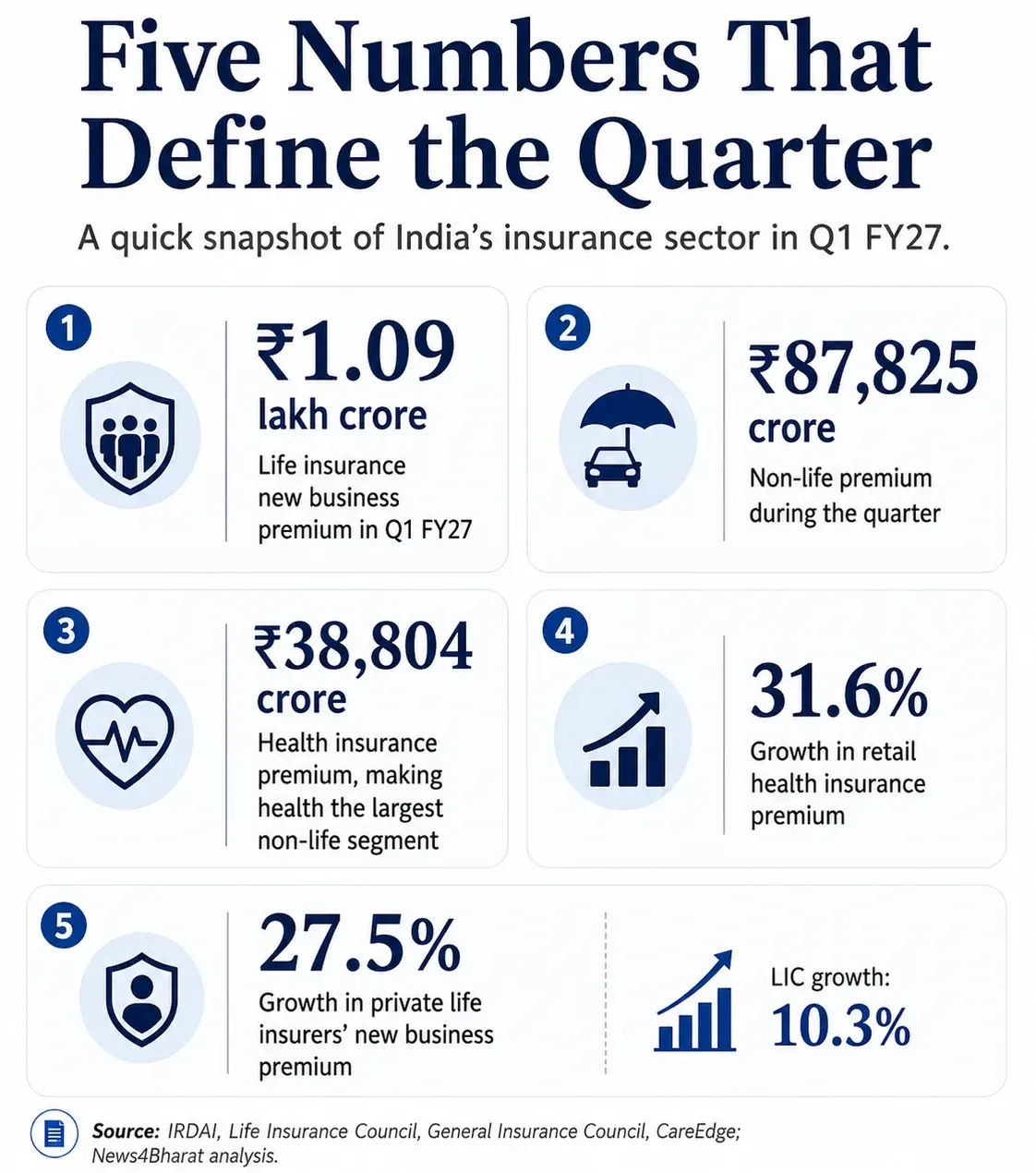
Five numbers that define the quarter
- ₹1.09 lakh crore: Life insurance new business premium in Q1 FY27.
- ₹87,825 crore: Non-life premium during the quarter.
- ₹38,804 crore: Health insurance premium, making health the largest non-life segment.
- 31.6%: Growth in retail health insurance premium.
- 27.5%: Growth in private life insurers' new business premium, compared with 10.3% for LIC.
Together, these figures show where the market's current growth is concentrated.
IRDAI Reforms to Watch in Q2 FY27
The next quarterly report should focus on five tests:
- Does retail health maintain 30% plus growth after the initial post-GST period?
- Do private life insurers continue gaining new business share from LIC?
- Does non-single life premium continue growing faster than single-premium business?
- Does fire insurance recover after its Q1 contraction?
- How quickly do IRDAI's July 2026 policyholder, intermediary and enforcement regulations move from notification to implementation?
A sixth issue will be Bima Sugam. Its rollout could begin changing how policies are compared, purchased and serviced, making digital distribution an important Q2 and Q3 data point.
Bima Sugam could also affect how insurers acquire customers and how investors value digital insurance distribution.
News4Bharat POV
Q1 FY27 gives a clearer picture of where India's insurance growth is coming from.
In life insurance, LIC still controls 60% of new business premium, but private insurers are growing much faster. Once sales are viewed through APE rather than raw premium, private insurers account for nearly 63% of the industry's annualised new business.
In non-life insurance, health accounts for 44% of premiums. Health and motor together account for about three-quarters.
Within health, standalone health insurers are gaining share, while retail health premium is growing above 30%.
This concentration creates opportunity and risk.
Health insurance can keep expanding as incomes, hospital costs, awareness and private healthcare use rise. Motor can benefit from vehicle ownership and EV adoption. Private life insurers can continue gaining business through banks, agents and digital platforms.
But the same concentration means any deterioration in health claim costs, changes in motor pricing or slowdown in regular-premium life demand can quickly affect industry growth.
The strongest Q1 signal is therefore not simply that "insurance grew".
It is where the growth came from.
Methodology and Data Sources
This report covers the quarter from April 1 to June 30, 2026. Life insurance new business premium figures are taken from IRDAI and Life Insurance Council data compiled in CareEdge's July 2026 life insurance report. Non-life, health, motor, fire and crop premium figures are based on General Insurance Council and IRDAI data compiled in CareEdge's July 2026 non-life report.
Figures labelled News4Bharat calculation are calculations made from the published underlying data. They include market shares, segment shares and contribution to incremental premium growth.
Life new business premium and non-life gross direct premium are not combined because the measures are not equivalent. Forecasts are clearly separated from historical results. Regulations notified after June 30 are treated as post-quarter developments rather than Q1 events.
Data cut-off: August 10, 2026.
Sources: IRDAI monthly business figures, Life Insurance Council:, General Insurance Council, IRDAI Handbook on Indian Insurance Statistics, Ministry of Finance, GST Council and Government of India