

If you have ever purchased an insurance policy through a bank or a large corporate distributor, you might have experienced a common frustration: trying to figure out exactly who sold it to you. When a policy turns out to be a poor fit—or worse, completely different from what was promised—customers are often left fighting a faceless institution. Customer care loops and denied responsibility have been the norm for far too long.
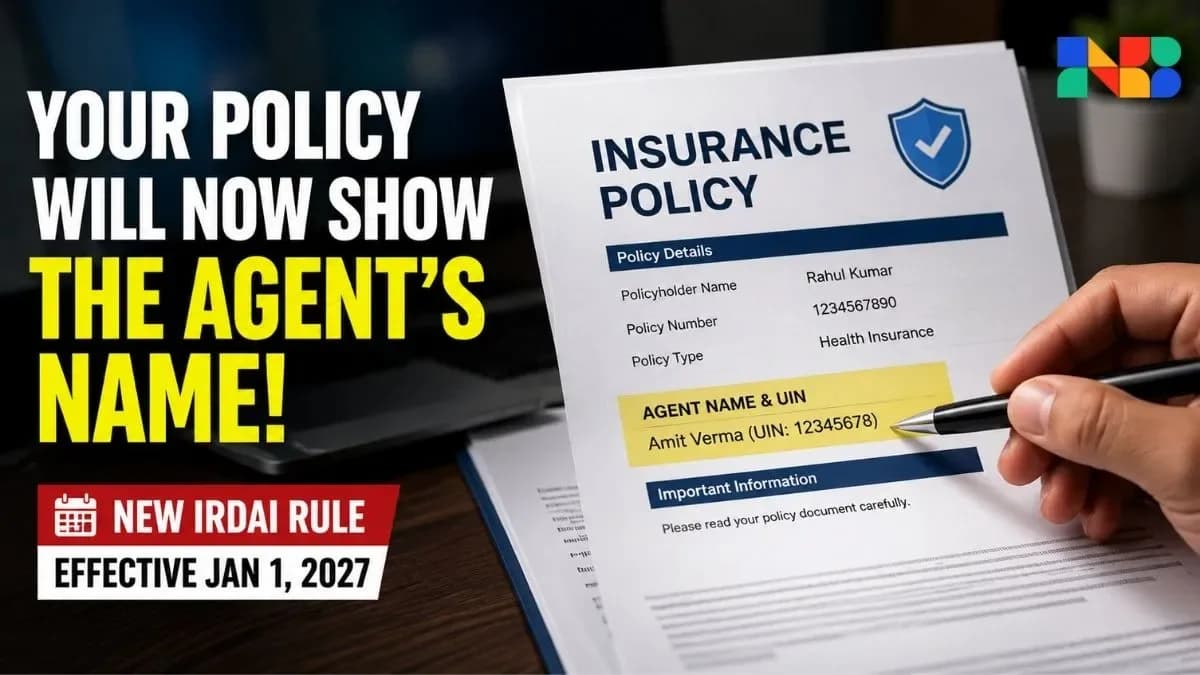
To solve this, the Insurance Regulatory and Development Authority of India (IRDAI) has introduced a landmark reform. Under the newly notified IRDAI insurance intermediary regulations 2026, a major change is coming to your policy documents.
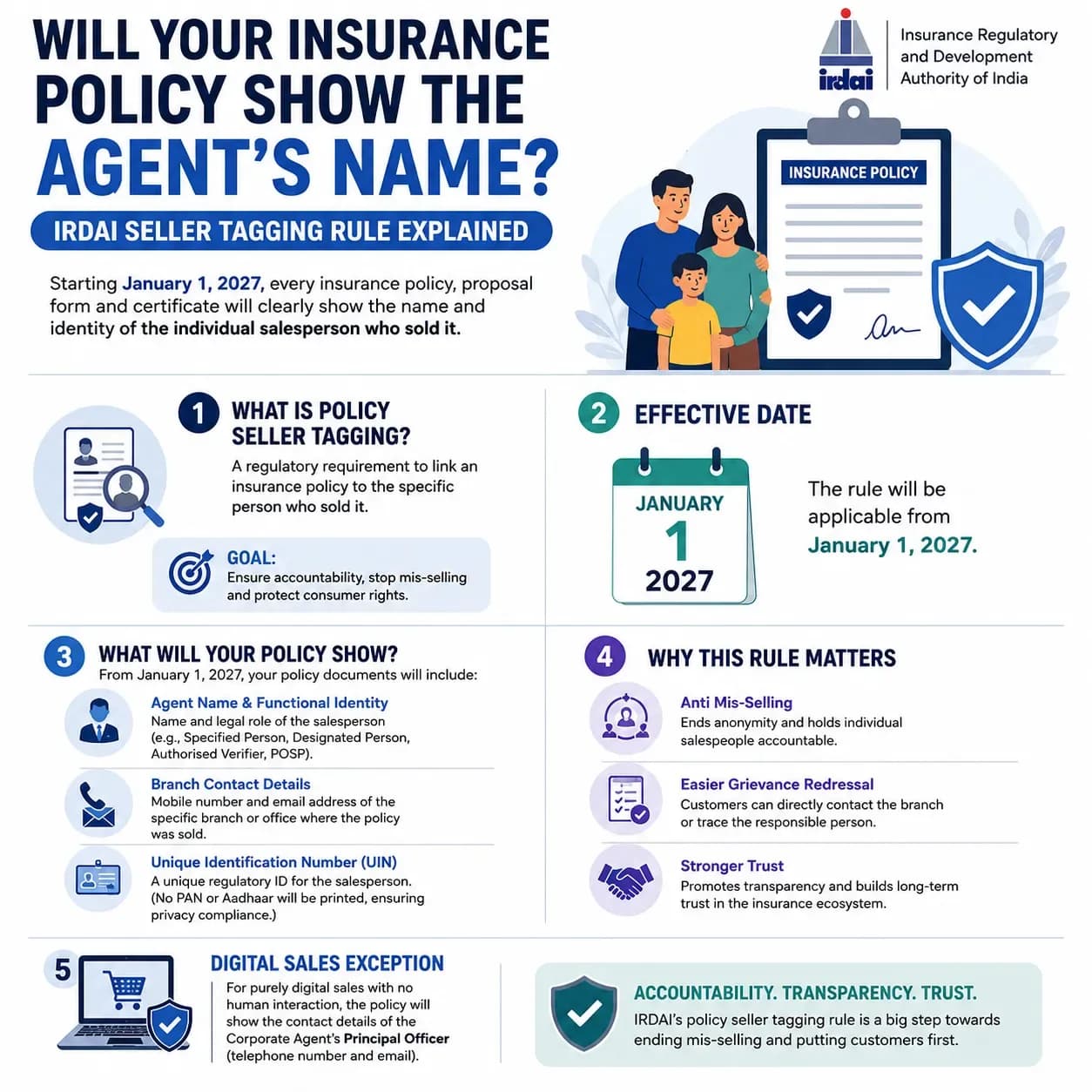
So, will insurance policy show agent name? The short answer is yes. Starting January 1, 2027, every insurance policy, proposal form, and certificate will explicitly state the name and identity of the individual salesperson who solicited and closed the sale. This deep-dive article provides the IRDAI policy seller tagging explained in full detail, uncovering how it works, why it matters, and what it means for accountability in the financial sector.
What is Policy Seller Tagging in Insurance?
To grasp the insurance seller tagging meaning, it helps to look at the traditional insurance sales model. Historically, when you bought an insurance policy from a massive corporate entity—like a bank acting as a corporate agent—your policy document would only bear the name or agency code of the bank itself. The actual Relationship Manager (RM) or bank employee who pitched the product remained completely anonymous on paper. This created a massive accountability gap.
In simple terms, what is policy seller tagging in insurance? It is the regulatory requirement to link an individual insurance policy directly to the specific human being who sold it. The "seller tag" acts as a permanent digital and paper footprint. It ensures that the exact authorized person—whether an individual broker, a corporate agent employee, or a Point of Sales Person (POSP)—is forever attached to the lifecycle of that specific policy.
The Core Problem: Why the IRDAI Mis-Selling Seller Identification Rule Was Needed
Mis-selling has plagued the Indian insurance sector for decades, severely damaging trust in financial products. Common patterns of mis-selling include pitching a Unit Linked Insurance Plan (ULIP) by disguising it as a high-interest Fixed Deposit, bundling unnecessary and expensive riders with standard term plans, or failing to disclose crucial waiting periods in health insurance.
Prior to this rule, identifying the culprit was incredibly difficult. If a customer filed a grievance, the bank or corporate agent could simply claim that the employee had resigned, or they could deflect the blame due to a lack of written evidence tying a specific employee to the transaction. The IRDAI mis-selling seller identification rule was born out of absolute necessity. IRDAI recognized that tackling mis-selling requires holding individual salespeople accountable, not just fining the intermediary firms. By creating a system where every policy can be traced back to the point-of-sale, the regulator aims to eliminate the anonymity that allows aggressive, unethical sales tactics to thrive.
How Will Policy Seller Tagging Work?
The new rules are meticulously structured to protect the consumer while respecting data privacy. Here is exactly how will policy seller tagging work once it goes live:
Mandatory Name and Functional Identity
From January 1, 2027, your proposal form, policy bond, and certificate of insurance must visibly record the name and the "functional identity" of the salesperson. This functional identity clarifies their exact legal capacity under IRDAI guidelines, such as Specified Person, Designated Person, Authorised Verifier, or Point of Sales Person (POSP).
Branch Contact Details
The documents will not only show the agent's name but must also include the mobile number and email address of the specific branch or office through which the policy was sold. This vital addition stops the endless, frustrating loop of calling generic toll-free customer care numbers only to be told that the head office has no record of the local branch's verbal promises.
Unique Identification Number (UIN)
To balance consumer rights with the privacy of the agents—keeping in compliance with the Digital Personal Data Protection Act—the IRDAI accepted industry feedback to avoid printing the agent’s PAN or Aadhaar card details on the policy. Instead, the person responsible for the solicitation will be assigned a Unique Identification Number (UIN). This UIN will act as their permanent regulatory identifier, making it impossible for them to hide behind a generic corporate umbrella.
Direct Digital Sales Exception
What if you buy a policy directly online from a corporate agent’s digital platform with absolutely zero human intervention?
In such purely digital transactions, the policy document must disclose the telephone number and email address of the corporate agent’s Principal Officer. This ensures that even algorithm-driven or self-directed sales have a designated human authority taking responsibility for the platform's compliance.
Remote Database Access for IRDAI
Corporate agents are now legally required to maintain policy-wise sales records in a structured format. More importantly, IRDAI must be able to access this database remotely. This allows the regulator to instantly pull up the track record of any agent suspected of serial mis-selling across multiple clients or even across different insurance companies.
Can I See Who Sold My Insurance Policy Right Now?
If you are looking at a policy purchased prior to the 2027 mandate, you might naturally wonder, can I see who sold my insurance policy? Currently, the answer is usually no—at least not easily. You will likely only see an agency code or the name of the bank or broker on the first page.
To trace the specific individual, you would have to formally write to the insurance company's grievance department or the bank's nodal officer, asking them to trace the internal employee ID mapped to your policy number. It is a tedious process that often yields vague answers. However, for all policies issued after January 1, 2027, the ambiguity vanishes. You will be able to see exactly who sold you the policy simply by glancing at the first page of your policy bond or your initial proposal form.
What Happens if an Insurance Agent Mis-Sells a Policy?
With the new seller tagging mechanism firmly in place, what happens if insurance agent mis-sells a policy? The consequences are now much more direct, traceable, and severe for the individual involved.
The Consumer's Action Plan
If you realize you have been mis-sold a policy—for instance, the promised returns do not match the printed benefit illustration, or your medical history was intentionally omitted by the agent—you now have a clear path to resolution:
- Invoke the Free-Look Period: If you discover the mis-selling within 15 days (or 30 days for electronic policies) of receiving the policy bond, you can cancel it under the free-look provision for a near-full refund.
- Lodge a Specific Complaint: Because the agent's name and UIN are clearly printed on the policy, you can make a highly specific complaint to the insurer's Grievance Redressal Officer. Instead of vaguely stating, "Your bank misled me," you can explicitly state, "Agent [Name], UIN [Number] at Branch [Location] misrepresented the product terms."
- Escalate to Bima Bharosa: If the insurer does not resolve the issue satisfactorily within 15 days, you can escalate the complaint to IRDAI’s Bima Bharosa portal, citing the specific agent's UIN.
- Approach the Insurance Ombudsman: For claims and disputes up to ₹50 lakh, you can approach the Insurance Ombudsman, whose rulings are legally binding on the insurance company.
Insurance Agent Accountability Under New IRDAI Rules
Previously, the corporate agent or bank might have absorbed a minor slap on the wrist or paid a collective fine. Now, insurance agent accountability under new IRDAI rules means the mis-selling complaint is permanently logged against the individual’s UIN.
A pattern of complaints will immediately flag the individual in IRDAI's central database. Furthermore, IRDAI is moving toward linking distributor incentives to the quality of sales rather than just sheer volume. Agents with high mis-selling flags, persistent customer complaints, or early policy surrenders attached to their UIN may face reduced commissions, immediate suspension of their license, or permanent blacklisting from the financial sector.
The Broader Picture: IRDAI Insurance Intermediary Regulations 2026
The seller tagging rule was passed alongside a suite of other pivotal reforms during IRDAI's 137th authority meeting. To understand the full landscape of how the regulator is cleaning up the market, two other interconnected changes are vital:
- Perpetual Registration for Intermediaries: To reduce administrative red tape, IRDAI has moved intermediaries away from the traditional three-year renewal cycle. Once registered, an intermediary's license remains valid indefinitely, provided they pay annual fees and maintain strict compliance. This shift relies heavily on data—by removing the friction of constant renewals, IRDAI expects brokerages and corporate agents to invest heavily in internal governance, rigorous staff training, and proper sales practices.
- Policyholders' Education and Protection Fund (PEPF): Operationalized under the Sabka Bima Sabki Raksha Act, this dedicated fund will proactively promote insurance literacy across rural and urban India. It is designed to strengthen grievance redressal mechanisms and help trace unclaimed insurance money, ensuring it is returned to the rightful beneficiaries.

The implementation of the seller tagging rule represents one of the most consumer-centric reforms introduced in the Indian financial sector this decade. By forcing accountability down to the individual level, the regulator is ensuring that the days of anonymous, aggressive, and misleading sales pitches are coming to a definitive end. Banks and insurance intermediaries will now be forced to train their staff to prioritize customer needs, as the regulatory spotlight will shine directly on the individual executing the sale. For policyholders, this translates to unprecedented transparency, much faster dispute resolution, and a significantly safer environment for securing their financial future.