

Arijit Chatterjee has joined Fino Payments Bank as Senior Vice President and Head of Credit Risk, bringing more than 20 years of banking and lending experience as the bank prepares to move from a payments bank to a small finance bank. His appointment comes after the Reserve Bank of India (RBI) granted Fino in-principle approval for the conversion on December 5, 2025.
The appointment matters because Fino is preparing to enter a business that its current payments bank licence does not permit: lending from its own balance sheet. Its latest investor presentation also shows how loan referrals, deposits and customer accounts are expanding while the bank develops its systems for the proposed change.
Fino Payments Bank appoints Arijit Chatterjee
Fino Payments Bank has announced the appointment of Arijit Chatterjee as its Head of Credit Risk Management. In its official LinkedIn announcement, the bank identified his experience in credit policy, underwriting and risk management as areas relevant to its plans. The announcement follows preparations for the institution's transition to a small finance bank.
Chatterjee's immediate institutional context is different from that of an executive joining an established lending bank. Fino already provides deposit, payment and transaction services, but its proposed move to a small finance bank would require it to build and manage a direct lending business.
Under a lending model, the bank must assess borrowers, determine repayment capacity, set credit limits, monitor overdue loans and account for expected losses. These responsibilities make credit risk management part of the bank's preparation for conversion.
The appointment announcement does not disclose his compensation, reporting relationship or specific performance targets. It also does not confirm a date on which Fino will begin lending under a small finance bank licence.
Source: Fino Payments Bank's official LinkedIn updates
Who is Arijit Chatterjee? His banking career and previous roles
Before joining Fino Payments Bank, Chatterjee was Head of Credit Policy for Retail, Rural and SME segments at DCB Bank, according to a career profile published by HR Today.
He previously spent more than seven years with ICICI Bank, holding roles that included Policy Head for Non-Home Mortgage Loans, Team Lead for Retail Policy and Zonal Credit Manager for Mortgages.
His earlier career includes positions at Axis Bank, ING Vysya Bank, HDB Financial Services, Fullerton India Credit Company, Cholamandalam DBS Finance and Citifinancial Consumer Finance India.
These roles span different types of lending and borrower profiles.
| Organisation | Reported responsibility or experience |
|---|---|
| DCB Bank | Credit policy for retail, rural and SME lending |
| ICICI Bank | Mortgage credit, non-home mortgage policy and retail credit policy |
| Axis Bank | Credit management for emerging enterprises |
| ING Vysya Bank | Unsecured loan credit management |
| HDB Financial Services | Credit functions |
| Fullerton India Credit Company | Lending and credit functions |
| Cholamandalam DBS Finance | Credit operations |
| Citifinancial Consumer Finance India | Consumer finance and credit operations |
The relevance of this career history becomes clearer when viewed against Fino's plans. Retail loans, small-business lending, rural credit and mortgages have different repayment patterns and require different approaches to assessing borrowers.
Also Read | Bank Credit in India: Who Is Borrowing the ₹219.6 Lakh Crore?
What RBI's approval means for Fino Payments Bank
On December 5, 2025, the RBI granted Fino Payments Bank in-principle approval to convert into a small finance bank.
The approval followed RBI guidelines issued in December 2019, which allow eligible payments banks to apply for conversion after completing five years of operations.
The distinction between approval to prepare for conversion and permission to operate as a small finance bank matters.
An in-principle approval allows the applicant to take steps towards meeting licensing requirements. It does not automatically permit the bank to begin offering loans under its proposed new licence.
Payments bank vs small finance bank: What changes?
| Banking activity | Payments bank | Small finance bank |
|---|---|---|
| Savings accounts | Allowed | Allowed |
| Payment and money transfer services | Allowed | Allowed |
| Direct lending from its own balance sheet | Not permitted | Permitted, subject to RBI rules |
| Loan referrals to partner lenders | Permitted under applicable arrangements | Can continue, subject to applicable rules |
| Credit risk from its own loans | No direct loan portfolio under the payments bank licence | Must assess and manage borrower defaults |
| Priority sector lending obligations | Not a direct lending requirement under its current model | Applicable under RBI rules |
| Credit underwriting systems | Relevant for loan referral arrangements and preparation | Required for direct lending decisions |
| Loan-loss provisioning | No provisions for a direct customer loan book under the current licence | Required under applicable asset classification and provisioning rules |
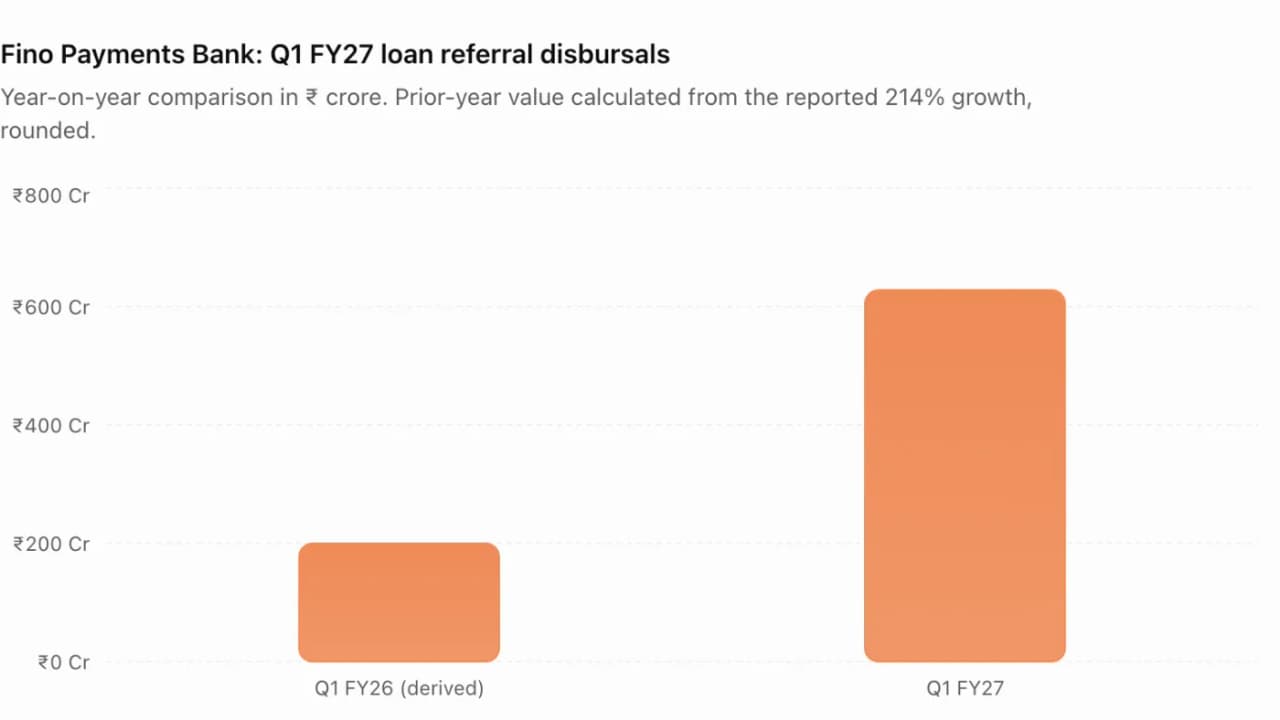
Fino Payments Bank: Q1 FY27 loan referral disbursals
Year-on-year comparison in ₹ crore. Prior-year value calculated from the reported 214% growth, rounded.
Deposit growth and profitability present two different pictures
Average deposits increased 12% to ₹2,772 crore, while digitally active customers rose to 64.6 lakh.
At the same time, the bank reported a ₹13.7 crore loss for Q1 FY27. Its EBITDA declined 30% year-on-year to ₹43.1 crore, despite improvement in the net revenue margin.
The deposit and customer figures indicate the size of the existing business that Fino could potentially serve with more banking products. The quarterly loss, however, shows why expenses, technology investment and earnings remain relevant as it prepares to enter lending.
A growing deposit base does not automatically translate into profitable lending. Loan pricing, collection costs, operating expenses and defaults will determine the economics of a future loan portfolio.
Also Read | Conrad D’Souza Joins Capital Small Finance Bank Board
Why credit risk management matters for Fino's next phase
The appointment draws attention to four questions that will determine how Fino enters lending.
- First, which customers will qualify for credit? - A large customer base does not mean every account holder is eligible for a loan. Account activity can support an assessment, but a lender must also consider income, existing debt, repayment ability and information from permitted sources.
- Second, which types of loans will the bank offer? - A small business loan, personal loan and mortgage involve different levels of risk. Credit policy determines what documents a borrower must provide, how much can be borrowed and the conditions under which a loan may be rejected.
- Third, how will repayment problems be identified? - Banks monitor missed instalments, changing repayment behaviour and overdue accounts. The quality of these processes affects collections and the amount of money a bank may need to set aside for possible losses.
- Fourth, how much risk can the bank take? - A lender must consider how its loans are distributed across regions, industries and customer groups. Excessive exposure to one segment can lead to losses if economic conditions worsen for that group.
Chatterjee's prior experience across retail, rural and SME credit is relevant to these questions. Whether this experience translates into lower credit losses or better loan performance at Fino can only be assessed after the bank begins lending and publishes portfolio data.
What happens next? Five developments to monitor
The bank's future disclosures should help answer the following questions:
- Final RBI authorisation: When will Fino receive permission to operate as a small finance bank, and what conditions will apply?
- Loan product announcement: Will the bank prioritise small-business, retail, secured or other eligible loan products?
- Operational readiness: When will Fino confirm that its loan origination, loan servicing, monitoring and reporting systems are ready?
- Credit portfolio disclosures: Once lending begins, what will the bank report on loan growth, overdue accounts, provisions and sector concentration?
- Financial performance: How will the costs of the conversion and any new lending operations affect revenue, expenses and profitability?
The next scheduled financial disclosure after the June quarter would normally cover the quarter ended September 30, 2026. The precise announcement date should be checked against Fino's stock exchange filings rather than assumed.
Also Read | AI in Indian Banking: Growth, Risks and Regulations
News4Bharat POV
The appointment of Arijit Chatterjee comes at a point where Fino must prepare for a different type of banking risk.
Its reported ₹628 crore in quarterly loan referral disbursals demonstrates the volume of lending facilitated through its partner arrangements. But it does not measure how well Fino would manage loans held directly on its own balance sheet.
That will require a different set of public indicators, including overdue loans, non-performing assets, credit costs and concentration of lending across customer groups.
Fino enters this preparation with 1.83 crore CASA accounts and average deposits of ₹2,772 crore in Q1 FY27. These figures establish the scale of its deposit operations, but they cannot predict the performance of a future loan book.
For Chatterjee, credit policy will be important in deciding which borrowers the bank can serve without taking on repayment risks that exceed its financial capacity.
Methodology note: The appointment is supported by the bank's own announcement. Career history beyond the bank's confirmation of more than 20 years of experience is attributed to third-party reporting. Financial figures are from Fino's corporate disclosures, with derived calculations identified. News4Bharat's analysis is based on the distinction between the bank's current payments model and the proposed lending model. No interview with Chatterjee has been conducted or implied.