

More than half of consumers now trust AI less than humans with their personal data. Yet people continue to upload resumes, medical reports, financial documents and workplace information to AI chatbots. A user uploads a resume to an AI chatbot to get it rewritten. Another pastes medical reports and asks for a simple explanation. Someone shares a bank statement and asks the AI to sum up monthly expenses. It feels harmless. Like handing a form to a helpful assistant.
But once you hit send, where does that information go? Who sees it? Does it come back later, buried in someone else's answer?
To answer that honestly, we need to separate two ideas people mix up. One is personal data. The other is AI privacy. They sound the same. They are not.
AI Privacy vs Personal Data: The Difference Most People Miss
Here is the simplest way to think about it. Personal data is the information itself. AI privacy is what happens to that information once it leaves your hands. Until you have checked a platform’s retention, training and privacy settings, it is safer to treat every AI prompt like a postcard rather than a private diary.
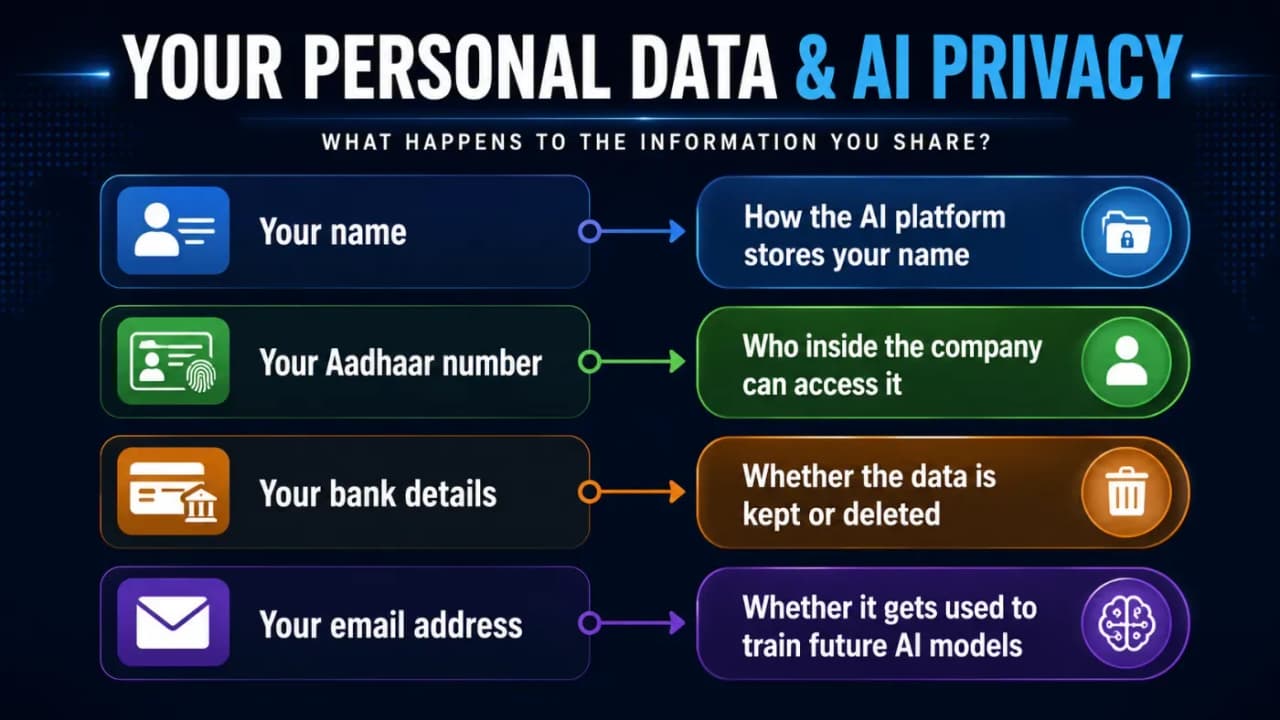
So personal data is what belongs to you. AI privacy is how a company handles it once you hand it over. That includes who gets to see it, how long it sits on a server, and whether it quietly becomes part of a model that answers questions for someone else entirely.
Most people only think about what they are sharing. Very few think about where it goes next. That journey, not the message itself, is where the real risk sits.
Also Read | AI Credit Scoring in India: How Loan Algorithms Works
The Journey of One AI Prompt
Here is what usually happens after you type a message and press send.
Your prompt leaves your device. It reaches the AI company's platform, then moves to cloud servers, which could sit anywhere in the world. The model reads your text and writes a reply. Before that reply reaches you, safety filters often scan it for harmful content. Many platforms also log the chat, for quality checks and abuse monitoring. The data may then sit in temporary storage for days or weeks. After that, depending on the company's rules, it gets deleted. Or it stays longer, sometimes to help train future versions of the model.
That is a long trip for one short message. And like a postcard, once it is out of your hands, you have little say in who reads it next.
The Hidden AI Data Economy
Your information does not just sit quietly on a server. It has become a business asset.
AI companies use your conversations to improve their products. Cloud providers host and process that data. Software firms build customer insights on top of it. Data labelling companies use it to train new models. Cybersecurity firms sell tools to protect or audit all of it.
This is simply how modern AI businesses grow. Personalised assistants, smarter customer service bots, and workplace copilots all run on this same pipeline. The catch is simple too. The more valuable your data becomes, the more hands want a piece of it. And more hands means more ways for it to leak.
Also Read | India's Sovereign AI Ambition Has A Hidden Weak Link, And It Is Not The Models
Where Privacy Risks Begin
Risk does not come from one place. It builds up in stages. Apps often collect more than the task needs. That is stage one. Chats get stored longer than users expect. That is stage two. Then comes a harder question: can something you typed months ago quietly shape how the model answers someone else today? Add third party plug-ins and connected apps, and each one becomes a fresh doorway in. Add rising cyberattacks, and AI databases full of private chats start to look like gold to hackers.
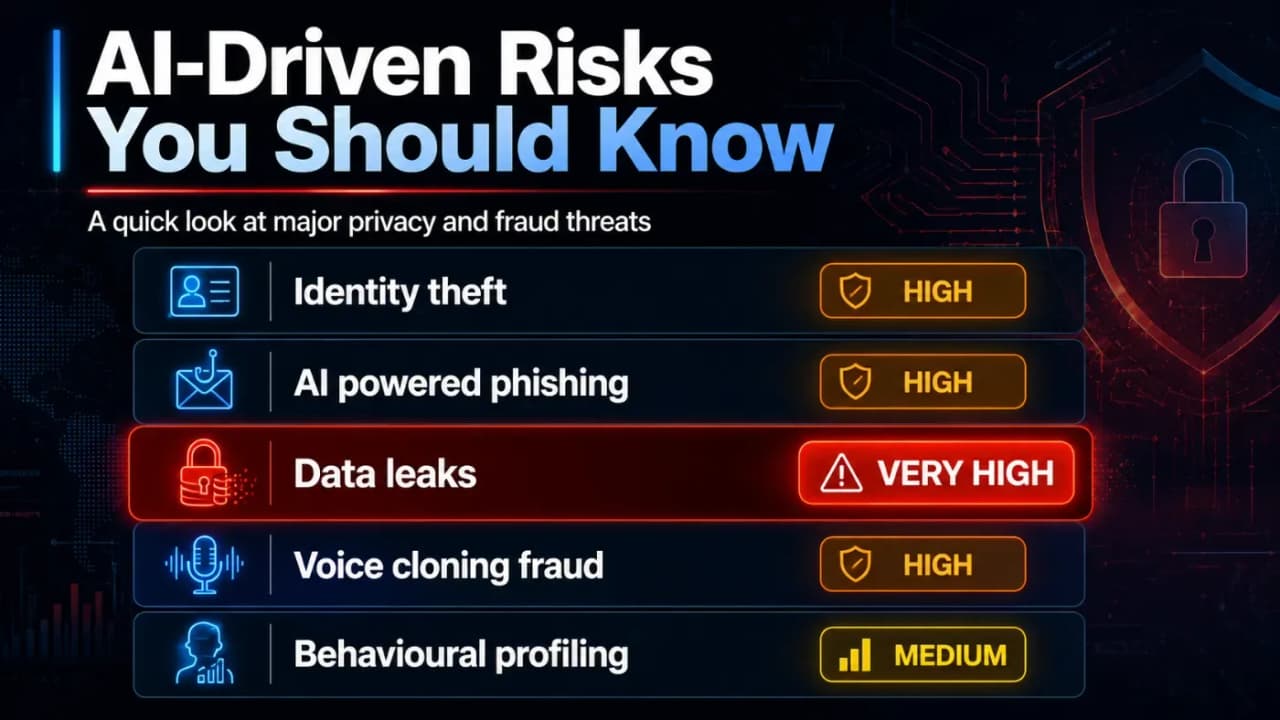
The numbers back this up. IBM's 2025 Cost of a Data Breach Report found that one in six breaches now involves attackers using AI themselves, mostly to write convincing phishing emails or fake voices and videos.
Almost all AI related breaches, 97 %, happened at companies with no real access controls in place.
Also Read | India's Data Centre Boom: Why States Are Competing for Digital Infrastructure
Is Regulation Keeping Up
Governments are racing to catch up. Every region is moving at its own pace. India notified its Digital Personal Data Protection Rules in November 2025. The Data Protection Board is already set up. Consent Managers, tools that let you control and withdraw consent across apps from one place, arrive around November 2026. Full enforcement, with fines up to 250 crore rupees per violation, starts in May 2027. Right now, only about 16 % of Indian consumers understand this law. Most businesses have not started preparing.
In the European Union, the AI Act's transparency rules kick in from August 2026. A recent deal has pushed back some deadlines for riskier AI systems, giving companies a bit more breathing room.
Here's the core problem regulators face. Old privacy laws were built for simple databases. AI does not behave like a database. It learns from millions of conversations at once, and that breaks the old rulebook. Consent, transparency, and accountability all need a rewrite for this new reality. Lawmakers are still working that out.
How Businesses Are Rethinking AI Privacy
Banks, hospitals, and schools no longer treat AI privacy as an afterthought. Many now build dedicated privacy teams. They collect less data by default. They encrypt what they keep. They write clear rules on what staff can type into an AI tool, and train people to follow them.
Samsung learned this the hard way. In March 2023, an engineer at its chip division hit a bug in some source code. Instead of asking a colleague, he pasted the code straight into ChatGPT and asked it to find the fix. Within twenty days, two more employees had done the same, one with test data, another with an entire meeting transcript.
Three leaks. Twenty days. Samsung banned generative AI on company devices soon after and built its own private AI system instead. Three years on, this is not a one-off story. IBM's 2025 report found that 63 % of breached companies still have no formal AI policy at all. Even large, well funded firms are still catching up.
Also Read | How AI in Automotive Industry Is Making Vehicles Safer, Smarter, & More Efficient
The Missing Half of the Story
Most coverage of AI privacy stops at "don't share your Aadhaar number." Three things deserve more attention than they get.
First, protection pays for itself. Companies that use AI security tools heavily save close to 1.9 million dollars per breach, compared to those that don't, per IBM's 2025 data. Privacy and AI adoption are not enemies. Done right, they work together.

Second, India's law is often reported as if it's already fully live. It isn't. It's a three phase rollout, and the real penalties don't bite until May 2027. That gap is a head start, not a deadline to ignore.
Third, trust has stopped being just an opinion. It has become an action. Usercentrics found that 47 % of consumers have already cancelled a subscription, switched providers, or cut their spending because of how a company handled their data with AI. That is not a survey footnote anymore. That is lost revenue.
Before you paste anything into an AI tool, take five seconds to ask: would I be comfortable if this ended up on a postcard, read by a stranger along the way? If the answer is no, don't send it.
What Comes Next
The next phase of AI is being built around privacy, not just power. A few ideas are leading the way. Federated learning lets AI learn from your device without your data ever leaving it. Synthetic data trains models on fake, computer-generated examples instead of real personal records. Confidential computing keeps data locked and encrypted even while it's being used. Consent dashboards and personal AI vaults give people one place to see what an AI system knows about them, and to switch that access off.
None of this removes every risk. But it marks a shift. AI companies are moving from simply asking for trust to having to prove they deserve it.
How to Use AI Without Exposing Sensitive Data
- Remove names, phone numbers, addresses and identification numbers.
- Redact account numbers and medical identifiers before uploading files.
- Do not paste passwords, OTPs, private keys or card details.
- Avoid uploading confidential source code or internal company documents.
- Check whether model training is enabled.
- Use temporary or private-chat settings where available.
- Review the provider’s retention and deletion policy.
- Use enterprise-approved AI tools for workplace information.
- Delete chats and uploaded files when they are no longer required.
News4Bharat POV
The danger isn't AI. It's the habit of not thinking twice.
The tools are not going away, and honestly, they shouldn't. They save time, simplify hard documents, and help people who have no one else to ask. The problem is not that AI exists. The problem is that most people treat it like a private diary when it behaves more like a postcard, read and handled by more hands than they realise.
News4Bharat take is simple. Use AI. Just use it the way you would use a new bank branch you have never visited before. Ask what it keeps, ask for how long, and never hand over anything you would not want a stranger to read on the way.
India's privacy law will eventually catch up with enforcement teeth by 2027. Until then, the safest filter is not the government. It is you, pausing for five seconds before you hit send.
That is the real story behind AI privacy in 2026. Not a scary headline. Just a habit worth building, one prompt at a time.