

Key Highlights
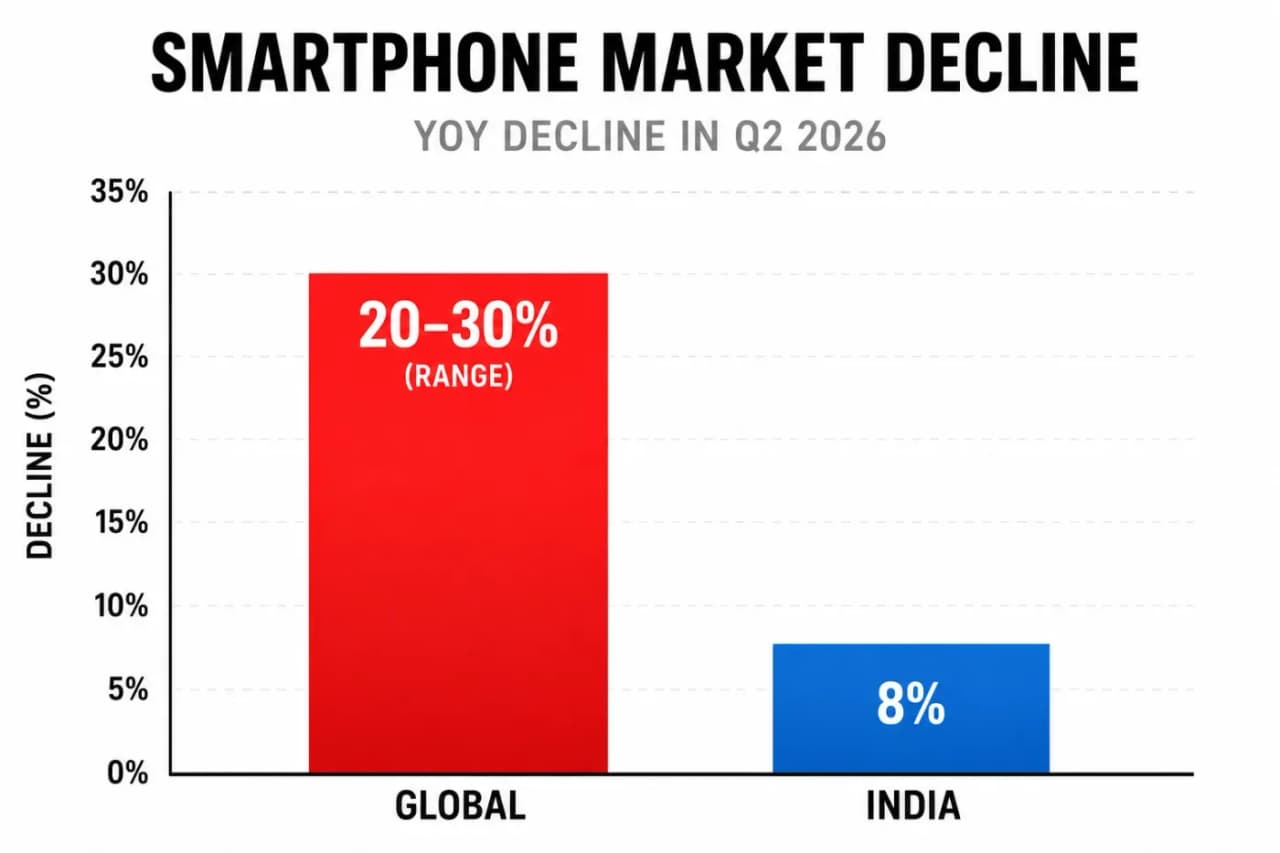
- India's foldable phone market is projected to grow around 8% year on year in 2026, while the global foldable market is projected to grow between 20% and 30% in the same year.
- Apple's first foldable iPhone is widely expected to launch globally around September 2026, at a starting price near $1,999 or higher.
- Asia Pacific, led by China, holds an estimated 55.2% share of the global foldable smartphone market in 2026.
- China accounts for roughly 70% of global foldable phone production, with Vietnam and India serving mainly as export focused manufacturing hubs.
- India's foldable shipments will cross 3 million cumulative units by the end of 2026, a small fraction of the worldwide total of over 20 million units expected in the same period.
India Foldable Phone Market Growth
India manufactures millions of smartphones for the world and proudly calls itself one of the fastest-growing mobile markets. Yet when it comes to foldable phones, India is quietly falling behind. While the global foldable market is expected to grow 20–30% in 2026, India's growth is projected at just around 8%. And ironically, Apple's biggest foldable launch yet may widen that gap instead of closing it.
Also Read | iPhone 18 Prices May Rise as Trump Confirms Apple-Intel Chip Deal in US
Foldables by the Numbers
- Global market growth (2026): 20–30%
- India growth: ~8%
- Apple's expected foldable price: $1,999+
- India's cumulative foldable shipments: 3 million
- Global shipments: 20+ million
- China's production share: ~70%
- Asia-Pacific market share: 55.2%
Why the global number looks so different
The International Data Corporation has forecast strong growth for worldwide foldable smartphone shipments through 2026. Foldables are expected to represent over 10 % of total smartphone market value by 2029. A large part of that acceleration is tied directly to Apple's rumoured entry into the category.
Apple's first foldable iPhone is widely expected to be branded either iPhone Fold or iPhone Ultra.
It is tipped to launch alongside the iPhone 18 Pro lineup around September 2026. Reports from Bloomberg's Mark Gurman and multiple supply chain analysts point to a starting price around 1,999 dollars for the base storage option. Higher storage variants could cross 2,300 dollars or more. Some leakers have suggested Apple may even price the device 10 % to 20 % higher than earlier expectations once final costs are locked in.
Even at that steep price, Apple entering the foldable category is expected to expand the entire market's visibility and credibility. A first time foldable buyer who was on the fence is far more likely to consider the category once a brand as widely trusted as Apple offers its own version. That halo effect on the wider market is a big part of why analysts expect global growth to be two to three times faster than India's growth rate this year.
Also Read | iPhone 16e Is Now Under ₹48,000 in India. Its Successor Is Here, and the Math Finally Makes Sense.
Why India is not keeping pace
India's slower growth comes down to a mix of price sensitivity and limited brand choice. The average selling price of a foldable phone in India sits close to 1,800 dollars. That is nearly five times the average price of a regular smartphone sold in the country. This gap is far wider in India than in developed markets, where the price difference between a flagship phone and a foldable is comparatively smaller.
Why India Is Growing More Slowly
- Foldables remain far more expensive than mainstream smartphones.
- Limited competition compared with China.
- Premium pricing reduces adoption.
- Export-focused manufacturing doesn't translate into lower domestic prices.
- Overall smartphone demand has weakened.

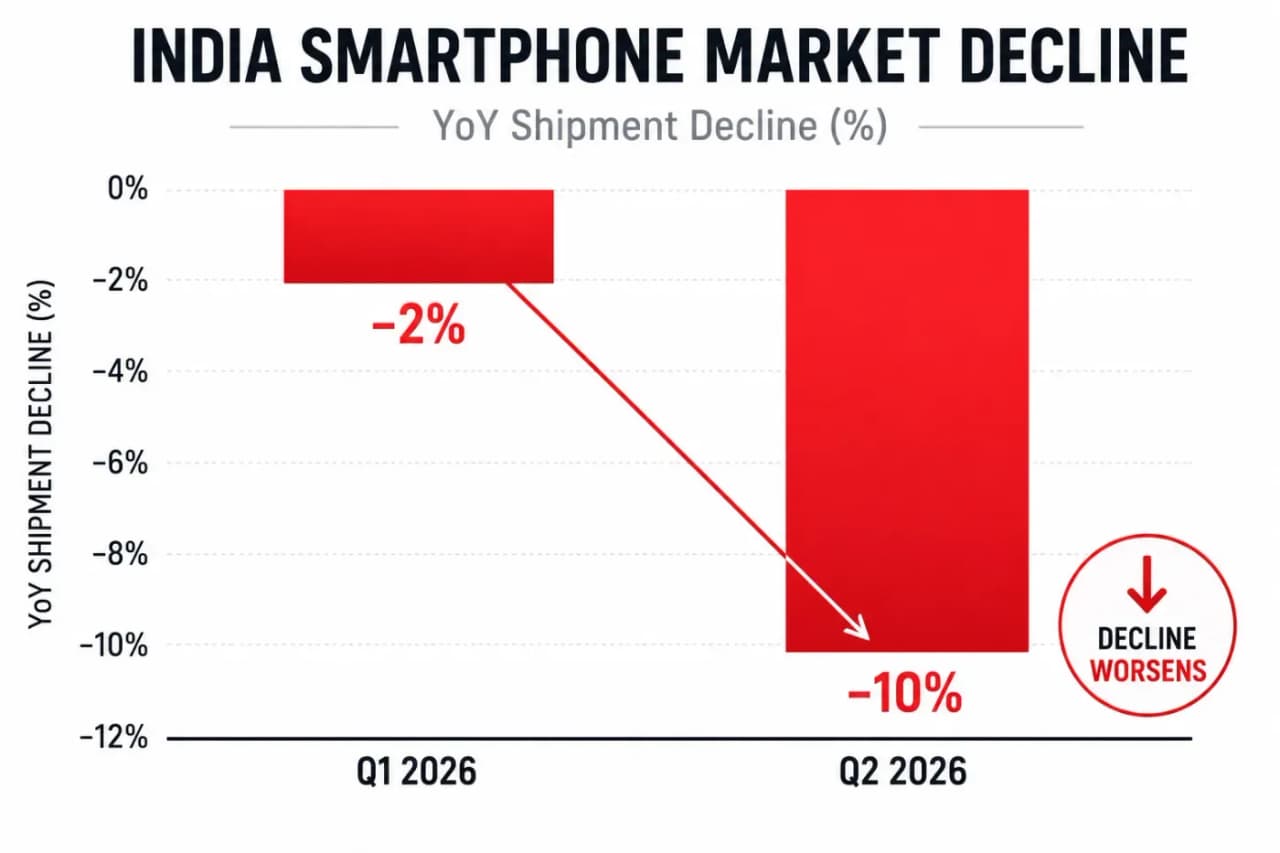
India's own smartphone market has not helped the cause this year either. Shipments fell 2 % year on year in the first quarter of 2026, according to IDC.
They fell a sharper 10 % year on year in the second quarter, the steepest June quarter decline in six years, according to Counterpoint Research. Both firms point to the same cause, a global surge in DRAM and NAND memory prices that pushed device costs up across nearly every price band.
A weaker overall smartphone market makes it harder for a premium category like foldables to accelerate, even though it has technically kept growing in absolute terms.
Here is the twist. Apple's arrival may not help India as much as it helps everyone else.
Apple has a long history of pricing its most premium devices higher in India than in the US, once import duties, GST, and margins are added in. If the foldable iPhone launches globally near 2,000 dollars, past pricing patterns suggest the Indian price could land well above that. It could even land higher than Samsung's most expensive foldable currently sold in the country. That would make Apple's launch a much weaker growth driver for India than for the rest of the world.
Picture two buyers on launch day. One is in the US, weighing a 1,999 dollar foldable iPhone against other flagship phones already close to that price. The decision, while still a stretch, feels within reach. The other buyer is in India, looking at a price that could sit well above what most people spend on a car down payment once local taxes and duties are added. For one buyer, Apple's entry is an invitation. For the other, it is a headline they will read and then scroll past.
Here is the part almost nobody has connected. India is becoming a major export hub for building foldable phones. That manufacturing boom has not made the phones any cheaper or more available for Indian buyers. The devices rolling off Indian production lines are mostly headed overseas. Indian consumers keep paying some of the highest relative prices for foldables anywhere in the world.
India builds the phones. The world buys them. India, largely, does not.
This is the kind of disconnect that rarely makes headlines. It does not fit neatly into either the India is booming narrative or the India is falling behind narrative. It is both, at the same time, in two different parts of the same industry.
Also Read | Apple Releases iOS 26.4: Focuses on Fixes Over Flash—What These Latest Update Actually Changes
What This Means for Indian Buyers
If you are waiting for foldables to become genuinely affordable in India, this year's numbers suggest patience is still required. Prices are not dropping because of local manufacturing. That manufacturing is aimed at export markets, not the domestic shelf. Apple's entry is driving prices down and interest up globally. It may do far less of that locally once India specific pricing kicks in.
The realistic path to cheaper foldables in India likely runs through local and Chinese brands competing harder on price. It does not run through Apple or Samsung's premium models becoming more accessible. That shift, if it happens, is more likely to show up in 2027 or later than in the current growth cycle.
What This Means for the Industry
For manufacturers and retailers watching this space, the message is equally clear. Chasing India as a high margin foldable market this year is a harder sell than chasing it as a volume story next to markets like China, the US, or Western Europe. The 3 million cumulative units matter as proof of concept. They prove Indian buyers will pay for foldables. They do not yet prove India is close to global pace.
The Bottom Line
India's foldable market will probably still end 2026 in positive territory. Positive is not the same as competitive.
The world is about to get a major push from Apple. India, because of its own pricing history and manufacturing role, may barely feel it. That is not a success story slowing down. It is a market that was never quite catching up to begin with.
The next real test comes once Apple's foldable iPhone actually launches and India specific pricing becomes public. Until then, every milestone headline about India's foldable market deserves one more question attached to it. Compared to what?
Also Read | Samsung's Flex Titanium Technology: Will It Finally Solve the Biggest Problem With Foldable Phones?
News4Bharat POV
Three million units sounds like a win until you put it next to the rest of the world's 20 million plus. Then it starts to look like India quietly falling behind in a category it has not even fully entered yet.
The 8 % growth number is not a slowdown to worry about later. It is a ceiling built from three things stacked together. Pricing puts foldables out of reach for most Indian buyers. A manufacturing setup ships the newest phones out of the country instead of into local stores. A broader smartphone market is currently shrinking, not growing.
Apple's entry is being treated as a turning point in every other market. It may end up being the clearest proof of this gap rather than the fix for it. If Apple's foldable iPhone lands in India priced above Samsung's current flagship, which its pricing history suggests is likely, the Apple halo effect boosting foldables everywhere else could simply skip India over.