

The ultimate Apple AI desktop has officially arrived. Apple just rewrote the rules of personal computing. The company's highly anticipated M6 and M5 Ultra machines are now on sale globally. Retail availability officially began on September 22, 2026. These are not standard iterative upgrades. They represent a brutal, calculated strike against cloud computing monopolies.
Can a single personal computer replace an entire cloud server rack? Apple's new hardware suggests it can.
The company is no longer selling mere computers. They are selling dedicated local AI engines. You can now run massive neural models privately. You can execute complex coding agents directly on your desk. This effectively eliminates expensive cloud API subscriptions. Data privacy is guaranteed. Latency drops to zero.

The Price Tag: Staggering Specs, Staggering Costs
The updated desktop lineup splits into two distinct categories. First is the Mac mini. It targets mainstream creators, developers, and students. Second is the Mac Studio. It is engineered specifically for extreme enterprise AI workloads.
Retail pricing in India covers a massive spectrum. The entry costs remain somewhat accessible. However, full-spec professional units command serious corporate investment.
16GB Unified Memory
Up to 512GB Memory Ceiling
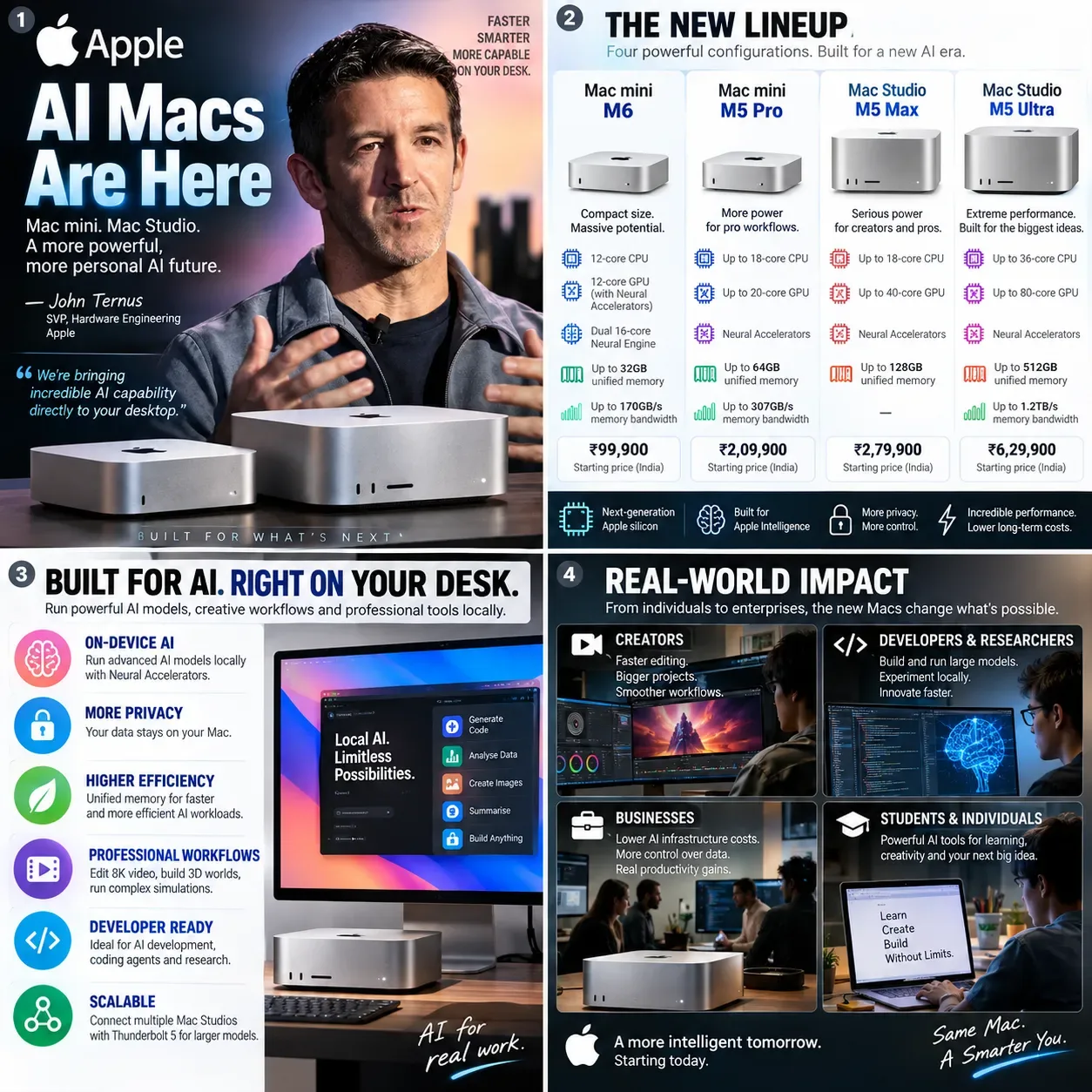
| Model | Processor Core Specs | India Starting Price | Max Unified Memory |
|---|---|---|---|
| Mac mini M6 | 12-core CPU / 12-core GPU | ₹99,900 | 32GB |
| Mac mini M5 Pro | Up to 18-core CPU / 20-core GPU | ₹2,09,900 | 64GB |
| Mac Studio M5 Max | Up to 18-core CPU / 40-core GPU | ₹2,79,900 | 128GB |
| Mac Studio M5 Ultra | Up to 36-core CPU / 80-core GPU | ₹6,29,900 | 512GB |
Data Note: The top-tier 512GB unified-memory configuration is scheduled to ship in late October 2026. Education pricing applies for verified institutions.
The M6 Breakthrough: Extreme 2-Nanometer Density
The Mac mini debuts Apple’s very first 2-nanometer architecture. This microscopic transistor scale is a massive engineering triumph. Smaller transistors equal superior power efficiency. They also unlock exponentially denser compute blocks.
Every Apple AI desktop in the entry lineup packs serious heat. What actually powers the base M6 chip?
- A powerful 12-core CPU.
- A robust 12-core GPU.
- Integrated dedicated Neural Accelerators.
- A completely revamped Dual 16-core Neural Engine.
- Fast unified memory throughput reaching 170GB/s.
Pattern Interrupt: Clock speeds do not dictate AI performance. Memory throughput dictates performance. Unified memory bandwidth controls how quickly data weights transfer into compute cores.
Apple's official press release details aggressive internal benchmarks. The performance leaps over the previous M4 base model are steep:
- Up to 40% faster CPU computation.
- Up to 2× faster graphical throughput.
- Up to 4× faster AI inference processing.
Note: These metrics represent Apple's internal testing conditions. Independent laboratory testing remains pending.
Mac Studio M5 Ultra: The 512GB Titan
The Mac Studio M5 Ultra destroys traditional computing boundaries. The machine features an astonishing 36-core CPU. Graphics are handled by an unprecedented 80-core GPU.
Yet, one specific metric dwarfs all others. It supports a staggering 512GB of unified memory.
Data moves across this massive memory pool at 1.2TB/s. That bandwidth surpasses nearly all high-end Windows workstations.
Crucial Insight: Traditional PCs physically split System RAM and Video RAM (VRAM). Apple Silicon merges them into one. The GPU and Neural Engine access the full 512GB pool instantly. There are no PCIe transfer bottlenecks.
This changes the engineering landscape completely. Developers no longer ask whether a desktop can load an LLM. They now ask: "Just how large can this model be?"
Does 512GB mean every massive model runs flawlessly? Absolutely not.
Execution speed depends on numerical precision. It depends on model quantization. Context length and software caching also heavily affect real-world output. However, the sheer physical headroom Apple now provides is unmatched on a standard office desk.
Thunderbolt 5 and The 1-Trillion Parameter Demo
Can multiple compact desktops collaborate to solve complex problems?
A report by Reuters detailed a landmark laboratory demonstration. Apple engineers clustered four distinct Mac Studio desktops together.
Working in parallel, this unified cluster ran a massive 1-trillion parameter AI model. The setup analyzed dense code and successfully patched a complex graphics engine bug.
How exactly did Apple connect them? They used Thunderbolt 5.
The Thunderbolt 5 interface supports blistering 120Gb/s data transfers. Crucially, Apple fully implemented Remote Direct Memory Access (RDMA). RDMA is an enterprise-grade protocol.
RDMA allows memory sharing between separate machines without CPU stalls. Data moves directly from one system's memory to another. Apple claims these clustered systems deliver up to 3× faster distributed inference.
Building an Apple AI desktop cluster now offers a viable alternative to heavy server racks.
The News4Bharat Perspective: Zero-Token Economics
What is Apple's underlying commercial playbook? They are directly attacking cloud economics.
Cloud AI runs on variable operational expenses (OpEx). Providers bill companies for every single token processed. High-volume inference quickly produces massive, recurring monthly invoices. The costs compound exponentially.
Apple introduces a compelling counterweight: The Zero-Token-Cost model.
Why Local AI Economics Make Financial Sense
- Data Sovereignty: Confidential proprietary code and medical data never touch public clouds.
- Zero Latency: Local execution eliminates network delays entirely. Autonomous coding agents run at raw machine speeds.
- Fixed CapEx: The hardware is purchased upfront. Ongoing inference costs reduce merely to basic electricity usage.
- Total Offline Independence: Complex models operate continuously without active internet connections.
For intermittent queries, cloud APIs remain much cheaper. But what about software shops running continuous autonomous agentic loops? The break-even point shifts rapidly toward owned desktop hardware.
The Enterprise Wall: Windows Still Dominates
Despite these massive hardware leaps, Apple faces a steep commercial hill. Raw hardware specs do not guarantee corporate adoption.
Enterprise IT remains deeply tied to legacy Microsoft ecosystems. Reuters cited precise IDC research highlighting a staggering corporate divide:
Most corporate networks rely exclusively on Active Directory. They depend on standard Windows device management. Migrating a workforce to macOS requires entirely new security audits. Developers must also rewrite deployment pipelines to support Apple's specific MLX framework.
Editorial Closing: The AI Desktop Era
Computing metrics have permanently shifted. Processor clock frequencies no longer tell the full story. Today, memory bandwidth and dedicated tensor acceleration dictate ultimate productivity.
With the Mac mini M6 and Mac Studio M5 Ultra, Apple has delivered serious on-device power. The hardware is incredibly fast, deeply private, and exceptionally power-efficient. The Apple AI desktop revolution is no longer a concept. It is sitting on a desk.
Will corporate IT managers dismantle their multi-million dollar cloud contracts tomorrow? Probably not immediately. But as open-source AI models shrink and desktop memory expands, Apple’s strategy looks exceptionally dangerous to the cloud establishment. Follow upcoming independent developer benchmarks for verified, real-world performance data.