

The Centre appointed five senior officers to the National Testing Agency on August 27 and 28, 2026, bringing IAS, IPS and IRS officers into Joint Secretary, Director and Joint Director posts as the government works on staffing, exam security and question-paper controls at the agency.
The five appointments were completed over two days. On August 27, the government selected Prasanna Venkatesh V and Ravi Kumar Singh as Directors and Amit Samdariya as Joint Director.
The next day, Anshuman Sharma was appointed Joint Secretary and Sathiya S was moved to the NTA as Director. This means the latest NTA staffing story is no longer limited to three officers. It now covers a five-member intake across three civil services.
According to separate orders issued by the Department of Personnel and Training (DoPT) on August 27, 2026, these officers will work under the supervision of Director General Abhishek Singh, a 1995-batch IAS officer of the Nagaland cadre who was appointed in April 2026.
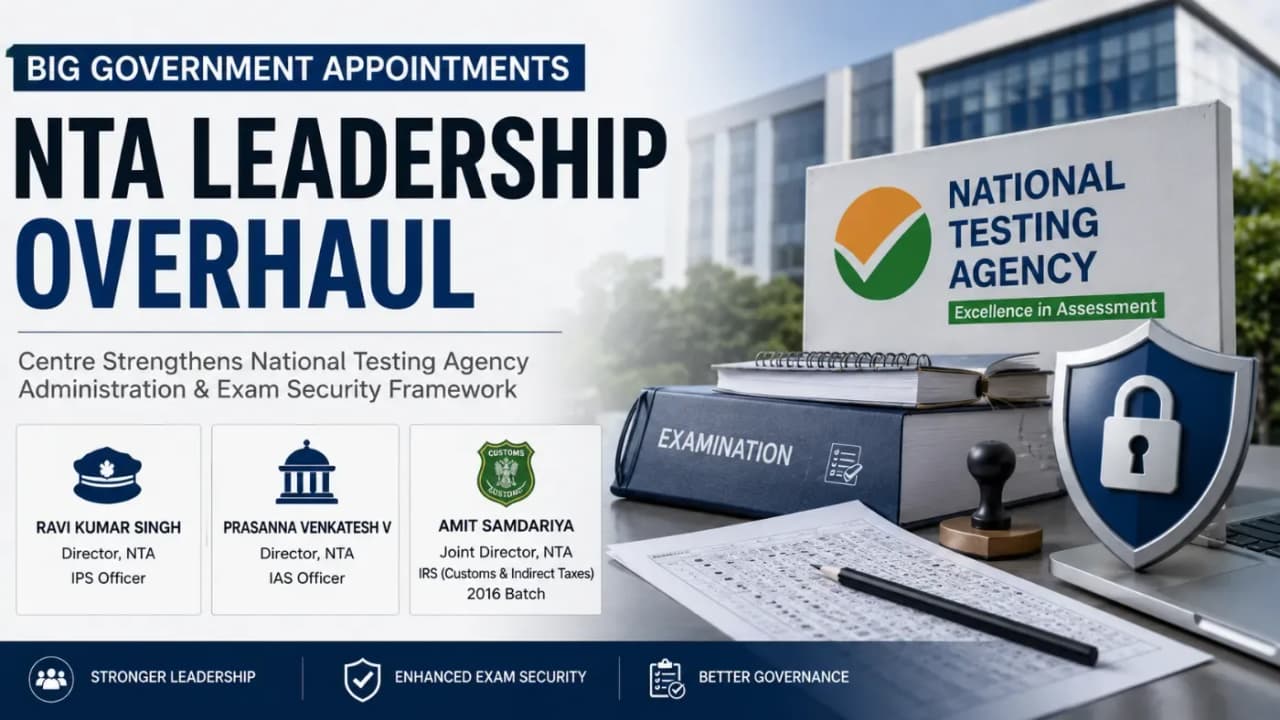
Who Are the New Appointees?
- Prasanna Venkatesh V (Director): A 2012-batch Indian Administrative Service (IAS) officer of the Andhra Pradesh cadre. He brings extensive governance and administrative logistics experience to the agency. He has been appointed as a Director under the Central Staffing Scheme for a five-year tenure.
- Ravi Kumar Singh (Director): A 2012-batch Indian Police Service (IPS) officer from the AGMUT cadre, Singh joins the NTA with roughly 14 years of policing experience. Recommended for central deputation by the Ministry of Home Affairs, his appointment is also for a period of five years. His background in managing complex situations and law enforcement positions him uniquely to address the systemic vulnerabilities and security breaches the NTA has faced.
- Amit Samdariya (Joint Director): A 2016-batch Indian Revenue Service (IRS) officer from the Customs and Indirect Taxes (C&IT) cadre. Recommended by the Department of Revenue, he provides crucial expertise in conducting system audits and tracking operational compliances. His tenure as Joint Director at the Deputy Secretary level is set for a period of four years.
What the Official Order Says
The DoPT orders mandate that Singh and Venkatesh will serve five-year terms from the date of taking over charge, while Samdariya will serve a four-year term. The government has explicitly directed the newly appointed officers to take up their positions within three weeks.
The notification carries a strict compliance clause, warning that failure to join within the stipulated timeframe will trigger the initiation of debarment proceedings from the Central Staffing Scheme.
Furthermore, the DoPT requested the Department of Revenue to relieve Samdariya immediately to expedite the administrative transition to the Department of Higher Education.
Also Read | PM Modi Announces Fast-Track Courts as NEET Paper Leak Protests Intensify
Who Is Anshuman Sharma and What Did He Do Before NTA?
Anshuman Sharma is a 2005-batch Indian Revenue Service officer from the Income Tax stream and has been appointed Joint Secretary in the NTA for five years. The government has temporarily upgraded a vacant Deputy Secretary or Director-level post to the Joint Secretary level for an initial period of two years to accommodate the appointment.
Before moving to the NTA, Sharma was listed in the 2026 Income Tax administrative directory as Commissioner of Income Tax, TDS-1, Chandigarh. Earlier public records also show his experience in the Department of Financial Services, Ministry of Finance, where he worked on industrial finance. He has also been associated with public-sector financial institutions during his government assignments.
His placement at the Joint Secretary level is relevant because the NTA is no longer dealing only with the conduct of examination days. Its reform programme now covers staffing, procurement, financial controls, technology contracts, testing infrastructure and oversight of service providers.
Who Is Sathiya S and What Was Her Previous Posting?
Sathiya S is a 2011-batch IRS Income Tax officer. Before the latest order, she was serving as a Director in the Ministry of Cooperation. Official Income Tax deputation records and the Ministry of Cooperation directory both list her in that role.
Her NTA appointment is a lateral shift under the Central Staffing Scheme rather than the start of a new five-year deputation period. She is expected to remain at the Director level until August 24, 2030, which is the balance of her existing central deputation tenure, unless another government order is issued earlier.
That distinction should be included in the report because her appointment is different from the fresh five-year terms given to Prasanna Venkatesh V and Ravi Kumar Singh.
Prasanna Venkatesh V Brings District and Education Administration Experience
Prasanna Venkatesh V is a 2012-batch IAS officer of the Andhra Pradesh cadre. Before his central appointment, he had served as Secretary of the Andhra Pradesh Social Welfare Residential Educational Institutions Society. He also previously served as Collector of Eluru district.
His work in Eluru also received national recognition. The Department of Administrative Reforms and Public Grievances recorded the Eluru initiative among the recipients of the Prime Minister's Award for Excellence in Public Administration 2023 under the Holistic Development of Districts category. In February 2026, Venkatesh presented the Eluru initiative during the National Good Governance Webinar series organised for sharing award-winning district practices.
His earlier assignments have included district administration and roles connected with public service delivery. The NTA appointment gives him a five-year Director-level tenure from the date he assumes charge.
Ravi Kumar Singh Brings Policing and Economic Offences Experience
Ravi Kumar Singh is a 2012-batch IPS officer of the AGMUT cadre. His police career has included district-level postings in Delhi as well as work in the Economic Offences Wing.
In May 2025, a Delhi Police reshuffle moved Singh from the post of DCP, Southeast district, to the Economic Offences Wing. He was later among the officers promoted to the DIG grade with effect from January 2026. Earlier Delhi Police records also show him serving in the Economic Offences Wing.
The policing background is relevant to the NTA at a time when exam security involves more than guarding examination centres. Paper-leak investigations can involve organised networks, digital communication, money trails, impersonation, access to confidential material and coordination between examination authorities and police agencies.
Singh has been appointed Director for five years from the date he assumes charge, subject to further government orders.
Amit Samdariya Has Worked in GST Policy and Intelligence
Amit Samdariya is a 2016-batch IRS officer from the Customs and Indirect Taxes stream. Before the NTA posting, government records show that he had worked in the GST Policy Wing of the Central Board of Indirect Taxes and Customs.
Minutes of the GST Council list Samdariya as a Deputy Commissioner in the GST Policy Wing. More recent CBIC human-resource records place him at the Directorate General of Goods and Services Tax Intelligence headquarters in Delhi. The May 2026 disposition data recorded his in-situ promotion to Joint Commissioner with effect from an order dated February 25, 2026.
At NTA, Samdariya has been selected as Joint Director at the Deputy Secretary level. The August 27 appointment order provides for a four-year tenure from the date of assuming charge, or until further orders.
Also Read | AI and Competitive Exams: How UPSC, JEE, NEET May Change
Decoding the Multi-Disciplinary Strategy
By bringing in officers from the IAS, IPS, and IRS, the Centre is executing a strategic, multi-disciplinary overhaul of the NTA. This triad of leadership covers all bases: the IAS officer manages vast administrative logistics; the IPS officer tackles security loopholes and secures the paper supply chain; and the IRS officer enforces strict compliance and administrative audits.
The Broader NTA Overhaul and Roadmap
The restructuring of the NTA's leadership follows intense public scrutiny regarding irregularities in the National Eligibility cum Entrance Test (NEET-UG) and the UGC-NET, which faced question-paper quality problems and security challenges. In response, the government recently announced a comprehensive revamp of the agency's examination process, which includes a rigorous four-tier paper-checking system, the removal of around 600 previous experts, and the onboarding of a fresh set of specialized domain authorities.
What Happens Next?
Three dates now need to be tracked.
- The first is September 13, 2026, when the public consultation being conducted for the Nandan Nilekani-led task force closes.
- The second falls around September 16, following the Education Minister's August 17 direction that the NTA complete an examination-process audit and submit an action-taken report within 30 days.
- The third is around September 17, which marks three weeks from the August 27 appointment orders for Prasanna Venkatesh V, Ravi Kumar Singh and Amit Samdariya. The DoPT orders require the selected officers to take up their assignments within the prescribed period.
These dates give the story a natural update cycle. Instead of publishing the appointments as a one-time personnel report, News4Bharat can update the same URL when the officers take charge, when the audit findings become available and when the examination reform task force moves to its next stage.
News4Bharat POV
The latest NTA appointments should not be judged only by the fact that the new team includes IAS, IPS and IRS officers. The more useful question is whether responsibility inside the agency becomes easier to trace.
Before this round of appointments, Parliament was told that NTA had 24 permanent officers against 39 sanctioned posts while depending on 197 contractual and outsourced workers. At the same time, it was handling examinations involving millions of candidate registrations. That gap between the size of the job and the permanent staffing available to perform it is one of the clearest numbers in the NTA reform debate.
The five appointments can begin to address that gap, but appointments alone are not proof that the reform has worked. The results will be visible when NTA publishes clearer responsibility for question-paper security, vendor supervision, examination-centre controls, technology systems and grievance handling, and when the agency can show what changed after its August process audit.