
Key Highlights
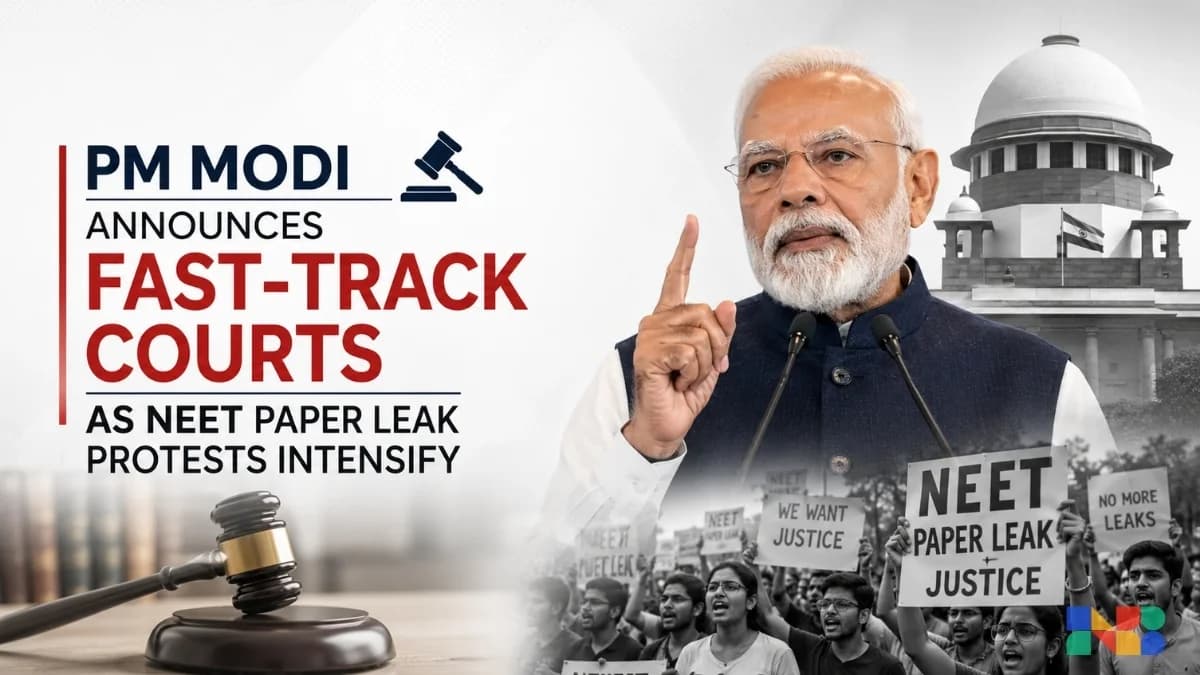
- PM Modi announced fast track courts for exam paper leaks on July 23, 2026.
- Delhi, Bombay, Madhya Pradesh and Calcutta High Courts have already set up these courts.
- India recorded 148 exam fraud cases since 2015, but only 1 ended in conviction.
- NEET 2026 exam was cancelled after a leaked guess paper matched real questions.
- A new bill to strengthen the 2024 anti paper leak law may reach Cabinet soon.
Prime Minister Narendra Modi has announced the creation of fast-track courts to hear exam paper leak cases, promising quicker justice after a series of scandals shook India's examination system. The move comes amid nationwide outrage over the cancellation of NEET 2026 and mounting protests by students demanding greater accountability.
PM Modi stated that, "Nothing is more important than the welfare and future of our youth... Those who try to harm the future of our youth will not be spared."
The announcement follows one of the biggest crises in recent years, after the NEET 2026 examination was scrapped when a leaked "guess paper" was found to closely match the actual question paper. More than 2.27 million candidates who appeared for the exam on May 3 were left facing uncertainty over their academic future.
As protests intensified in Delhi under the banner of the Cockroach Janta Party, the Prime Minister also announced plans to strengthen the Public Examinations (Prevention of Unfair Means) Act, 2024, through a new amendment that is expected to be placed before the Union Cabinet soon.
Also Read | Cockroach Janta Party Goes Viral: Internet Reacts With Funny Memes
The Real Data Behind Exam Paper Leak Cases In India
Fast track courts sound like a strong step forward. But past data tells a harder story. Since 2015, India has recorded 148 exam fraud cases across the country. Only one of these cases has actually ended in a conviction.
That single case was the Haryana Judicial Services exam leak from 2017. A Delhi court delivered the final verdict in August 2024, seven years later. This is the only conviction the country has to show for over a decade of leaks.
Here is what the data shows so far.
- 148 exam fraud cases recorded across India since 2015.
- Only 1 case has ended in a conviction till date.
- The Haryana Judicial Services 2017 case is that lone conviction.
- The verdict came in August 2024, seven years after the leak.
- Over 50 paper leak cases reported in eight years, per Lok Sabha records.
- These cases spread across 8 different states.
- Around 1.4 crore students and job aspirants affected in total.
- Rajasthan recorded 14 leak cases between 2015 and 2023.
- Gujarat recorded a similar number of cases in the same period.
- Uttar Pradesh and Uttarakhand also reported repeated leaks over the years.
Rajasthan's own police data shows why fast track courts for exam paper leaks matter so much.
- 615 people arrested in 33 leak cases since 2014.
- Charge sheets filed in 32 of these 33 cases.
- Very few of these cases reached a final conviction.
This gap between arrests and real convictions is the core problem fast track courts must solve.
Also Read | NEET CBT 2027 Explained: Why NEET Is Going Computer Based After Paper Leak
NEET Paper Leak Cases Show A Repeating Pattern
NEET exams have faced leak allegations more than once in recent years. Two recent cases show this is not a one time problem. Here is how each one played out.
NEET 2024
- Nearly 2.4 million students took the exam across the country.
- The Supreme Court found that 155 students had gained an unfair advantage.
- The court ruled there was no proof of a large scale leak.
- It refused to order a fresh exam for all candidates.
NEET 2026
- The exam was held on May 3 across the country.
- It was cancelled within days after fresh doubts emerged.
- A guess paper sold before the exam matched real questions.
- This raised concerns about how question papers are handled and stored.
- It became the direct trigger for the current wave of protests.
Two exams, two years, the same core problem. This is what makes NEET a repeating case study, not a one time failure.
Also Read | AI and Competitive Exams: How UPSC, JEE, NEET May Change
How This Affects Students And Job Aspirants
Every leaked paper means lost time, lost money and lost trust for lakhs of students. Many aspirants spend years preparing for a single exam attempt. A cancelled or leaked paper forces them to wait months for a fresh chance. For job aspirants, this delay can mean missing an age limit for good.
Fast track courts for exam paper leaks aim to bring faster justice to these students. But justice delayed for years, as seen in the Haryana case, has already cost many their careers. Real change will depend on how quickly these new courts deliver verdicts.
Also Read | Sonam Wangchuk’s Hunger Strike; A Stand for Student Rights or an Operational Dilemma?
What Happens Next
The government's new bill is expected to reach the Union Cabinet soon. If passed, it will work alongside the existing 2024 law. The four fast track courts already notified will begin hearing pending cases first. More states may set up similar courts if this model shows results.
Students and job aspirants across India will now watch closely. The real test is not the announcement itself. It is whether these fast track courts for exam paper leaks can turn arrests into actual convictions.
News4Bharat POV
The announcement of fast-track courts marks one of the government's strongest responses yet to India's growing paper leak crisis. But the real measure of success will not be how quickly courts are notified—it will be how quickly investigations conclude, trials finish, convictions follow, and future leaks are prevented. Until then, millions of students remain unconvinced that India's examination system is truly secure.
