

The Invisible Curriculum: Why Student Mental Health is Now Central to Education Policy
We used to measure school success purely by marks on a piece of paper. Not anymore. A silent crisis has forced a massive change in how we teach our youth.
For a very long time, schools all over the world cared about one main thing. Academic achievement.
Success was simple. You took a test. You got a rank. You secured a job placement.
Students learned a highly visible curriculum. Math. Science. History. Literature. But right under our noses, something else was happening.
A quieter, far more dangerous reality took hold.
We are now living through a severe crisis in student mental health. This crisis is so big that it is changing the very definition of education.
Today, student mental health is not just a side issue. It is not just a problem for parents to fix at home. It is rapidly becoming the core focus of education policy.
It is changing how we design classrooms. It is changing how teachers speak to kids. We can no longer ignore it.
Why? Because a broken mind simply cannot learn.
A Generation Under Pressure: The Breaking Point
Are our children doing okay?
The short answer is no. The sheer scale of this crisis will shock you.
The Shocking Truth About Our Classrooms:
- Over 23% of school children in India suffer from mental health issues.
- More than 30% report regular feelings of intense anxiety and deep depression.
- Globally, 1 out of every 5 students fights a daily mental battle that ruins their grades.
These are not just kids acting out. These are real, clinical cries for help.
When a child feels constant emotional pain, they miss school. They stop caring about their future. Their natural curiosity dies.
Why Is This Happening Now?
You might wonder, "School has always been hard. What changed?"
The world changed. The pressure on students today comes from many different directions at once. It creates a perfect storm of stress.
- The Endless Race for Marks: The fight to get into a good college is brutal. A single test can decide a child's entire career path. This "do-or-die" feeling steals their sleep and ruins their childhood.
- The Toxic Screen Trap: Today's kids live on their phones. They scroll through perfect, fake lives on social media. This constant comparison breeds severe jealousy, fear of missing out (FOMO), and digital burnout.
- The Loneliness Epidemic: Kids are connected to the internet, but they are deeply lonely. Real-life friendships are fading. The recent pandemic only made this worse, locking kids away from normal social growth.
- Crushing Expectations: Parents want the best for their kids. But often, this love turns into extreme pressure. Schools also push kids too hard just to keep the school's reputation high.
Let's look at India’s famous coaching cities. These are hubs where kids go to study for huge exams.
The stress in these cities got so bad that the government had to step in. Authorities are now legally forcing coaching centers to reduce study hours. They are demanding stress-reduction rules.
This is a massive policy shift. It proves that high marks mean nothing if a child is broken inside.
The darkest proof of this failure is in the numbers. In a single recent year, India recorded over 13,000 student suicides.
We cannot look away from that number. The system failed them. But finally, the system is waking up.
From Panic to Action: How the Government is Fighting Back
How do you fix a broken system?
You change the laws. And that is exactly what is happening right now.
The response from leaders has been fast. In many ways, it is making history.
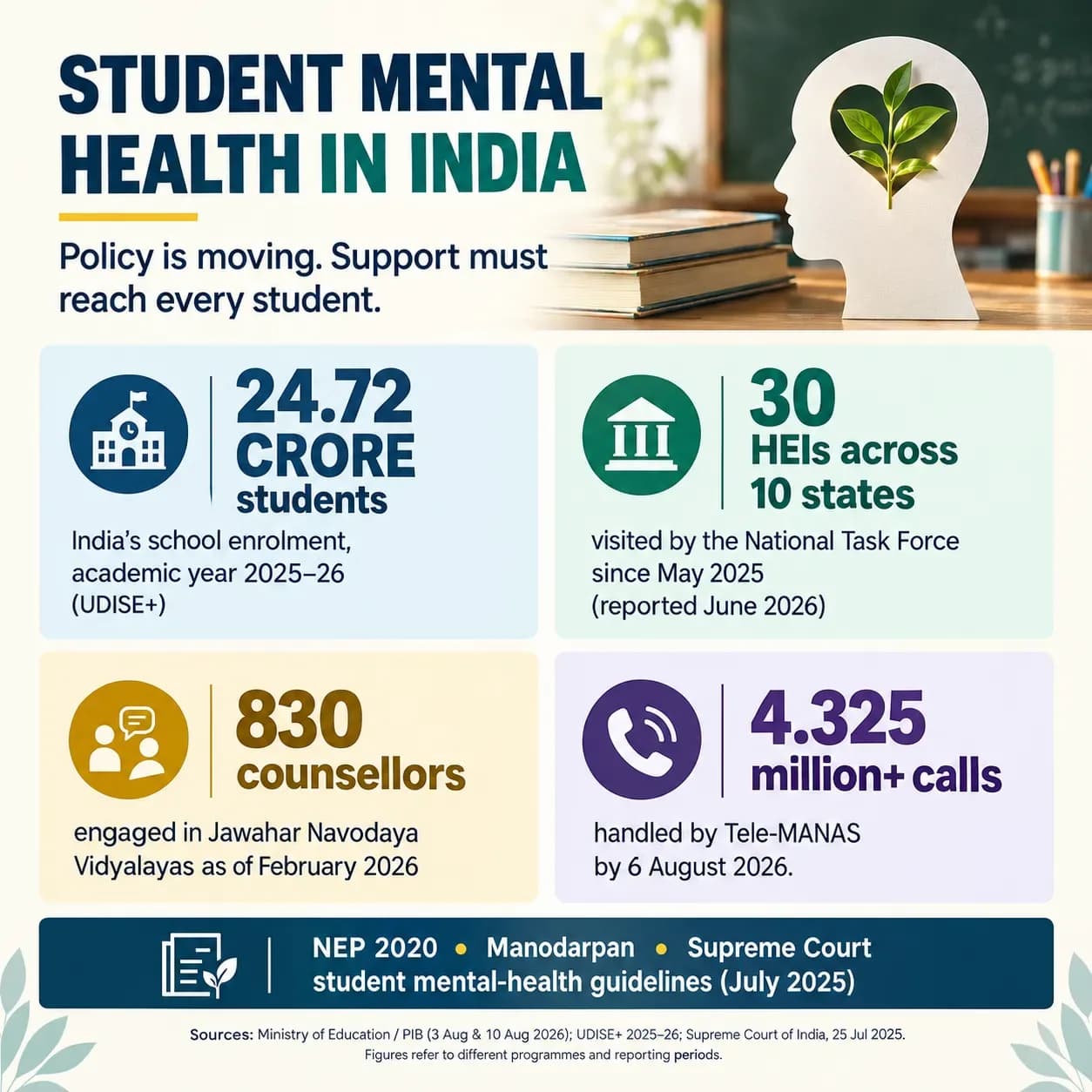
In March 2025, the Supreme Court of India made a huge move. They built a special National Task Force just for student mental health. They told the country: We need massive changes in our schools, right now.
Shortly after, the government issued strict, binding rules. These rules are designed purely to stop student suicides. This is one of the most powerful legal steps taken for student safety anywhere in the world.
The Magic of NEP 2020
Before the Supreme Court stepped in, the groundwork was already laid. The National Education Policy (NEP) 2020 changed the game.
The NEP said: Stop making kids just memorize textbooks.
Instead, the policy pushed for holistic development. It forced schools to teach emotional intelligence. It made mental health a core part of the daily school routine.
Since then, the changes on the ground have been amazing:
- The CBSE “Hub & Spoke Model” (2025–26): Rich schools with great counselors are now pairing up with poorer schools. They share resources so every child gets a safe person to talk to.
- New State Laws: States like Gujarat are making it illegal to run a school without a trained mental health professional on staff.
- Taming the Coaching Centers: Private tuition centers are now forced to follow strict mental health safety rules. The days of 16-hour study grinds are ending.
But the support goes beyond schools. The government linked student health to the massive Ayushman Bharat health scheme.
Because of this one move, over 65,000 struggling students received free, professional counseling in just one year.
We are no longer just putting band-aids on the problem. We are rebuilding the entire machine.
Inside the New Classroom: Wellness Comes First
Walk into a modern school campus today. It looks very different from 10 years ago.
Schools are slowly transforming. They are no longer just exam factories. They are becoming safe well-being ecosystems.
What exactly does this look like on the ground?
- Safe Spaces: Schools are building dedicated wellness rooms. These are quiet places to calm down when the noise gets too loud.
- Kids Helping Kids: Students trust their friends most. Schools are starting peer-support clubs. They teach kids how to listen to their friends safely.
- Learning to Feel: Emotional literacy is now an actual subject. Kids learn how to handle anger and sadness, just like they learn math.
- Upgrading Teachers: Teachers are the first to see a kid cry. Now, they are getting real training in "psychological first aid" to handle panic attacks in class.
The Big Problem We Still Face
Let's be honest. It is not all perfect yet.
There is a massive shortage of help. Experts say schools need at least one counselor for every 250 students. But right now? Most schools have one counselor for every 400 kids. Sometimes even worse.
In massive universities, one poor counselor might be trying to care for 10,000 students. It is impossible to give personalized care with those numbers.
But the goal is clear. We are moving away from "wait until a crisis happens" to "check on kids every single day."
AI & Mental Health: The Digital Savior?
If we don't have enough human counselors, what do we do?
We bring in technology.
The rise of Artificial Intelligence (AI) in student well-being is the most exciting change happening right now.
How can a computer help a crying child? AI is stepping up in three massive ways:
- 1. Spotting the Danger Early: AI can look at a student's attendance. It watches their grades dip. It notices behavior changes. Long before a child asks for help, the AI quietly warns a teacher to go check on them.
- 2. Mood Tracking on the Go: Smart apps let students log how they feel during the day. If the app sees high stress, it instantly offers breathing exercises to calm them down.
- 3. 24/7 Access: AI chatbots never sleep. When a student feels terrified at 2 AM before a big exam, the chatbot is there to talk them through the panic.
This sounds like science fiction, but it is real. These tools are running in schools right now.
Research proves it works. AI spots stress patterns weeks before human teachers notice anything is wrong.
Here is a wild statistic: Surveys show that 88% of Indian students now turn to AI tools when they feel stressed. They trust the robots.
This is brilliant because it reaches millions of kids instantly. But it is also a bit scary. Kids still need human love, not just algorithms. We must find the perfect balance.
Redefining True Success
At the end of the day, all these new laws and AI bots point to one massive philosophical shift.
We are finally asking: What is the actual point of going to school?
Education is no longer just about filling a child's brain with facts. It is evolving. The new model of learning values deeply human skills.
The New Rules of Schooling:
- Emotional Intelligence: Knowing how to talk to people and handle your own anger.
- Resilience: Learning that failing a test is not the end of the world. You bounce back.
- Empathy: Understanding the pain of others and refusing to bully classmates.
- Joy as a Metric: Graduating a happy, stable student is now just as important as graduating a genius.
This is exactly what the NEP 2020 dreamed of. A holistic, completely well-rounded child.
Science backs this up. A relaxed mind absorbs information like a sponge. A terrified mind shuts down. When kids feel safe, their grades naturally go up.
Summing it up: The Invisible is Now Visible
The secret is out. Student mental health has moved from the shadows to the center stage.
Governments are passing laws for it. Schools are building rooms for it. Artificial Intelligence is tracking it.
But the real magic lies much deeper. We are finally changing what it means to be successful.
In the classrooms of tomorrow, we won't just look at a child's report card. We will look at their heart.
Success will be measured by a student's ability to think clearly, feel deeply, and live a strong, resilient life.
Academic excellence and emotional health are no longer enemies. They are best friends. And they are completely inseparable.
Frequently Asked Questions (FAQs)
1. What exactly is the student mental health crisis?
It is a massive rise in daily stress, severe anxiety, and clinical depression among youth. These issues are so bad they stop kids from learning, sleeping, and socializing normally.
2. What is causing all this stress today?
Kids face a terrible mix of pressures. They have incredibly tough exams, they constantly compare themselves to fake lives on social media, they feel very lonely, and they face huge pressure from parents to be perfect.
3. How is India fighting back against this crisis?
India is taking strong action. The government rolled out the NEP 2020 policy, ordered schools to hire professional therapists, and the Supreme Court even created a special Task Force just to fix the problem.
4. Why is the NEP 2020 policy so important for mental health?
NEP 2020 shifts the focus away from blind memorization. It officially forces schools to care about a child's emotional growth and overall happiness, not just their math skills.
5. What are local schools doing to help right now?
Schools are changing their buildings to add quiet wellness rooms. They are teaching teachers how to handle panic attacks, and they are creating clubs where students can safely talk about their feelings.
6. Can a robot (AI) really help a sad student?
Yes. AI is amazing at spotting patterns. It can notice if a student's grades drop suddenly. It also provides 24/7 chat support and calming apps for kids when human teachers are asleep.
7. Why should we even care about mental health in education?
Because biology proves that a stressed brain cannot learn. Good mental health directly leads to better grades, higher focus, less bullying, and happier human beings.