

Dozens of engineering colleges have shut down across India.
The All India Council for Technical Education (AICTE) has confirmed that 58 engineering and technical colleges have been closed for the 2025–26 academic year.
The closure is being done through a process called progressive closure. This means the colleges will not admit any new first-year students, but students who are already enrolled can continue their studies and complete their degrees without any interruption.
According to an AICTE official, the decision was taken because many of these colleges had very low student admissions, not enough qualified teachers, and failed to meet the required infrastructure and operational standards.
Which states are affected the most?
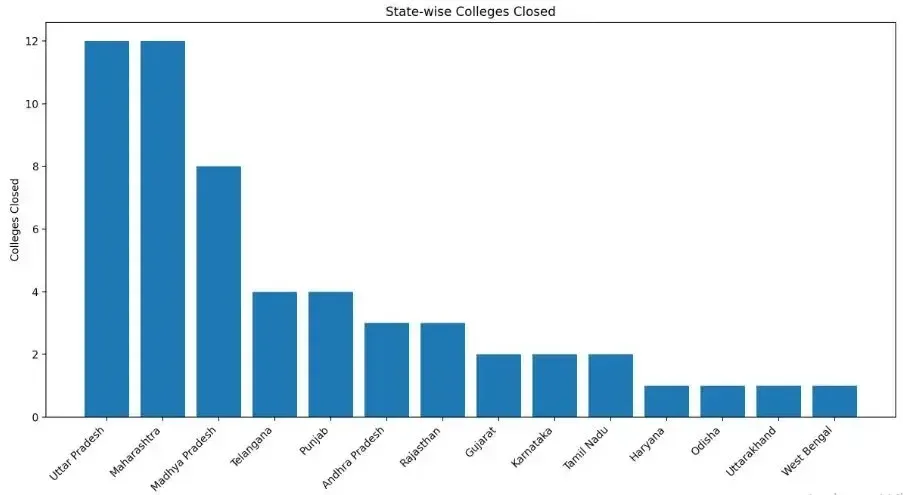
Uttar Pradesh and Maharashtra top the list with 12 college closures each. Madhya Pradesh follows with 8. Telangana and Punjab recorded 4 closures each.
The list does not stop there. Andhra Pradesh and Rajasthan saw 3 closures each. Gujarat, Karnataka, and Tamil Nadu recorded 2 each. Haryana, Odisha, Uttarakhand, West Bengal, and Puducherry each lost one college. In total, 14 states and union territories have been touched by this shutdown, a spread that most reports on this topic have not mentioned.
Most of these colleges sit in smaller towns and semi urban belts rather than big cities. That detail matters more than it seems, and the next section explains why.
The Story Behind the Closures
These closures did not happen overnight. They are part of a trend that has been growing for several years.
AICTE's data shows that many engineering seats across India have remained vacant year after year. In the 2017–18 academic session, nearly 49% of approved engineering seats were left unfilled. By 2021–22, the situation improved, but 33% of seats were still vacant, with more than 4.21 lakh seats remaining empty out of 12.53 lakh available seats.
One of the biggest reasons is changing student preferences. Today, many students are choosing courses like computer science, data science, and management instead of traditional branches such as civil and mechanical engineering.
As admissions fell, many private engineering colleges struggled to earn enough money to pay teachers, maintain laboratories, and meet AICTE's quality standards. In such cases, AICTE allows these colleges to shut down through the progressive closure process.
The Angle Everyone Else Missed
A large share of the 58 colleges sat in tier 2 and tier 3 towns, where they often served as the only affordable engineering option nearby. Local students now face a tough choice. Move to a bigger city and pay higher fees, or step away from a technical degree altogether. This shutdown is not a sudden or unexpected move either. AICTE stopped approving new engineering colleges back in 2020 because seats already outnumbered students. That restriction got extended again in 2022. What is happening now is the outcome of a long term correction, not a fresh crisis.

Course level data tells its own story. More than 950 engineering courses have shut alongside these colleges. Civil and mechanical engineering continue to lose demand, while newer fields like artificial intelligence and data science keep pulling in students.
Teachers and non teaching staff carry a quiet cost in all of this. Every college closure puts jobs at risk, yet there is almost no public tracking of how many staff members find new positions afterward. This turns a college closure story into a jobs story too, one that rarely gets a mention.
Why it matters for Bharat?
- For students: Fewer risky colleges to choose from, and less chance of enrolling somewhere that cannot deliver quality teaching or placements.
- For parents: A clear reminder to check a college's track record before spending lakhs on a technical degree.
- For the government: Confirmation that new college capacity must follow real job market demand, not blanket expansion.
- For the economy: A slow but real shift toward fewer, stronger colleges that can produce engineers ready for today's industries.