

Key Takeaways
- The Cause: Innovator Sonam Wangchuk joined youth activists in late June 2026, demanding accountability, ministerial resignation, and systemic reforms following major competitive exam irregularities (NEET-UG).
- Current Status: On Day 21 of his fast, Wangchuk was transferred from Jantar Mantar to Delhi's Safdarjung Hospital under Delhi High Court medical directives. He continues his fast from the hospital.
- The Core Debate: Advocates demand moral accountability and exam integrity for millions of aspirants, while governance experts emphasize operational complexity, ongoing CBI investigations, and institutional stability.
Sonam Wangchuk, the well-known engineer and innovator is sitting on an indefinite fast at Jantar Mantar, New Delhi. This time, his protest is not about technology or regional issues, but about the future of millions of Indian students.
In late June, Sonam Wangchuk joined a youth-led movement led by the Cockroach Janta Party (CJP) and student groups, protesting against alleged paper leaks and scoring irregularities in major nationwide entrance exams like NEET-UG. As his fast passed its third week, the protest grew into a national headline, raising a debate on accountability, public trust, and governance.
Also Read | All About Cockroach Janta Party
What are the Demands of Sonam Wangchuk?
The demands made by Wangchuk and student groups center on four key points:
- Systemic Accountability: Taking direct responsibility for paper leaks and exam cancellations.
- Ministerial Resignation: Demanding that Union Education Minister Dharmendra Pradhan step down on moral grounds.
- Parliamentary Action: Formal assurances that exam reforms and student grievances will be debated in Parliament during the Monsoon Session.
- Relief for Aspirants: Support, re-examinations, and financial compensation for students and families affected by delayed or cancelled exams.
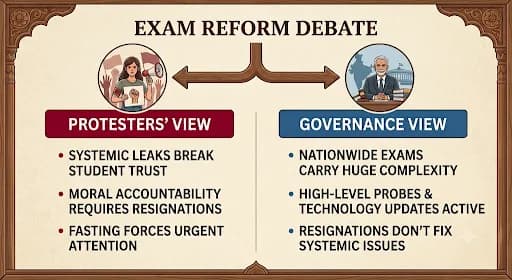
Side A: The Case for the Protesters
- Protecting Millions of Aspirants: Students spend years preparing for competitive exams like NEET-UG. When papers leak or exams are cancelled, it causes deep emotional and financial distress to families.
- Demanding Moral Responsibility: Supporters argue that in a healthy democracy, leadership must take moral ownership when national systems fail.
- Urgent Reform Needed: Protesters feel that without extreme steps like a hunger strike, systemic flaws in exam security will continue to be brushed aside.
Side B: The Governance & Administrative Perspective
- Vast Operational Scale: Conducting competitive exams for millions of candidates across thousands of centers in India is a massive logistical effort. Occasional breaches are investigated through high-level police and judicial inquiries.
- Reforms Over Resignations: Government representatives maintain that technological overhauls, stricter anti-leaking laws, and legal actions against guilty individuals are actively underway. Sudden resignations or canceling full exams mid-cycle can disrupt the academic calendar for millions of innocent students.
- The Policy Precedent: Critics of forcing policy changes through fasts argue that governance decisions must follow established legal and parliamentary procedures rather than fasts.
What Has Happened So Far?
- June 20: The Cockroach Janta Party (CJP) launches a youth sit-in at Jantar Mantar over exam irregularities.
- June 28: Wangchuk joins the protest site and begins an indefinite hunger strike alongside student activists.
- Mid-July: After 20 days without food, his health worsens significantly, losing nearly 10 kg with blood parameters altered due to prolonged fasting.
- July 18: Following Delhi High Court directives regarding his health, Delhi Police move Sonam Wangchuk from Jantar Mantar to VMMC & Safdarjung Hospital. Other youth leaders, including CJP founder Abhijeet Dipke, step up to continue the fast at Jantar Mantar.
- July 20: Student groups launch the "Sansad Chalo" (March to Parliament) as the Monsoon Session opens. Police deploy barricades near Parliament Street, leading to brief clashes and baton charges to clear crowds.
- Wangchuk's Vow from Hospital: From his hospital bed, where he has refused intravenous fluids and medications, Sonam Wangchuk states he will extend his fast until youth leaders are permitted to meet with lawmakers or he is allowed to see them.
The Question Ahead
This hunger strike highlights two important priorities for any country:
- The need for transparent, leak-free examinations that protect the hard work of young students.
- The challenge of managing massive national administrative systems without disrupting the education cycle for millions.
As Parliament's Monsoon Session unfolds, the central question remains: Will the government break its silence, or will Sonam Wangchuk break his fast?