

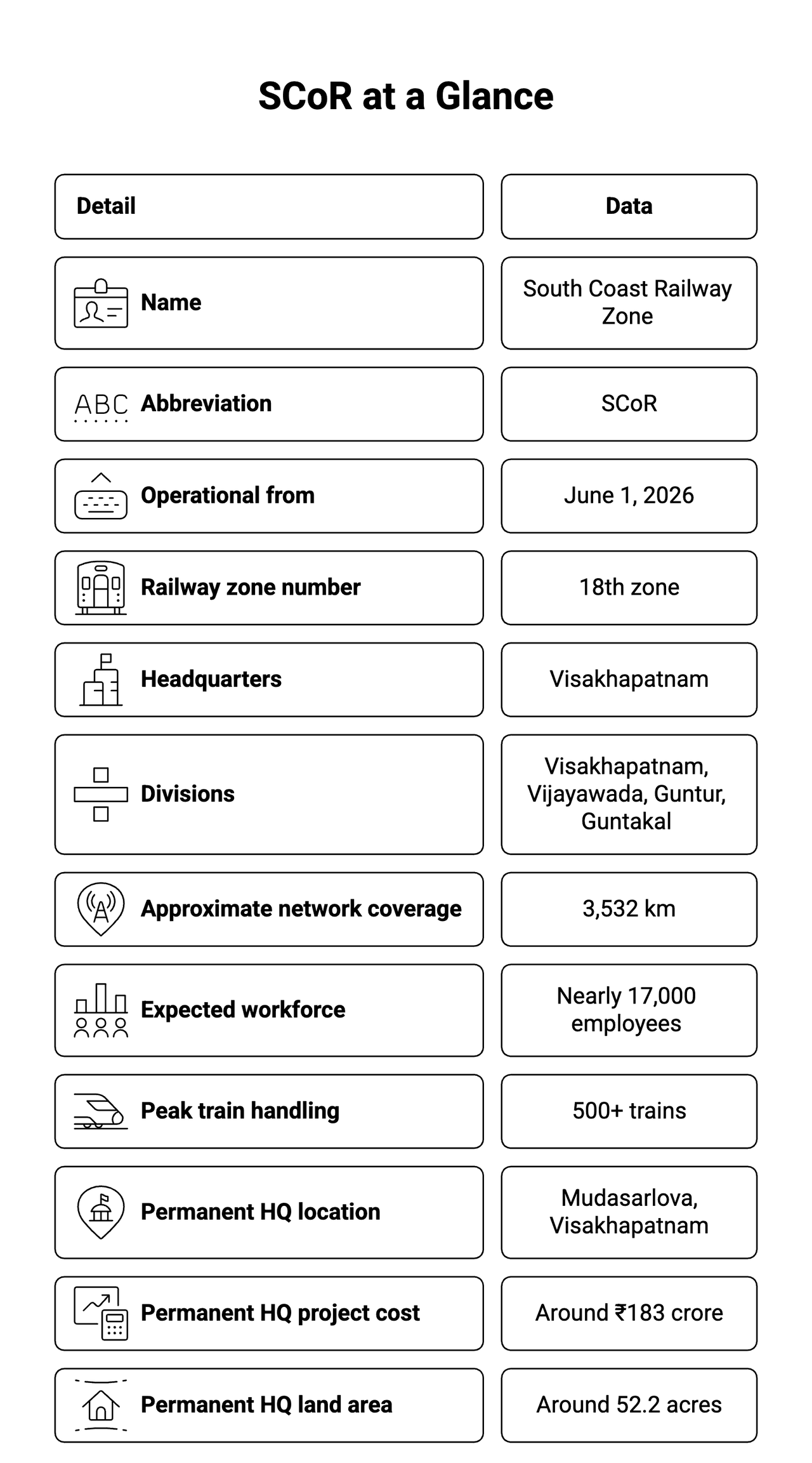
India now has its 18th railway zone. The South Coast Railway Zone (SCoR) became operational on Monday, June 1, 2026. This is a big moment for Andhra Pradesh. The region had been demanding a separate railway zone for over a decade.
The creation of SCoR is not just an administrative change. It is one of the biggest railway reorganisations for Andhra Pradesh in recent years. The new zone is expected to cover nearly 3,532 km of railway network and bring together important passenger, freight and port-linked routes under one regional command.
With Visakhapatnam as the headquarters, Andhra Pradesh will now have a stronger role in railway planning, project execution and regional connectivity.
Union Minister for Civil Aviation and TDP MP Kinjarapu Ram Mohan Naidu officially launched the zone, and unveiled the SCoR name board at the AS Peta railway track near Ichapuram in Srikakulam district.
Why Was SCoR Created?
For years, people in Andhra Pradesh felt that railway operations in the region were not getting enough attention. The existing East Coast Railway and South Central Railway zones were large. Managing them efficiently was a challenge.
A dedicated zone was seen as the solution. It would improve day-to-day railway administration. It would also help speed up infrastructure projects across the region.
The need for a separate zone became stronger because Andhra Pradesh has a high railway dependency for both passenger movement and industrial logistics. The state connects major ports, power plants, industrial clusters, agricultural markets and pilgrimage centres.
Routes passing through Vijayawada, Visakhapatnam, Guntur and Guntakal are among the busiest in the region. A separate zone is expected to reduce the administrative burden on larger zones and ensure that project approvals, maintenance planning, train operations and passenger services receive closer attention.
The Centre issued a gazette notification on May 4, 2026, confirming the formation of SCoR. The operational start date was fixed as June 1, 2026.
Also Read | CBSE Class 10 Results 2026 Declared: 93.70% Pass, Over 45,000 Students Score Above 95%
What Will Be the Structure of SCoR?
South Coast Railway will consist of four divisions: Visakhapatnam, Vijayawada, Guntur and Guntakal. The Visakhapatnam Division has been created from a portion of the earlier Waltair Division, while Vijayawada, Guntur and Guntakal have come from South Central Railway.
The zone is expected to manage nearly 17,000 employees across 18 departments, making it a major administrative unit of Indian Railways. During busy travel periods, it is expected to handle more than 500 trains, while also playing an important role in freight movement linked to ports and industrial corridors.
What the Official Gazette Says?
The Ministry of Railways notification states that the Central Government has constituted a new Zonal Railway named South Coast Railway. Its headquarters is at Visakhapatnam. It has been carved out of the East Coast Railway and South Central Railway zones.
How Will the Waltair Division Change?
One of the key operational changes involves the Waltair Division. It currently falls under the East Coast Railway zone. With SCoR now in place, the Waltair Division will be split into two parts. One part will stay with the East Coast Railway.
It will be renamed as the Rayagada Division. The other part will move to the new South Coast Railway zone. That portion will become the Visakhapatnam Division.
This change is significant because Waltair has been one of the strongest railway divisions in terms of freight earnings. In 2025-26, Waltair Division earned around ₹11,598 crore, including more than ₹10,422 crore from freight, and handled about 85.1 million tonnes of freight loading. These numbers show why the division’s restructuring has both administrative and economic importance.
Also Read | Andhra Pradesh Reorganisation (Amendment) Bill 2026 Explained: Amaravati Becomes AP’s Sole Capital
Why Visakhapatnam Matters for SCoR?
Visakhapatnam is not just the headquarters of the new railway zone. It is also one of India’s major port cities and a key industrial centre on the east coast. The city connects port-based cargo, steel, minerals, petroleum, power, seafood exports, tourism and passenger traffic.
By placing the zonal headquarters in Visakhapatnam, railway decision-making moves closer to one of the most strategically important transport hubs in Andhra Pradesh.
The permanent headquarters of SCoR is planned at Mudasarlova in Visakhapatnam, reportedly over 52.2 acres, with an estimated project cost of around ₹183 crore. Until the permanent headquarters is ready, the zone is expected to function from a temporary office at VMRDA’s “The Deck” building in Siripuram.
What This Means for the Region?
A new railway zone means better administrative focus. Decisions about train schedules, station upgrades and new lines can now be taken at a regional level. This removes layers of bureaucracy.
Visakhapatnam is a major port city. It is also a growing industrial and IT hub. Having a railway headquarters here puts decision-making closer to where the demand is. Districts like Srikakulam, Vizianagaram and Visakhapatnam stand to benefit the most.
For passengers, the change may not be visible right away. But over time, better planning at the zone level should bring more trains, improved services and faster execution of pending railway projects in the region.