

Navigating the world of finance can sometimes feel like trying to read a novel in a language you do not fully understand. However, recent changes in India's financial rulebook are making things much simpler. Today, we are breaking down a major update regarding SEBI regulatory compliance. The Securities and Exchange Board of India (SEBI) has just rolled out new guidelines that make life significantly easier for two specific groups: foreign investors buying government bonds, and angel funds investing in early-stage startups.
If you are wondering how these updates impact the economy, you are in the right place. We are going to strip away the complex jargon. By the end of this guide, you will understand exactly what these changes mean, why they were made, and how they contribute to India's broader financial growth.
What is SEBI and Why Does It Matter?
Before we dive into the new rules, it helps to understand who is making them. SEBI is the regulatory body for securities and commodity markets in India. Think of SEBI as the referee in a massive financial football game.
Their primary job is to protect investors, ensure fair play, and promote the healthy growth of the financial markets. Whenever people buy stocks, mutual funds, or government bonds, SEBI is the watchdog ensuring nobody is breaking the rules.
However, sometimes the rules can get a bit too strict, slowing down the game. When regulations create too much paperwork or friction, investors might hesitate to participate. Recognizing this, SEBI occasionally updates its rulebook to speed things up without compromising safety. That is exactly what happened with their latest circulars.
Read More: SEBI FIRE Cyber Reporting Framework Explained: What Changes?
Foreign Portfolio Investors (FPIs) and Government Securities
The first major update focuses on Foreign Portfolio Investors. To understand this, we need to break down two core concepts: who these investors are and what they are buying.
Understanding Foreign Portfolio Investors (FPIs)
An FPI is simply an investor or an investment fund from another country that puts money into India's financial markets. They buy stocks, bonds, and other financial assets. Because they bring foreign currency into India, FPIs are vital for the country's economic growth. They provide capital that Indian businesses and the government use to fund large-scale projects.
What are Government Securities (G-Secs)?
When the Indian government needs money to build highways, schools, or hospitals, it borrows from the public. It does this by issuing Government Securities, commonly known as G-Secs.
When an investor buys a G-Sec, they are essentially lending money to the government. In return, the government promises to pay them back with interest after a set period. Because the government backs them, G-Secs are considered one of the safest investments in the world.
The Old Problem: Regulatory Friction
In the past, FPIs faced a heavy burden of compliance. Even if a foreign investor only wanted to buy incredibly safe G-Secs, they had to jump through the same complex regulatory hoops as someone engaging in high-risk stock trading.
They had to submit endless paperwork, undergo rigorous audits, and constantly prove their eligibility. For many global investors, this administrative headache was not worth the effort. They would simply take their money to other countries where the rules were simpler.
The New Solution: Easing the Burden
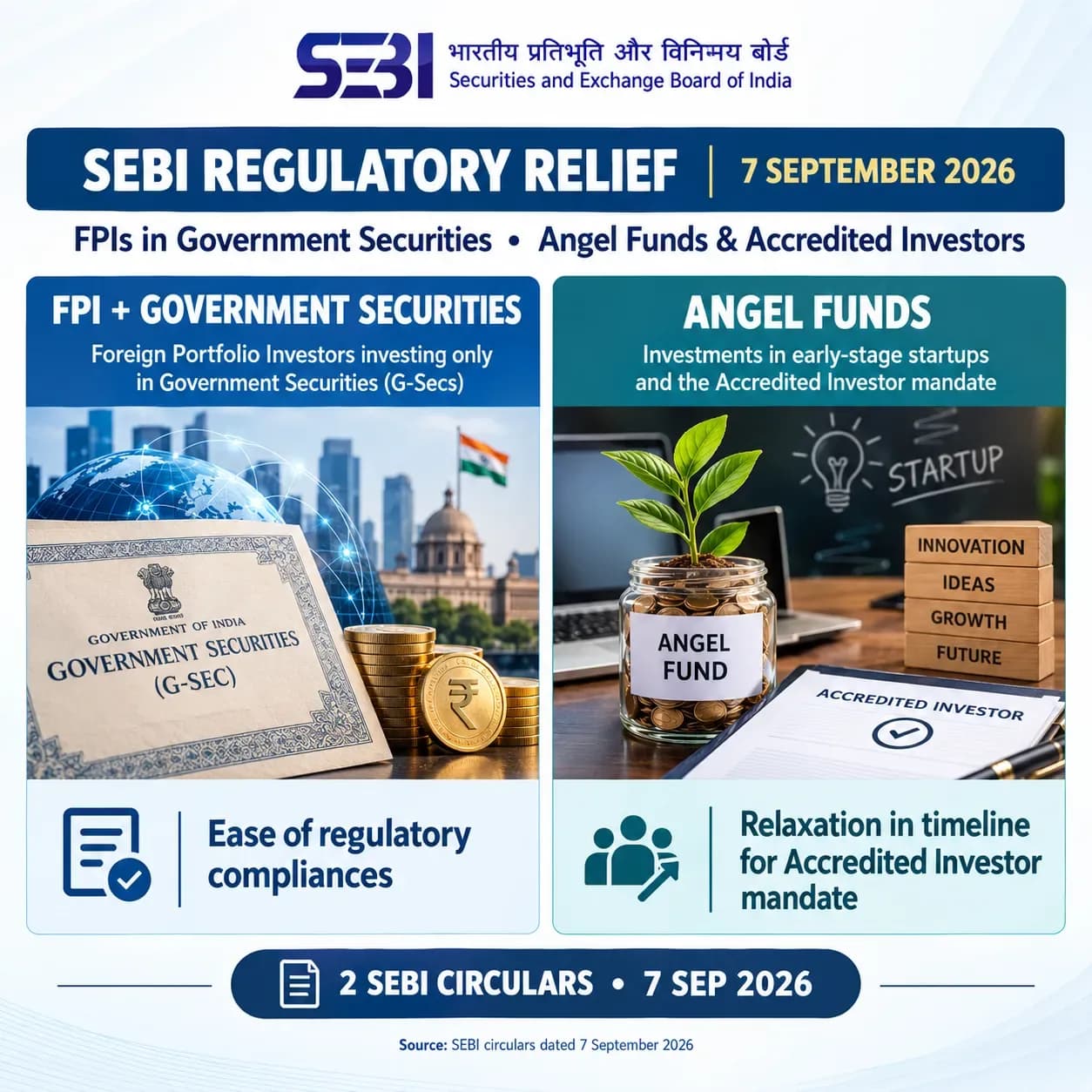
SEBI's new circular, titled “Ease of regulatory compliances for FPIs investing only in Government Securities,” changes the game entirely. The regulator recognized that if an FPI is only buying safe government debt, they shouldn't be treated like high-risk traders.
By slashing the paperwork and easing the reporting requirements, SEBI has rolled out the red carpet for foreign capital. Here are the immediate benefits:
- Faster onboarding for new foreign investors.
- Reduced administrative costs for global funds.
- Increased foreign money flowing directly into government infrastructure projects.
Angel Funds and the Accredited Investor Mandate
The second half of SEBI's recent announcement targets a completely different sector of the market: the vibrant world of startups and alternative investments. Specifically, SEBI has relaxed the timeline for the Accredited Investor mandate for Angel Funds.
What is an Angel Fund?
When a brilliant entrepreneur has an idea for a startup but no money to build it, they often turn to angel investors. An angel fund is a pool of money collected from wealthy individuals (angels) used to invest in these highly risky, yet potentially highly rewarding, early-stage companies.
Angel funds are the lifeblood of India's startup ecosystem. Without them, many of the apps, services, and technologies we use today would never have made it past the drawing board.
Understanding the Accredited Investor Tag
Because startup investing is exceptionally risky—many startups fail—SEBI wants to ensure that the people putting money into angel funds can actually afford to lose it. This is where the "Accredited Investor" tag comes in.
An accredited investor is someone who has a proven high net worth and financial sophistication. Think of it like a VIP pass. To invest in certain high-risk alternative investment funds (AIFs), individuals must prove they hold this VIP status. They do this by submitting financial documents to an accreditation agency.
Read More: Municipal Bonds in India: Why City Borrowing Is Rising in 2026
The Timeline Challenge
Previously, SEBI introduced a strict mandate requiring angel funds to ensure all their participants had this official accredited investor status by a specific deadline. While the intention was good—protecting investors—the reality was a logistical nightmare.
Gathering financial documents, waiting for agencies to process them, and officially tagging every investor takes a massive amount of time. Angel funds were struggling to meet the strict deadline, which threatened to halt their fundraising efforts entirely. If an angel fund cannot raise money, startups do not get funded, and innovation stalls.
Breathing Room for Startups
By relaxing the timeline for this mandate, SEBI has given angel funds a crucial lifeline. They now have more breathing room to get their investors officially accredited without having to pause their investment activities.
This relaxation means that angel funds can continue to operate smoothly. They can keep writing checks to promising startups while handling the compliance paperwork in the background at a more reasonable pace.
The Bigger Picture: India's Financial Future
When you zoom out and look at both of these circulars together, a clear pattern emerges. India is aggressively working to improve its "ease of doing business."
Whether it is a massive global pension fund looking to park billions in Indian government bonds, or a local angel fund trying to seed the next major tech unicorn, regulatory friction is the enemy of growth. Strict rules are necessary for safety, but unnecessary red tape only holds the economy back.
These moves by SEBI show a mature, adaptive regulatory approach. By tailoring the rules to match the actual risk involved, the market regulator is helping India's capital markets become more globally competitive. Less friction means more money, and more money means a stronger, more resilient economy for everyone.