

The world of finance is moving faster than ever before. With just a few taps on a smartphone, an individual can secure a loan in minutes. However, this massive speed has caught the attention of regulators. Recently, the Reserve Bank of India (RBI) raised a massive red flag. They issued a firm directive focusing squarely on maintaining pristine NBFC asset quality.
The central bank's message is crystal clear: rapid credit expansion must never compromise the health of the financial system. Let us break down exactly what this means, why the RBI is stepping in now, and how technology is set to rewrite the rules of lending in India.
Understanding the Current Situation
To truly grasp the gravity of the RBI’s warning, we first need to understand the players involved. The financial landscape is no longer just dominated by traditional brick-and-mortar banks.
What Exactly is an NBFC?
An NBFC stands for a Non-Banking Financial Company. Think of them as the agile, specialized cousins of traditional banks like SBI or HDFC. NBFCs provide banking services, specifically lending, but they do not hold a full banking license.
Also Read | RBI’s New NBFC Rules 2026: Type I, Type II and Unregistered NBFC Explained
This means they cannot accept regular savings deposits from the public. Instead, they borrow money from larger banks or the bond market and lend it out to consumers and small businesses. They are the institutions that finance your new smartphone, your two-wheeler, or the working capital for a local shopkeeper.
Because they focus on specific niches, they are incredibly efficient at reaching the "last-mile" borrowers. These are people in remote areas or small businesses that traditional banks might ignore.
The Explosion of Credit Growth
Over the past few years, NBFCs have grown at a breathtaking pace. According to recent RBI data, NBFC credit now accounts for roughly 16.7% of India's nominal GDP. This is a significant jump from 15.9% just a year earlier.
To put that into perspective, NBFCs are now responsible for extending an amount equivalent to 27% of the total credit given by all scheduled commercial banks. This means more than a quarter of the lending power in the country rests on their shoulders.
While this growth is fantastic for financial inclusion, it creates a massive potential problem. When you grow your loan book that fast, you might start giving money to people who cannot pay it back.
The RBI’s Core Message: Quality Over Quantity
Speaking at the 7th CII NBFC and HFC Summit, RBI Deputy Governor S C Murmu laid down the law. He acknowledged the incredible work NBFCs have done to bring credit to underserved segments. But he immediately followed it with a stern warning.
The Danger of Diluted Underwriting
Murmu emphasized that growth must never come at the cost of underwriting standards. But what is underwriting?
In simple terms, underwriting is the process of evaluating the risk of lending money to a specific person. It involves checking their income, their credit history, and their ability to repay.
When a lender is desperate to grow and capture market share, they might start cutting corners. They might ignore a slightly spotty credit history or overlook a borrower's existing debt. This is called diluting underwriting standards.
Why Growth Cannot Ignore Risk
When you dilute these standards, you issue bad loans. Eventually, these borrowers default. When borrowers do not pay back their loans, the lender's asset quality drops.
In the banking world, a loan is considered an "asset" because it makes money for the lender through interest. If the loan goes bad, it becomes a "non-performing asset" (NPA). The RBI is terrified of a sudden spike in NPAs across the NBFC sector.
Therefore, securing NBFC asset quality is now the central bank's absolute top priority. They want lenders to grow, but only if they can prove that the loans are safe and secure.
The Role of Technology and AI in Banking
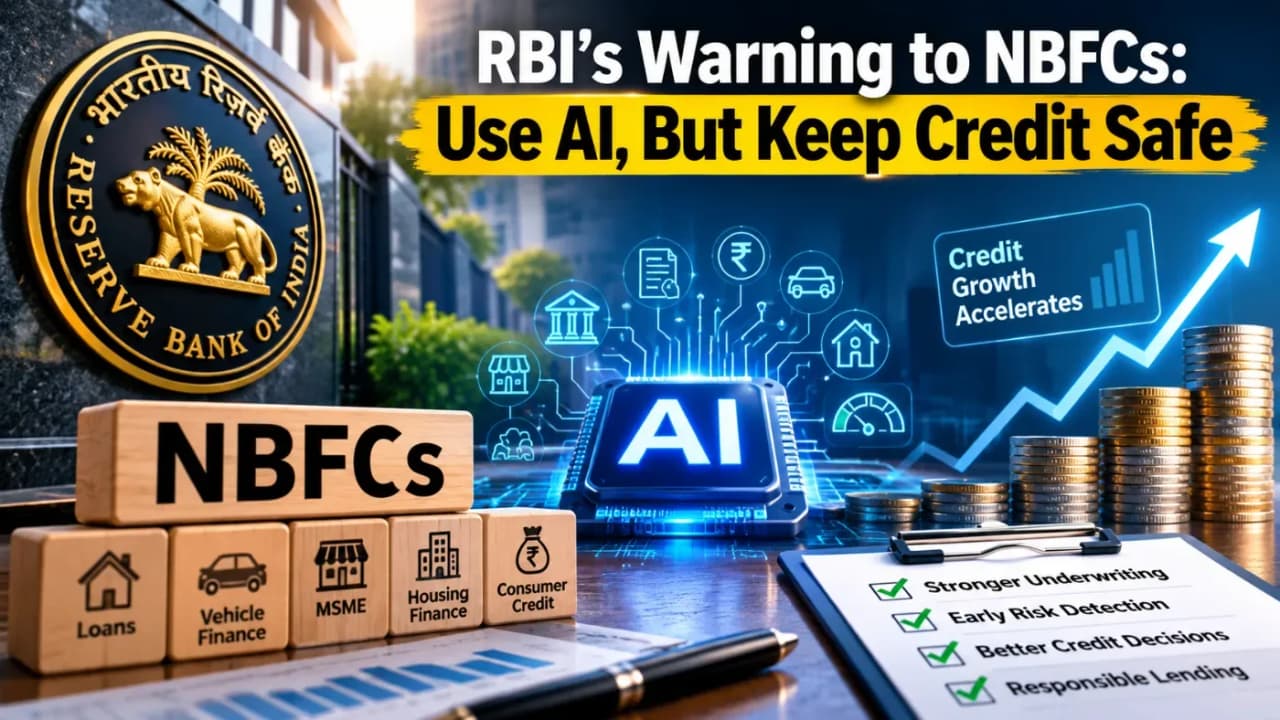
So, how does a massive NBFC with millions of customers ensure that every single loan is safe? The answer lies in modern technology. The RBI is aggressively pushing institutions to adopt Artificial Intelligence (AI) and Machine Learning (ML).
Moving Beyond Sales to Risk Mitigation
Until now, many financial companies have used AI primarily for marketing and sales. They use algorithms to figure out which customer is most likely to click on a loan advertisement. They use it to speed up the onboarding process so a customer can get money in five minutes.
The RBI wants this to change. They want lenders to point that massive computational firepower toward risk management.
Also Read | Why RBI Will No Longer Treat Every NBFC the Same Way?
Machine Learning as an Early Warning System
Machine Learning can process millions of data points in seconds. It can look beyond a traditional credit score. AI can analyze alternative data, like a borrower's utility bill payment history, their digital transaction frequency, and even broader economic trends in their specific geographic region.
By analyzing these subtle clues, AI acts as an early warning system. It can flag a borrower who might be facing financial stress months before they actually miss a loan payment.
If an NBFC knows a borrower is struggling early on, they can take proactive steps. They can restructure the loan, offer a payment holiday, or tighten further credit limits. This protects the lender's asset quality and helps the borrower avoid a total default.
Changing How Loans Are Given
Beyond AI, the actual mechanics of how loans are evaluated are shifting. The traditional way of lending is highly dependent on physical collateral. If you want a business loan, you usually have to pledge a piece of property or equipment.
The Shift to Cash-Flow-Based Lending
This collateral-based model leaves out millions of small businesses (MSMEs) that have great daily sales but do not own real estate. The RBI wants NBFCs to transition to cash-flow-based lending.
In this model, the lender looks at the actual money flowing in and out of the business's digital bank account. If the cash flow is strong and consistent, the business gets the loan, regardless of whether they own property.
What is Digital Public Infrastructure?
To make cash-flow-based lending possible, India is relying on its Digital Public Infrastructure (DPI). This includes revolutionary systems like the Account Aggregator framework and the Unified Lending Interface (ULI).
These systems allow a borrower to securely and instantly share their verified bank statements and GST data with a lender. There is no need for physical paperwork or forged documents. The lender's AI systems can instantly analyze this verified data, assess the true risk, and approve the loan safely.
The Systemic Risk: Why We Should All Care
You might be wondering why the RBI is so stressed about NBFCs. After all, if a private finance company makes bad choices and fails, isn't that just their problem? Unfortunately, in finance, everything is connected.
The Connection Between NBFCs and Traditional Banks
Remember how NBFCs get their money? They borrow it from large, traditional banks. If an NBFC hands out millions of bad retail loans, it will eventually run out of money.
When the NBFC runs out of money, it defaults on the massive loans it took from the traditional banks. Suddenly, the traditional bank is facing a crisis. This is known as financial contagion. A sickness in the NBFC sector can easily spread and infect the entire banking system, putting regular citizens' savings at risk.
Exploring New Avenues for Funding
To fix this dangerous dependency, industry leaders are calling for structural changes. At the summit, experts highlighted the need for NBFCs to find new ways to raise money.
Instead of just borrowing from local banks, NBFCs need a deeper corporate bond market. They need easier rules for External Commercial Borrowings (ECB), which would allow them to raise funds from global investors. By diversifying where they get their money, they reduce the systemic risk to the domestic Indian banking sector.
Consumer Protection in a Digital World
While securing the balance sheet is crucial, the RBI has not forgotten the actual human beings taking out these loans. Rapid digitalization brings its own set of dangers for consumers.
Stopping Mis-Selling and Fraud
When loan approvals become fully automated, there is a high risk of mis-selling. An app might hide hidden fees in the fine print, or aggressively push a vulnerable person into taking a loan they do not need.
The RBI has mandated that fast digitalization must not come at the expense of customer protection. Lenders must maintain fair conduct, transparent pricing, and responsible lending practices. If a customer has a problem, there must be a robust, easy-to-use grievance redressal system in place.
Read More: RBI Rules Out NBFCs New Rules; What It Means for You?
Building Trust Through Cyber Resilience
Furthermore, as NBFCs collect massive amounts of data for their AI models, they become targets for hackers. Cyber resilience is no longer optional. A data breach could expose millions of citizens to identity theft.
The RBI insists that as NBFCs upgrade their AI, they must simultaneously upgrade their cybersecurity. Trust is the foundation of the financial sector, and a single massive hack can destroy years of built-up consumer confidence.
NEWS4BHARAT Views: The Underlying Message
The RBI’s recent address to the non-banking sector is not just a routine regulatory update. It is a preemptive warning shot. For the past few years, NBFCs have aggressively capitalized on the post-pandemic retail credit boom. They relied on high-speed, frictionless digital onboarding to disburse unsecured consumption loans at breakneck speeds.
The End of Growth at All Costs
This directive signals the end of the "growth at all costs" era. The central bank is pointing out a glaring blind spot in the industry. Currently, lenders are using their best technology just to acquire customers faster. The regulator is demanding that this computational firepower be redirected toward protecting the balance sheet.
Pushing for Productive Lending
There is also a subtle nudge regarding credit allocation. The central bank is increasingly uncomfortable with the massive surge in consumption-driven loans—like borrowing money to buy a luxury phone or take a vacation.
By emphasizing Digital Public Infrastructure for MSMEs, the RBI is pushing lenders to pivot. They want capital to flow toward productive, cash-flow-based lending for small businesses. These are the loans that actually drive economic output, create jobs, and build the nation's infrastructure.
The Fear of Systemic Contagion
Finally, the sheer size of the NBFC sector is keeping regulators awake at night. At 27% of bank credit, these institutions are no longer peripheral players; they are systemically vital. The calls for deeper bond markets are critical. NBFCs must urgently decouple their liabilities from domestic banks and find independent, institutional pools of capital.
Conclusion
The Reserve Bank of India has drawn a line in the sand. As the financial sector hurtles forward into a digital future, the fundamental rules of banking remain unchanged. You must know your borrower, you must assess the risk accurately, and you must prioritize the safety of your assets above all else.
Also Read | Anuj Jain Joins Aye Finance as Chief Compliance Officer; Why This Matters for NBFCs?
By mandating the use of AI and Machine Learning for risk management, the RBI is forcing the industry to mature. For NBFCs, artificial intelligence is no longer just a shiny marketing buzzword. It is now an essential regulatory survival tool. Those who adapt will thrive in this new era of safe, sustainable, and technologically advanced lending. Those who ignore the warning and chase reckless growth will soon find themselves facing the harsh penalties of a vigilant regulator.