

You joined a company as an intern and expected to receive a stipend. Then HR deducted TDS—or worse, sent you a Form 16. Naturally, the question arises: if I am an intern, why am I being taxed like an employee?
Yes, an intern can receive Form 16 if the organization treats the payment as salary and deducts TDS under the applicable salary provisions. However, a stipend is not automatically taxable or tax-free merely because it is called a stipend.
Depending on the nature and purpose of the payment, a stipend may be taxable, may qualify for an exemption such as Section 10(16) in appropriate cases, or may be subject to different TDS documentation such as Form 16A.

Do Interns Get Form 16?
Whether an intern receives a Form 16 in India depends on how the employer classifies the intern's engagement, whether tax was deducted at source (TDS), and under which specific provision of the Income Tax Act, 1961 the deduction occurred. Interns may receive Form 16 if the organization treats their payment as salary and deducts tax under the salary-TDS provisions.
Is Internship Stipend Taxable in India?
While many interns assume that a "stipend" is inherently tax-exempt, Indian tax laws treat stipends according to the underlying legal relationship and the ultimate purpose of the payout. The word "stipend" itself does not decide taxability.
The Income-tax treatment depends on the substance and purpose of the payment, including:
- Why the payment is being made.
- Whether the recipient is primarily receiving education or training.
- Whether there is an employer-employee relationship.
- If the payment is intended to meet educational costs.
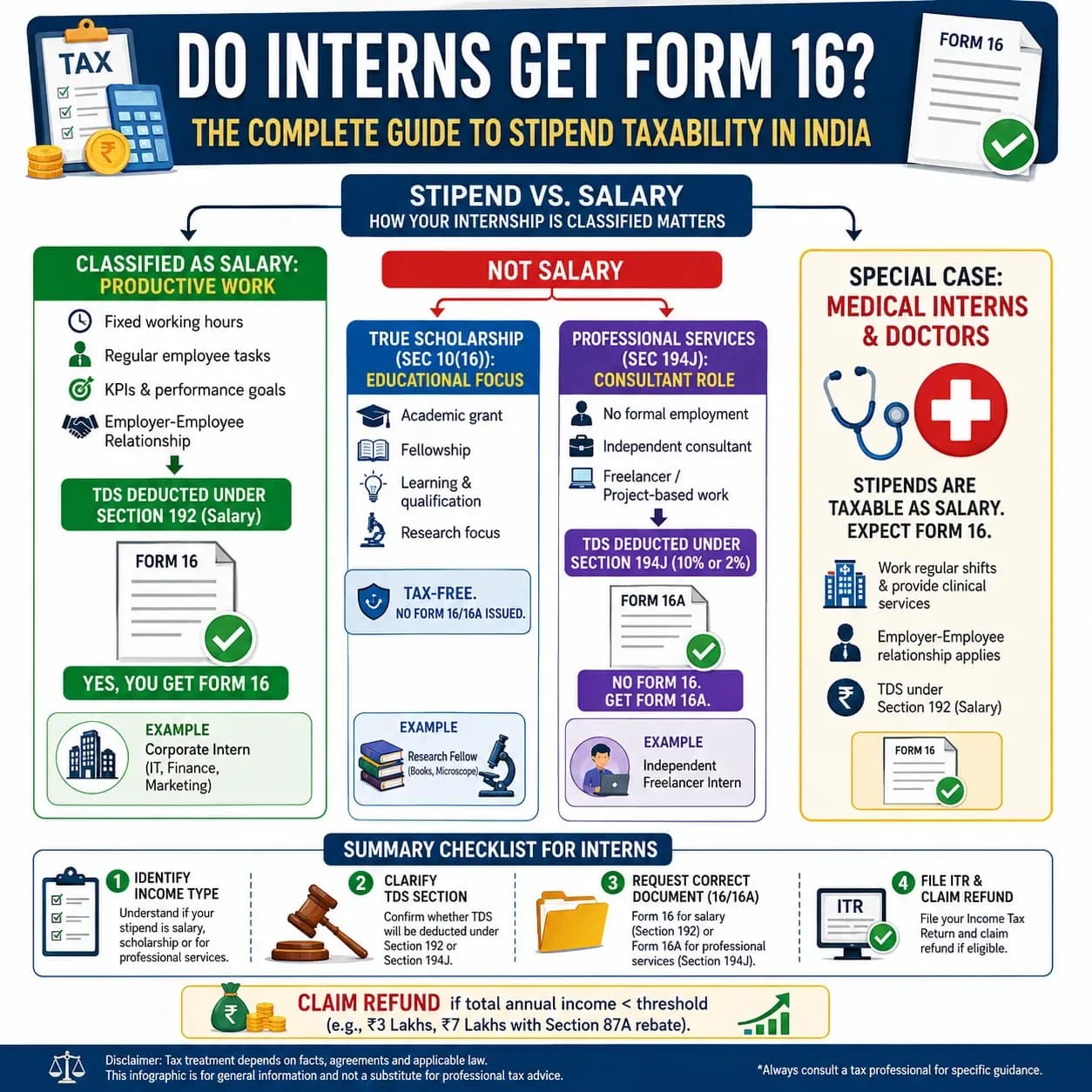
Stipend vs. Salary — The Legal Difference
The term "Stipend" is not defined anywhere in the Income Tax Act, 1961. Consequently, tax treatment is determined by applying statutory definitions of "Salary" and the specific exemption for "Scholarships".
For compensation to be taxed as "Salary" under Section 15, an employer-employee relationship (a master-servant relationship) must exist. This relationship exists when:
- Control & Supervision: The company sets working hours, assigns Key Performance Indicators (KPIs), mandates attendance, and manages daily execution.
- Productive Output: The intern performs tasks that contribute directly to company operations or commercial revenue.
- Contract of Service: The engagement letter functions as an employment contract rather than a pure training grant.
When these conditions are met, the stipend is legally classified as Salary under Section 17(1).
Also Read | Income Tax Bill 2026: How the New ‘Tax Year’ Changes Assessment Year and FY
When Can a Stipend Be Exempt Under Section 10(16)?
Under Section 10(16) of the Income Tax Act, "scholarships granted to meet the cost of education" are completely excluded from gross total income.
- As held by various judicial benches, the "cost of education" is not restricted to tuition fees alone.
- It encompasses living, travel, books, and daily incidental expenses incurred while gaining an education.
- If the payout is granted solely to enable the recipient to pursue studies, research, or academic qualifications without requiring commercial output, it qualifies as a tax-free scholarship.
Corporate Internship Stipend vs. Educational Scholarship
Corporate, tech, and management interns are generally fully taxable. Corporate internships in IT, investment banking, consulting, or marketing involve direct project contributions. Because the enterprise derives economic value from the intern’s work, the stipend cannot be claimed as an educational grant under Section 10(16).
It is reported under "Income from Salary" if Form 16 is issued, or "Income from Other Sources" if no TDS was deducted.
By contrast, Junior Research Fellowships (JRF), Senior Research Fellowships (SRF), and post-doctoral grants awarded by universities or government bodies exist solely to fund independent academic research and educational advancement. These are exempt under Section 10(16).
Similarly, stipends paid to Chartered Accountancy (CA) Articled Assistants are exempt from Income Tax. Under the Chartered Accountants Act, 1949 and ICAI regulations, articleship is mandatory practical training required to complete the professional qualification. Payouts are officially designated as stipends to cover incidental expenses rather than salary for services rendered, meaning it is treated as a scholarship under Section 10(16).
Form 16 vs. Form 16A for Interns
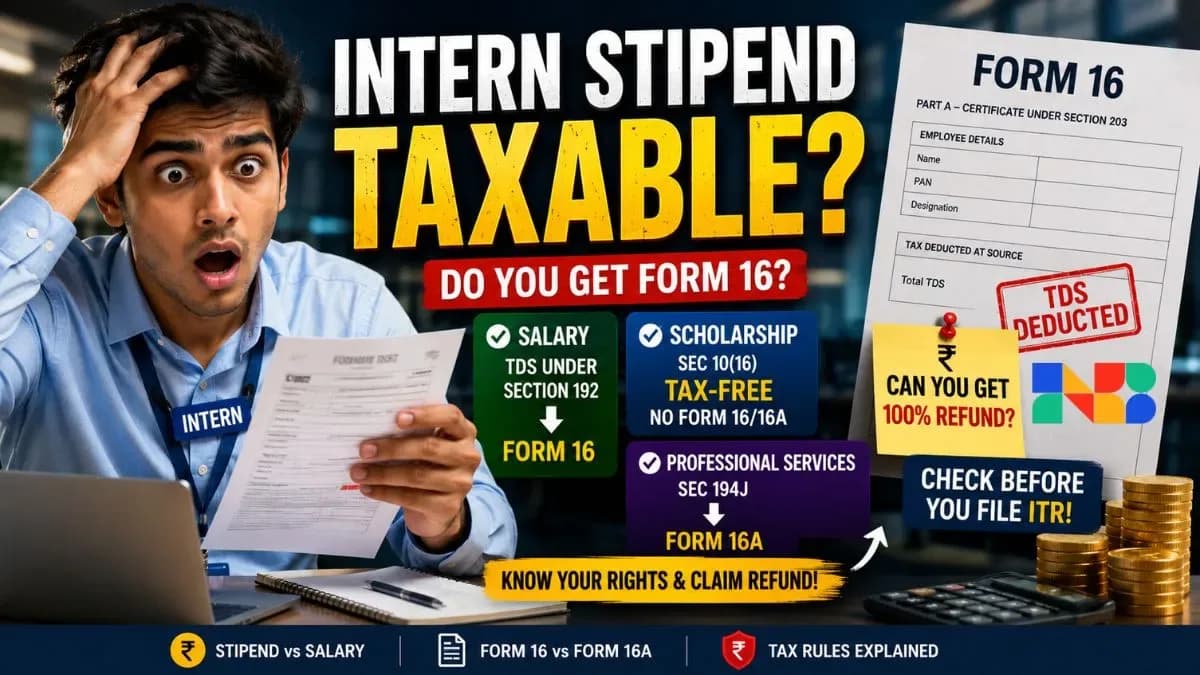
Receiving a Form 16 depends directly on the tax section used by the organization to deduct TDS.
Situation | Possible Document Issued |
| Payment treated as salary with salary TDS (Sec 192) | Form 16 |
| TDS on qualifying non-salary payment (e.g., Sec 194J) | Form 16A |
| No TDS deducted (Income below limits) | May receive neither |
| Educational scholarship | Depends on facts and documentation |
- Form 16: If an organization processes an intern's stipend through its standard payroll software, it treats the payment as salary. TDS is deducted under Section 192 if the intern's projected annual income crosses the basic exemption threshold. Form 16 Part A contains TRACES-generated details of tax withheld, PAN, TAN, and government Challan Identification Numbers (CIN). Form 16 Part B provides a breakup of gross stipend, standard deductions, regime choices, and net taxable salary.
- Form 16A: If an organization treats the intern as an independent professional or consultant, the applicable tax and TDS treatment depends on the actual nature of services and the relevant statutory provision. Tax might be withheld under Section 194J at 10% for professional services or 2% for technical services on payouts exceeding ₹30,000 per annum. In this case, the company issues Form 16A, a quarterly TDS certificate, instead of Form 16.
- No Document: If total stipend earnings fall below the basic exemption limit or if the payout is treated as exempt under Section 10(16), the employer is not legally obligated to deduct TDS or issue a Form 16/16A.
Does TDS Deduction Mean Your Stipend Is Taxable?
Not necessarily. TDS is a mechanism for collecting tax at source. The final tax treatment of an amount depends on the applicable provisions of the Income-tax law and the facts of the payment.
An intern should separately examine:
- The nature of the payment.
- The applicable head of income.
- Whether an exemption applies.
- The total taxable income for the year.
- The tax already deducted and reflected in tax records.
Are Medical Intern and Resident Doctor Stipends Taxable?
There is no single answer for every medical internship or residency. A medical stipend may potentially qualify for exemption under Section 10(16) where it is genuinely connected with education and is granted to meet the cost of education. However, where the facts show that the payment is effectively salary or remuneration for services under an employment relationship, tax authorities may treat it as taxable income.
READ MORE: How TDS & Compliance Changes Will Impact Salaries and Cash Flows
The taxability of stipends paid to MBBS interns and Post-Graduate (MD/MS/DNB) resident doctors is historically one of the most heavily litigated areas of Indian tax law. Tax authorities frequently argue that medical residents manage wards, perform clinical surgeries, attend night shifts, and provide routine patient care—duties identical to full-time medical officers. Thus, hospitals deduct Section 192 TDS and issue Form 16.
However, various judicial precedents support the educational exemption:
- The ITAT Delhi held that stipends received by PG medical students during residency attached to an academic program are intended to meet the cost of education and are exempt under Section 10(16), even if clinical duties are performed.
- The ITAT Chandigarh reaffirmed that primary residency training is an integral requirement for the award of an MD/MS degree; the stipend received is a non-taxable educational grant.
- The Karnataka High Court established that stipends paid to doctors pursuing higher studies/research to meet educational costs fall squarely under Section 10(16) exemption.
Understanding Tax Slabs and the Section 87A Rebate
Tax slabs and rebate thresholds can change through Finance Acts. Always check the rates applicable to the relevant financial year before calculating tax or deciding whether a refund is due.
For FY 2025–26 (AY 2026–27), under the default New Tax Regime, tax liability is structured with a basic exemption limit of ₹4,00,000. Income from ₹4,00,001 to ₹8,00,000 is taxed at 5%, and ₹8,00,001 to ₹12,00,000 is taxed at 10%.
Resident individuals earning a total taxable income up to ₹12,00,000 receive a tax rebate up to ₹60,000 under Section 87A, reducing net tax payable to ₹0. Salaried interns receiving Form 16 are eligible for a ₹75,000 standard deduction under Section 16(ia). This means an intern earning a gross taxable salary stipend up to ₹12,75,000 under the New Tax Regime pays zero income tax.
Can You Claim a Refund of TDS Deducted From Your Internship Pay?
Yes. TDS is tax already deducted, but the final liability depends on your total taxable income. Eligible taxpayers may receive refunds after filing the appropriate return.
If an employer deducted TDS under Section 192 or 194J but your total annual taxable income is below the taxable threshold, you can claim a complete refund of the tax withheld. Automated processing under Section 143(1) will compute the excess tax paid and credit the full refund directly to your bank account with statutory interest under Section 244A.
What Should an Intern Check Before Filing an ITR?
Before filing your taxes, verify your Form 26AS and Annual Information Statement (AIS) to cross-check the total TDS deducted by the employer under your PAN on the portal. You must also gather your internship agreement, offer/appointment letter, salary slips, Form 16, Form 16A, bank credits, and TDS details.
- File ITR-1 (Sahaj) if your stipend is reported in Form 16 under Section 192, and total income is below ₹50 Lakhs. You can claim the ₹75,000 Standard Deduction here.
- File ITR-2 if you claim Section 10(16) exemption for exempt stipends/scholarships exceeding ₹5,00,000 or if you have capital gains from investments.
- File ITR-3 or ITR-4 (Sugam) if tax was deducted under Section 194J and you received Form 16A.
If you are claiming a full tax exemption, navigate to Exempt Income (Schedule EI) and select "Section 10(16) - Scholarships granted to meet the cost of education". Entering the total annual stipend amount removes the amount from taxable income while ensuring full statutory disclosure.
Tax treatment can depend on the specific facts of an internship, appointment agreement, and applicable law for the relevant financial year. This article is for general informational purposes and is not a substitute for professional tax advice.