

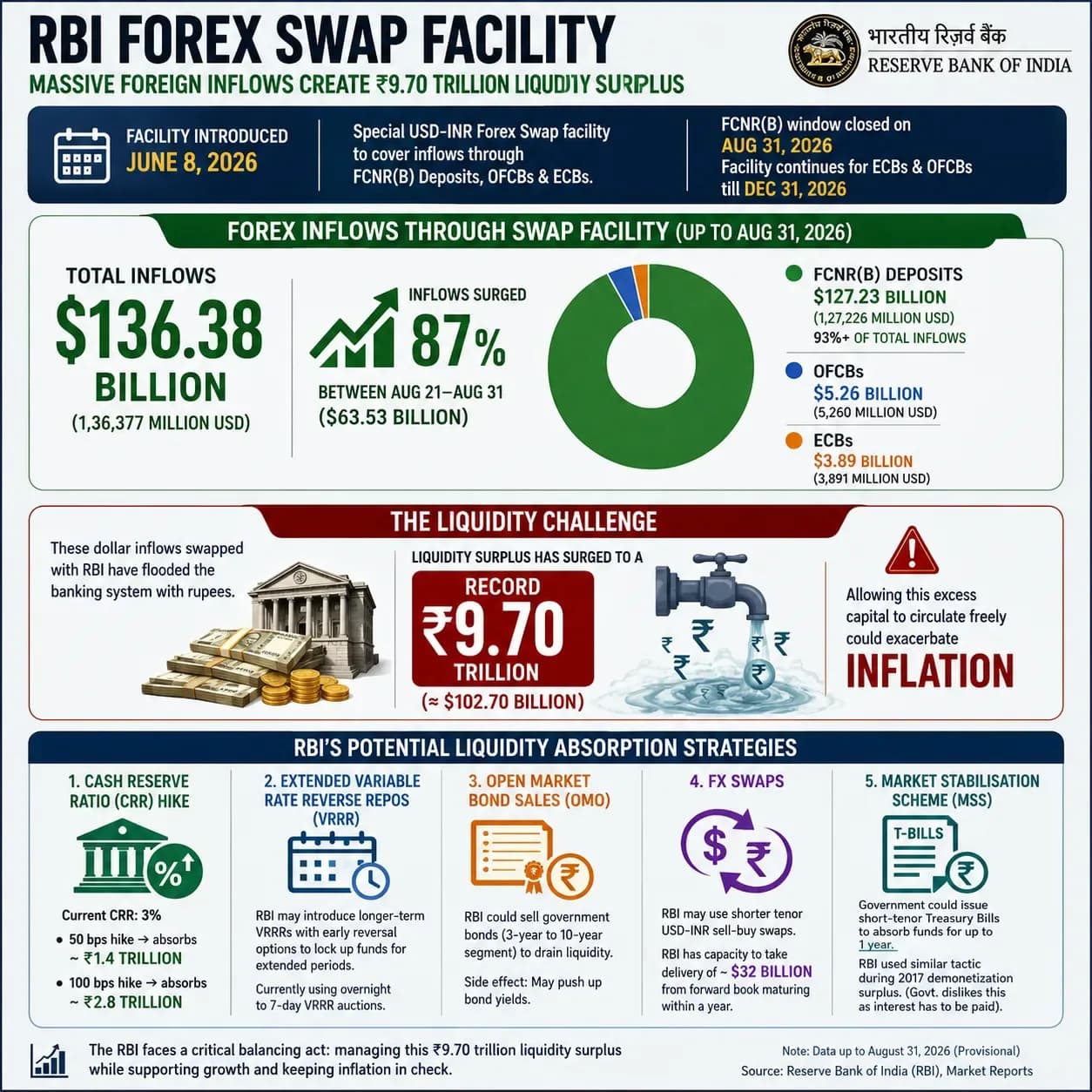
The global financial landscape just witnessed a massive movement of capital into India. Recently, the RBI forex swap facility created a tidal wave of foreign exchange inflows, securing a staggering $136.38 billion as of August 31, 2026.
While a war chest of foreign dollars is generally excellent news for a country's economic stability, it has created a unique problem: a "problem of plenty". When banks hand these dollars over to the Reserve Bank of India (RBI), they get Indian rupees in return. This dynamic has pushed the liquidity surplus in India's banking system to an all-time high of 9.70 trillion rupees ($102.70 billion).
If you are wondering how this happened, why too much money can actually be a bad thing, and how the central bank plans to fix it, this guide breaks it down in simple terms.
The Avalanche of Dollars: Breaking Down the Numbers
To understand the scale of this event, we have to look at how the money entered the country. The RBI introduced this special USD-INR Forex Swap facility on June 8, 2026. It was designed to cover inflows from three main sources: Foreign Currency Non-Resident (Bank) deposits, External Commercial Borrowings (ECBs), and Overseas Foreign Currency Borrowings (OFCBs).
The response was overwhelming. According to the RBI's provisional data, the total inflows reached $136.38 billion.
Here is exactly where that money came from:
- FCNR(B) Deposits: These brought in $127.23 billion (1,27,226 million USD), accounting for the absolute bulk of the money.
- OFCBs: These borrowings added $5.26 billion (5,260 million USD).
- ECBs: These contributed another $3.89 billion (3,891 million USD).
What Exactly Are FCNR(B) Deposits?
Think of an FCNR(B) deposit as a special savings account for Non-Resident Indians (NRIs). Instead of keeping their money in rupees, NRIs can deposit foreign currencies (like US Dollars or British Pounds) into Indian banks.
The window for these specific deposits under the RBI's special scheme closed on August 31, 2026, triggering a massive last-minute rush. Between August 21 and August 31, total inflows skyrocketed by 87%, adding about $63.53 billion in just ten days. FCNR(B) deposits alone jumped by about $61.83 billion during this tiny window.
(Note: The window for ECBs and OFCBs will remain open until December 31, 2026).
The Ripple Effect: Why Too Much Money is a Problem
It sounds strange to say that a country has "too much money." However, in macroeconomics, an extreme cash surplus in the banking system can be dangerous.
When the commercial banks collected that $136.38 billion from overseas, they didn't just hold onto it. They swapped those dollars directly with the RBI. In exchange for the dollars, the RBI credited the banks with Indian rupees.
Suddenly, domestic banks are sitting on an extra 9.70 trillion rupees.
Also Read | Indian Rupee Near ₹95.60/$: Why It Is Falling and What RBI Is Doing
The Inflation Connection
If banks have massive amounts of spare cash, they naturally want to lend it out. If too much money is loaned out to businesses and consumers, spending skyrockets. When everyone is spending but the actual supply of goods (like cars, houses, and groceries) stays the same, prices go up. This is the textbook definition of inflation.
Traders and economists are currently debating how the RBI will stop these funds from sloshing around and fanning already-rising inflation.
The RBI's Arsenal: How to Drain the Swamp
The Reserve Bank of India acts like the financial system's thermostat. Right now, the system is running too hot, and the RBI needs to cool it down by pulling rupees out of circulation.
Financial experts have identified five main tools the RBI might use to absorb this 9.70 trillion rupee surplus.
1. The Cash Reserve Ratio (CRR) Strategy
The most common and direct tool is the Cash Reserve Ratio (CRR). The CRR is simply the percentage of total deposits that banks are legally required to keep locked in a vault (or with the RBI) rather than lending out.
- Currently, the CRR sits at 3%. Market participants believe the RBI could temporarily raise this percentage.
- A 50 basis point (0.50%) increase would instantly suck about 1.4 trillion rupees out of the system.
- A full 100 basis point (1.00%) increase would withdraw around 2.8 trillion rupees.
2. Long-Term VRRR Auctions
The central bank routinely uses Variable Rate Reverse Repo (VRRR) auctions to manage daily cash flows. Usually, these operations lock up excess bank liquidity for just a few days (overnight to seven days).
However, traders suggest the RBI might start conducting longer-term VRRRs, giving banks the option to reverse them early if needed. Think of this as the RBI offering banks a high-interest, short-term CD (Certificate of Deposit) to convince them to park their cash at the central bank instead of lending it to the public.
3. Open Market Bond Sales (OMO)
Another effective method is for the RBI to sell off government bonds it currently holds to investors.
When investors buy these bonds, they pay the RBI in rupees, effectively removing that cash from the public system. Upasna Bhardwaj, chief economist at Kotak Mahindra Bank, noted that these bond sales would likely focus on the three-year to 10-year maturity segment. However, selling large amounts of bonds comes with a catch: it generally pushes bond yields (interest rates) higher.
Read More: Suman Ray RBI Executive Director: DICGC Role Explained
4. FX Swaps
The RBI could also fight fire with fire using shorter-tenor dollar-rupee sell-buy swaps.
By selling dollars back to the market, or taking delivery of forward positions, the RBI pulls rupees back into its own vaults. Madhavi Arora, an economist at Emkay Global, suggested that the RBI might comfortably take delivery of around $32 billion from its forward book that matures in one year.
5. The Market Stabilisation Scheme (MSS)
Finally, there is the Market Stabilisation Scheme (MSS). This was famously used in 2017 after India's demonetization drive resulted in a massive surge of banking deposits.
Under this scheme, the government issues short-term Treasury bills specifically designed to absorb surplus liquidity for up to a year. However, traders point out that the government generally dislikes using this tool because it forces them to pay interest on those securities.
In the coming weeks, the financial world will be watching closely as the RBI deploys a mix of these strategies to digest its record-breaking dollar haul while keeping domestic inflation firmly in check.