

The financial world is buzzing with a massive update that impacts two of the largest institutions in the country. If you actively follow the Indian stock market or banking news, you need to pay attention to this development. The Reserve Bank of India (RBI) has officially stepped in to grant a major clearance. They have approved a significant potential increase in the LIC ICICI Bank stake. But what does this actually mean for the everyday investor, and why is this such a monumental deal for the economy? Let us break down the complex financial jargon into simple, easy-to-understand terms.
Understanding the Big Announcement
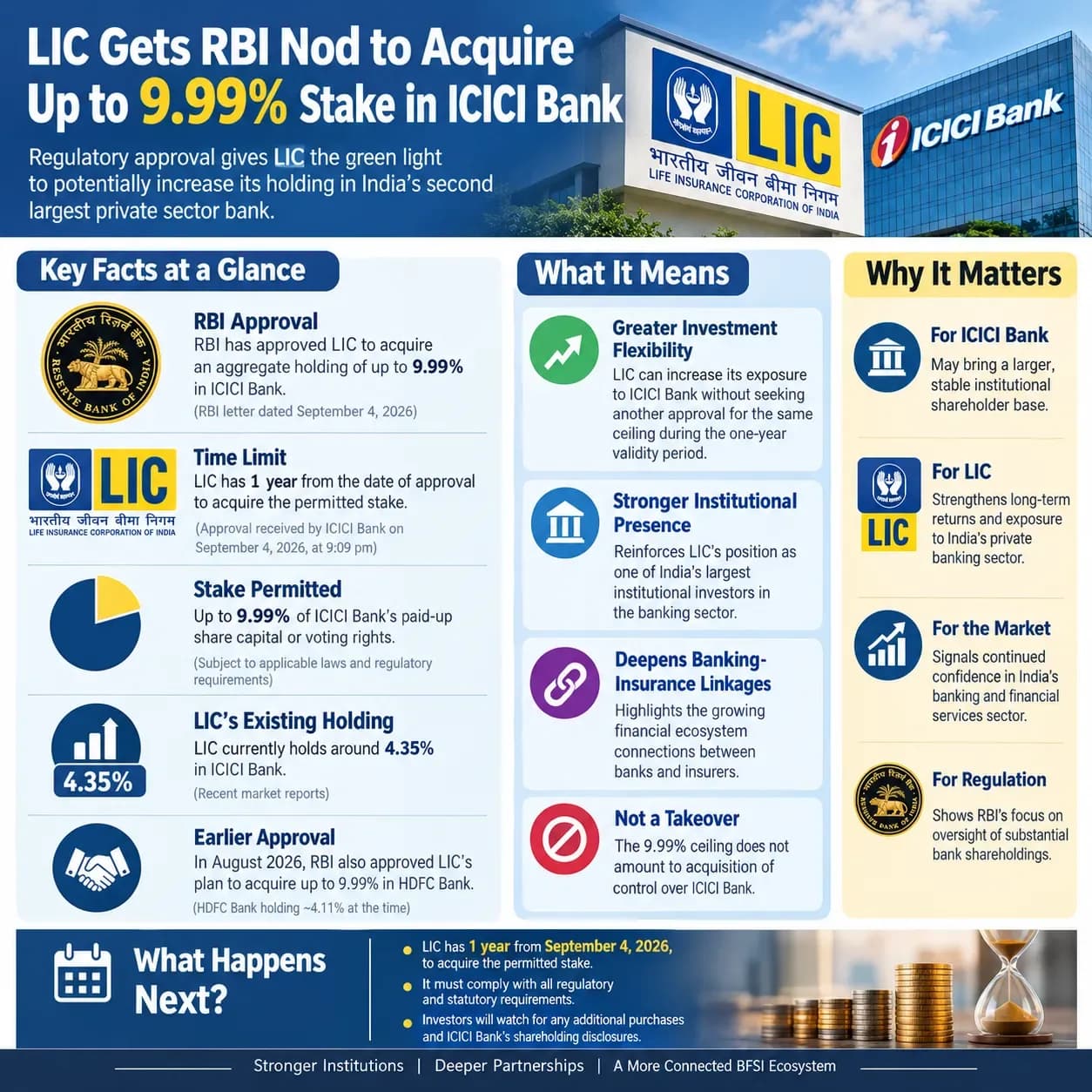
On the evening of September 4, 2026, ICICI Bank received a very important letter from the Reserve Bank of India. The contents of that letter were promptly shared with the stock exchanges. The central bank gave the Life Insurance Corporation of India (LIC) the green light to acquire up to 9.99% of ICICI Bank’s paid-up share capital.
To put this into perspective, LIC is already a massive player in the Indian economy. As the country's largest insurer, it collects billions in premiums and has to invest that money somewhere to generate returns. A large chunk of those investments goes directly into the Indian stock market.
By getting this nod from the RBI, LIC now has the legal headroom to significantly boost its ownership in one of India's largest and most profitable private-sector banks. However, there are rules and timelines attached to this permission.
Read More: RBI ₹7 Lakh Crore VRRR Auction: Why Bank Liquidity Is Surging
The Magic Number: 9.99 Percent
You might be wondering why the approval is specifically for 9.99% and not a rounded number like 10%. In the Indian banking sector regulations, crossing the 10% threshold changes a shareholder's legal status and brings in an incredibly strict layer of regulatory scrutiny. By staying at 9.99%, LIC remains a "public shareholder" rather than a promoter or controlling entity.
Currently, LIC holds about a 4.35% stake in ICICI Bank. This means that if they want to, LIC has the room to more than double its current investment. They do not have to buy all these shares tomorrow, but the ceiling has been lifted to allow for future purchases.
Why the RBI Step-In Was Required
Many people ask why a company like LIC cannot just log into a trading account and buy whatever shares they want. When you or I buy shares on the stock market, we can buy as much as we can afford. But when it comes to banks, the rules are entirely different.
The 5 Percent Banking Rule
Banks hold the public's money, making them the backbone of the economy. Because of this, the Reserve Bank of India is incredibly protective of who owns them. Under current RBI rules, any single investor or entity that wants to buy 5% or more of a bank's total shares must get explicit, prior approval from the RBI.
Since LIC currently sits at 4.35%, any further major purchases would have pushed them over that 5% line. Therefore, LIC proactively applied for permission to go all the way up to 9.99%. The RBI reviewed the application, ensured everything was financially sound, and granted the permission.
Read More: RBI Warns NBFCs: Don’t Sacrifice Asset Quality for Rapid Growth
Is This a Hostile Takeover?
Whenever news breaks about one massive corporation buying up shares of another, people naturally worry about a takeover. Let us clear the air immediately: this is absolutely not a takeover.
LIC is what the financial world calls a Domestic Institutional Investor (DII). Their primary goal is not to run a bank, manage branches, or issue credit cards. Their goal is simply to make their money grow so they can pay out life insurance claims to their policyholders.
Even if LIC hits the maximum 9.99% limit, they will not have control over ICICI Bank’s day-to-day operations. They will just be a very large, silent partner enjoying the dividends and the stock price appreciation that ICICI Bank generates.
The Strategy: Why is LIC So Interested in Banks?
To understand this move, we have to look at the broader picture of how LIC operates. LIC manages trillions of rupees. They need safe, reliable, and growing companies to park this money into.
The Indian banking sector is experiencing a massive boom. As the country's middle class expands, more people are taking out home loans, buying cars, and using credit cards. Private sector banks like ICICI Bank are at the forefront of this credit-growth cycle. By investing heavily in these banks, LIC ensures that its own wealth grows alongside the Indian economy.
The HDFC Bank Connection
This ICICI Bank approval is not an isolated incident. In fact, it is part of a very clear, calculated pattern. Just a few weeks prior, in August 2026, the RBI granted LIC the exact same approval regarding HDFC Bank.
At that time, LIC held about a 4.11% stake in HDFC Bank, and the RBI allowed them to increase it up to 9.99%. LIC also holds massive amounts of shares in public sector giants like the State Bank of India (SBI) and Punjab National Bank. By spreading its wealth across all the major players, LIC is essentially betting on the success of the entire Indian banking system.
The One-Year Ticking Clock
One of the most crucial details of this RBI approval is that it comes with an expiration date. LIC does not have unlimited time to make up its mind.
The central bank has given LIC a strict one-year window, starting from September 4, 2026, to acquire these shares. If September 2027 rolls around and LIC has not increased its stake to 9.99%, the approval simply lapses. If they want to buy more shares after that date, they will have to start the paperwork all over again.
This gives LIC incredible flexibility. They can wait for the stock market to dip and buy ICICI Bank shares at a discount. They are not forced to rush into the market and buy at inflated prices.
What This Means for Everyday Investors
If you hold shares in ICICI Bank, or even if you just invest in mutual funds, this news has direct implications for you.
First, it brings a massive wave of confidence. When India's largest institutional investor signals that it wants to buy more of a specific stock, it tells the rest of the market that the stock is highly valued and fundamentally strong. It acts as a powerful stamp of approval.
Second, it provides stability. LIC is a "long-term" investor. Unlike day traders who buy and sell in hours, LIC holds onto shares for years, sometimes decades. Having a massive chunk of ICICI Bank shares locked away in LIC’s vaults means the stock is less likely to experience wild, chaotic price swings during market panics.
Deepening the Financial Ecosystem
This move perfectly illustrates how interconnected India's financial sectors have become. The insurance sector and the banking sector rely heavily on one another.
Banks often sell insurance products to their customers (a practice known as bancassurance). In turn, insurance companies take the premiums they collect and invest them back into the banks. This creates a closed-loop system of capital that keeps the wheels of the national economy turning smoothly.
Read More: How RBI Forex Swap Facility Inflows Hit a Massive $136.38B
The Road Ahead: What to Watch Out For
Now that the regulatory hurdles have been cleared, the ball is entirely in LIC's court. Financial analysts and stock market watchers will be keeping a very close eye on the stock exchange disclosures over the next twelve months.
Every time a company’s shareholding pattern changes significantly, they must report it to the exchanges. The key thing to watch is the pace at which LIC buys. Will they slowly drip-feed their money into ICICI Bank every month? Or will they wait for a broader market correction to buy a massive block of shares all at once?
Regardless of the timeline, this RBI approval cements LIC’s position as the undisputed whale of the Indian stock market. It proves that as India’s private banking sector grows, LIC plans to be right there to reap the financial rewards.