

Imagine a massive water tank that supplies an entire city. If the water level gets too low, people go thirsty. If the water level gets too high, the tank overflows and causes flooding.
The banking system works in the same way, but with cash instead of water. Right now, the Indian banking system's "water tank" is overflowing to historic levels. To prevent a financial flood, the central bank has stepped in.
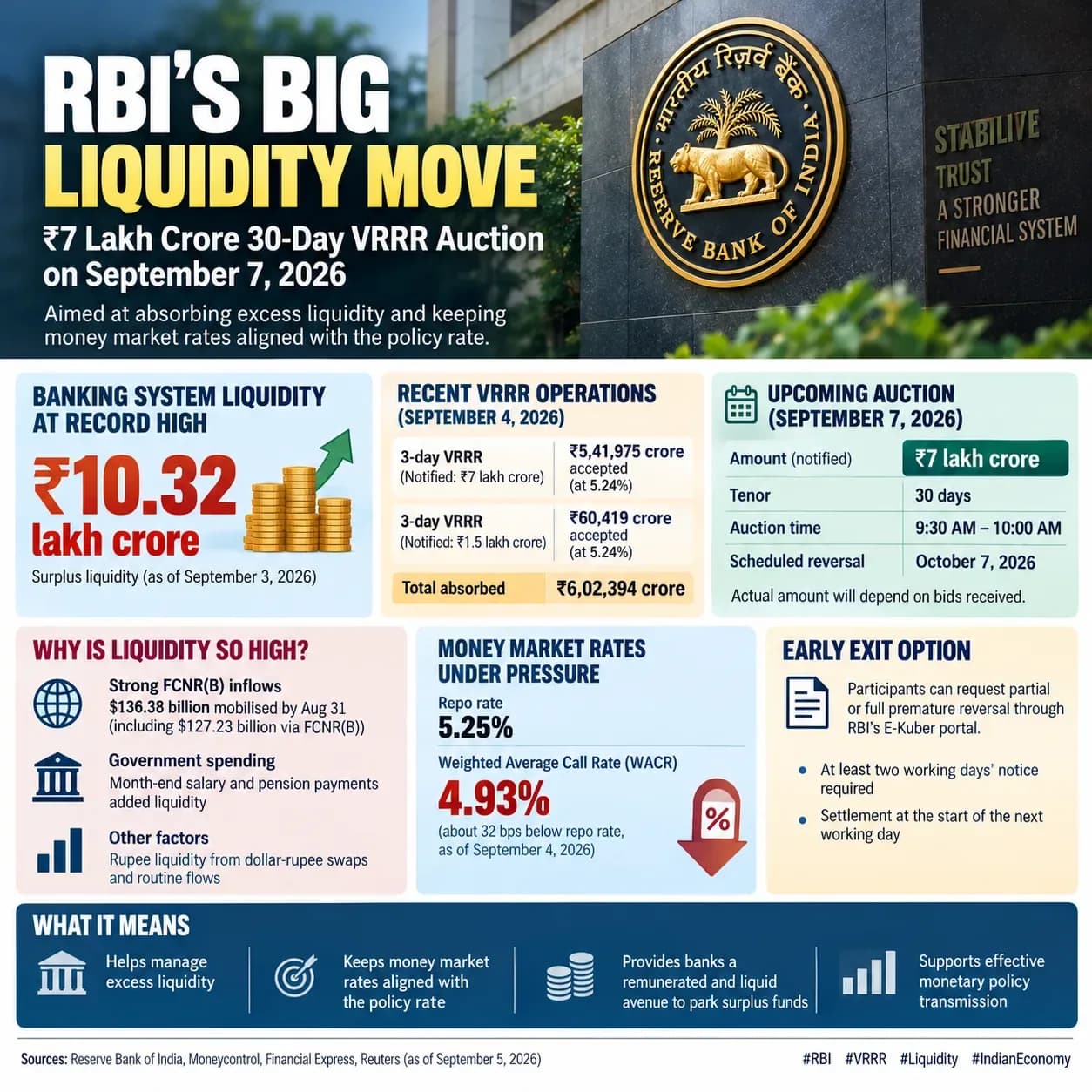
The upcoming RBI ₹7 lakh crore VRRR auction scheduled for September 7, 2026, is the ultimate pressure-release valve. This operation is designed to safely absorb excess cash and restore balance to the financial ecosystem. But what exactly does this mean for the everyday citizen, the banking sector, and the broader Bharat growth story?
Let us break down this complex monetary mechanism into simple, easy-to-understand concepts.
Understanding the ₹10.32 Lakh Crore Problem
To understand the solution, we first need to understand the scale of the "problem of plenty." As of September 3, 2026, the banking system liquidity surplus hit a staggering estimated figure of ₹10.32 lakh crore.
This means that after fulfilling all their daily requirements, clearing all customer withdrawals, and meeting their mandatory reserve ratios, Indian banks are sitting on over ten trillion rupees of idle cash.
For a bank, idle cash is terrible. Banks are businesses. They take money from depositors, pay them interest, and then lend that money out at a higher interest rate to make a profit. If the cash just sits in the vault, the bank loses money every single day.
To Know More, Read: How RBI Forex Swap Facility Inflows Hit a Massive $136.38B
Why Too Much Cash is a Headache
When banks have mountains of excess cash, they scramble to lend it out to each other in the overnight money markets. This intense competition to deploy funds drives short-term interest rates down.
In a healthy economy, the RBI wants short-term interest rates to hover closely around its official benchmark, known as the repo rate (currently at 5.25%). But because of this massive cash glut, the Weighted Average Call Rate (WACR) has plummeted.
By early September, the WACR had dropped to around 4.93%, roughly 32 basis points below the RBI's target. If this goes unchecked, the RBI loses its grip on monetary policy transmission, meaning its carefully planned economic strategies stop working properly.
The Global Vote of Confidence: Where Did the Cash Come From?
You might be wondering: how did Indian banks suddenly end up with an extra ₹10.32 lakh crore? The answer lies in the sheer global confidence in the Bharat growth story.
The surplus was not created out of thin air. It is the direct result of massive foreign capital inflows and domestic fiscal operations colliding at the same time.
The Role of FCNR(B) Deposits in India
A major catalyst for this cash surge was the RBI's special foreign-exchange measures. Over recent months, global investors and Non-Resident Indians (NRIs) poured money into India. By August 31, these measures mobilized a breathtaking $136.38 billion.
The lion's share of this—about $127.23 billion—came through Foreign Currency Non-Resident (Bank), or FCNR(B), deposits. This shows immense trust in the Indian economy. But foreign dollars cannot be directly lent out as rupees to local businesses in Gorakhpur or Pune.
The Dollar-to-Rupee Swap
When these billions of dollars entered domestic shores, the RBI stepped in. Through complex financial transactions and swaps, the RBI took the incoming dollars into its reserves and released the equivalent amount of rupees into the domestic banking system.
This dollar-to-rupee conversion acted like a massive firehose of cash, instantly flooding commercial banks with unprecedented liquidity. In fact, demand from foreign investors was so incredibly strong that the RBI had to close the FCNR(B) facility ahead of schedule.
The Government Spending Catalyst
Foreign inflows were only half the story. The end of August also coincided with routine, but massive, government expenditures.
The government pays out salaries to millions of public sector employees, clears pensions, and pays contractors for infrastructure projects. When the government spends, it moves money from its accounts directly into the bank accounts of everyday citizens and businesses.
This combination of foreign-currency inflows and domestic government spending pushed the banking system liquidity surplus from an average of ₹1.07 lakh crore in July to over ₹10.32 lakh crore by early September.
What is a VRRR Auction? (Explained Simply)
So, the banks have too much money, and short-term interest rates are falling too fast. Enter the RBI's primary cleanup tool: the Variable Rate Reverse Repo (VRRR) auction.
Think of the RBI as the ultimate "bank for banks." When commercial banks have too much cash, they can park it with the RBI for safekeeping and earn interest on it.
Breaking Down the Acronym
Let us look at what VRRR actually stands for:
Variable Rate: Unlike the standard fixed reverse repo rate (which sits lower at 3.35%), the interest rate in this auction is decided by the market. Banks bid on the rate they want.
Reverse Repo: A "repo" is when banks borrow from the RBI. A "reverse repo" is when banks lend their surplus money to the RBI.
Auction: The RBI announces it wants to absorb a specific amount of money (like ₹7 lakh crore), and banks compete to offer their surplus cash at competitive rates.
The RBI's Proactive Response
The RBI is not taking this liquidity glut lightly. The central bank's liquidity management strategy has been swift, calculated, and executed in multiple phases.
The September 4 Precursor
Before announcing the massive 30-day operation, the RBI tested the waters with shorter-term absorptions. On September 4, the central bank conducted two separate 3-day VRRR auctions.
The notified amounts were massive. The RBI aimed for ₹8.5 lakh crore across both operations. Ultimately, the central bank accepted ₹6,02,394 crore (over ₹6.02 lakh crore) at a cut-off rate of 5.24%.
This immediate action successfully mopped up a large chunk of the surplus cash over the weekend, proving that banks were desperate for a safe, remunerated place to park their funds.
The September 7 Mega-Auction: A Shift in Strategy
Short-term 3-day auctions are like bailing water out of a leaky boat with a small bucket. The money comes right back into the system three days later. To truly stabilize the financial plumbing, the RBI needed a bigger bucket.
This is why the September 7 operation is so historic. The RBI announced a massive 30-day VRRR auction with a notified amount of ₹7 lakh crore.
Why 30 Days Matters
By locking up the money for an entire month, the RBI is shifting away from overnight firefighting. A 30-day absorption provides a durable, longer-lasting reduction in surplus cash.
This longer duration gives the central bank greater control over short-term money-market conditions. It prevents it from having to resort immediately to blunt, permanent tools, like raising the Cash Reserve Ratio (CRR), which could shock the market. The funds absorbed on September 7 are scheduled to reverse and return to the banks on October 7, 2026.
The E-Kuber Early-Exit Option
But what if a bank parks its money for 30 days and suddenly faces a massive surge in loan demand two weeks later? The RBI has thought of this, too.
The 30-day VRRR is not a rigid prison for capital. Participating banks have an early-exit option through the RBI's E-Kuber system.
If a bank needs its cash back early, it can request a partial or full premature reversal. They simply need to submit a request on a working day at least two days before they need the funds. This brilliant safety valve ensures banks remain flexible while the RBI maintains broad control over systemic liquidity.
Debunking the Bank Net Interest Margins (NIM) Myth
There is a common misconception floating around financial circles that this VRRR operation is designed to artificially protect bank Net Interest Margins (NIMs). We need to set the record straight: this is factually inaccurate.
What Actually Impacts NIM?
A bank's Net Interest Margin is the difference between the interest it pays out to depositors and the interest it earns from loans and investments.
When the banking system has ₹10.32 lakh crore of excess liquidity, the returns on overnight money markets plummet. The VRRR simply allows eligible banks to park surplus funds with the RBI at a fair, auction-determined rate (usually near the 5.25% repo rate).
A Safe Parking Spot, Not a Profit Guarantee
However, earning 5.24% in a VRRR auction does not automatically protect a bank's profit margin if a bank is paying its retail customers 7% on fixed deposits, parking that money at 5.24% with the RBI still results in a negative spread on those specific funds.
Therefore, the VRRR is best understood as a highly liquid treasury deployment tool. It prevents banks from earning zero (or taking massive risks to chase returns), but the ultimate impact on NIMs depends entirely on a bank's broader funding costs and credit demand.
What Does This Mean for the Bond Market?
Another frequent question is how this massive ₹7 lakh crore absorption will impact government bonds and the sovereign yield curve.
Money Market vs. Bond Market
It is vital to separate the short-term money market from the long-term bond market. Changes in banking-system liquidity directly influence banks' appetite for short-term instruments.
When cash is drained via VRRR, banks have less idle money to buy up short-term Certificates of Deposit (CDs) and Commercial Paper (CP). This naturally helps support short-term yields.
The Bigger Picture for G-Secs
However, it would be incorrect to say this single VRRR auction will stabilize the entire government bond market. Yields on long-term government securities (G-Secs) are determined by much larger macroeconomic forces.
Factors like government borrowing supply, investor demand, global bond yields, and long-term inflation expectations play a much heavier role. The VRRR is a plumbing tool for the banking sector, not a magic wand for the sovereign yield curve.
Looking Ahead: The Resiliency of the Indian Economy
The events leading up to September 7 are a testament to the scale and maturity of India's financial system today.
Decades ago, a massive influx of foreign capital might have caused uncontrollable inflation or currency volatility. Today, the Reserve Bank of India possesses the sophisticated, market-based tools required to absorb a ₹10.32 lakh crore surplus seamlessly.
What Happens Next?
The entire financial world will be watching the auction on Monday morning. The key metric to watch is not just the notified amount of ₹7 lakh crore, but how much the banks actually bid, and at what specific cut-off rate.
If banks eagerly lock away massive sums for 30 days, it will prove that the RBI's strategy has successfully neutralized the excess cash without disrupting the flow of credit to the real economy.
Ultimately, this situation is a "problem of plenty." It reflects a Bharat that is attracting immense global capital, generating robust domestic fiscal activity, and being managed by a proactive, highly competent central bank. While the numbers are staggeringly large, the financial plumbing is holding strong, ensuring the nation's growth engine continues to run smoothly.
Also Read | Green Bonds in India: A Complete Guide to the Market and Regulations