

Beyond the $18 Billion Timer: Analyzing Meta’s Landmark Meta Teen Safety Settlement
Meta’s recent agreement to a settlement package worth up to roughly $18 billion is not simply a penalty for allegedly harmful social-media design. It represents an ambitious attempt to reset the rules of youth engagement online—by altering default settings, mandating robust age assurance, establishing independent oversight, and uniquely tying billions in financial obligations to whether its biggest rivals adopt similar safeguards.
Yet, underneath the massive headline figure lies a central, unresolved tension: whether this agreement meaningfully alters Meta's engagement-driven business model, or if it merely puts a timer around it.
The Legal Context: Allegations, Not Admissions
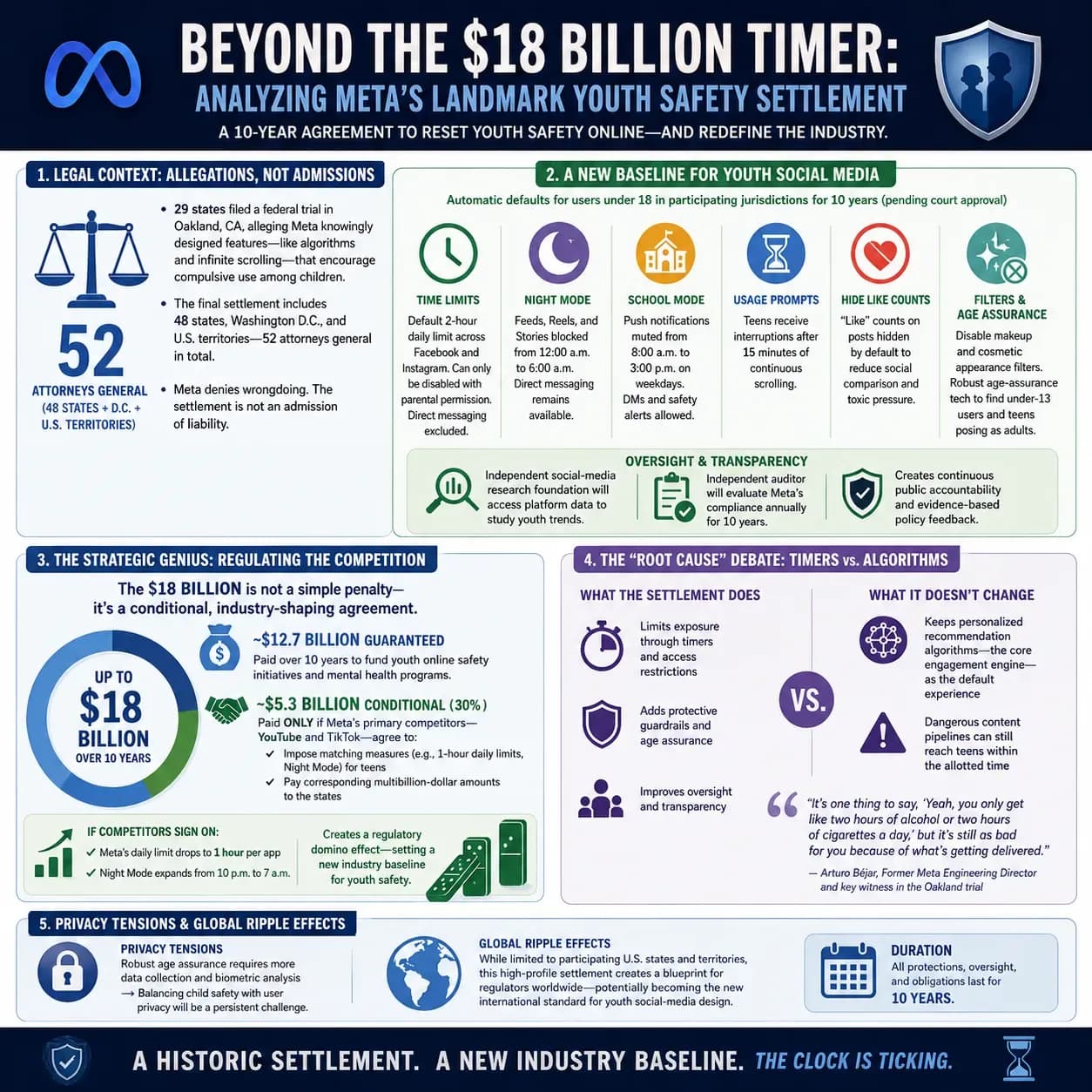
To understand the settlement, it is crucial to clarify the legal landscape. The federal trial in Oakland, California, which was halted by this agreement, involved 29 states acting jointly to hold Meta accountable for its platforms' effects on children. The state prosecutors alleged that Meta knowingly designed features—such as recommendation algorithms and infinite scrolling—that encouraged compulsive use among young users, despite internal and external warnings about potential harms.
However, the final settlement coalition is much broader than the trial group, encompassing 48 states, Washington D.C., and several U.S. territories, totaling 52 attorneys general. Crucially, the settlement does not establish the states' allegations as adjudicated facts; Meta has explicitly denied wrongdoing, and the agreement is not an admission of liability.
A New Baseline for Youth Social Media
The agreement mandates significant behavioral guardrails that fundamentally shift the responsibility of teen safety from solely resting on parents to being co-managed by the platform.
Pending judicial approval, these protections will apply automatically to under-18 accounts in participating jurisdictions for ten years. The core defaults include:
- Time Limits: A default two-hour daily limit, cumulative across Facebook and Instagram, which can only be disabled with parental permission. Direct messaging is excluded from this limit so teens can stay connected with family and friends.
- Night Mode: App access to feeds, Reels, and Stories is blocked entirely from midnight to 6 a.m., though direct messaging remains functional.
- School Mode: Push notifications are muted between 8 a.m. and 3 p.m. during weekdays, with exceptions for direct messages and safety alerts.
- Usage Prompts: Teenagers will receive regular prompts interrupting their scrolling after 15 minutes of continuous use.
- Engagement Metrics: "Like" counts on posts will be hidden by default to reduce toxic social comparison.
- Age Assurance & Filters: Meta must implement robust age-assurance technology to identify users who may be under 13 or teens masquerading as adults. The platform will also disable makeup and cosmetic appearance filters for young users.
The settlement also establishes a major structural feedback loop by creating an independent social-media research foundation. This foundation will have access to platform data to study youth trends, while an independent auditor will evaluate Meta's compliance annually.
The "Root Cause" Debate: Time Limits vs. Algorithmic Architecture
While child safety advocates celebrated the guardrails, critics argue the settlement fails to address the underlying mechanism generating the harm. The agreement attacks user behavior through access restrictions and timers, but it leaves Meta's personalized recommendation system—the engine that keeps users engaged—largely intact as the default experience.
Arturo Béjar, a former Meta engineering director and key witness in the Oakland trial, praised the age assurance requirements but warned that the settlement still allows Meta to define what constitutes harm. Summarizing the fundamental tension, Béjar argued that limiting exposure does not eliminate a system's toxicity: “It's one thing to say, 'Yeah, you only get like two hours of alcohol or two hours of cigarettes a day,' but it's still as bad for you because of what's getting delivered”. Critics note that until recommendation algorithms are disabled by default for teens, young people remain susceptible to dangerous content pipelines.
The Strategic Genius: Regulating the Competition
Perhaps the most consequential, yet hidden, aspect of the settlement is its unique financial structure, which transforms a legal penalty into a potent competitive strategy. The widely reported $18 billion figure is not a simple check handed to a coalition of states.
Meta guarantees an initial payout of roughly $12.7 billion distributed over a 10-year period to fund youth online safety initiatives and mental health programs.
The remaining 30 percent—approximately $5.3 billion—is strictly conditional.
Meta will only pay this remaining sum if its primary competitors, YouTube and TikTok, agree to impose matching measures (such as one-hour daily limits and Night Mode) and pay corresponding multi-billion dollar amounts to the states.
If industry peers sign on to the agreement, Meta's defaults become even stronger: the daily limit drops to one hour per app, and Night Mode widens from 10 p.m. to 7 a.m..
This creates a powerful regulatory domino effect. By leveraging the settlement, Meta avoids a massive competitive disadvantage. If Meta were the only platform to heavily restrict teen usage, teenagers might simply migrate to TikTok or YouTube. By incentivizing the states to pressure rival platforms into adopting identical restrictions, Meta is effectively dictating the new industry baseline for children's social media.
Privacy Tensions and Global Ripple Effects
Finally, the settlement introduces complex second-order consequences. Meta's requirement to implement "robust" age assurance forces a delicate balance between child safety and data privacy. More aggressive age verification necessarily requires enhanced data collection and biometric analysis to prove a user's age, raising inevitable privacy concerns.
Furthermore, while this settlement applies strictly to participating U.S. states and territories, it establishes a high-profile blueprint for regulators globally. As governments worldwide grapple with the youth mental health crisis, Meta's U.S. agreement may inadvertently become the new international benchmark for acceptable product design, permanently altering how the next generation interacts with the internet.