
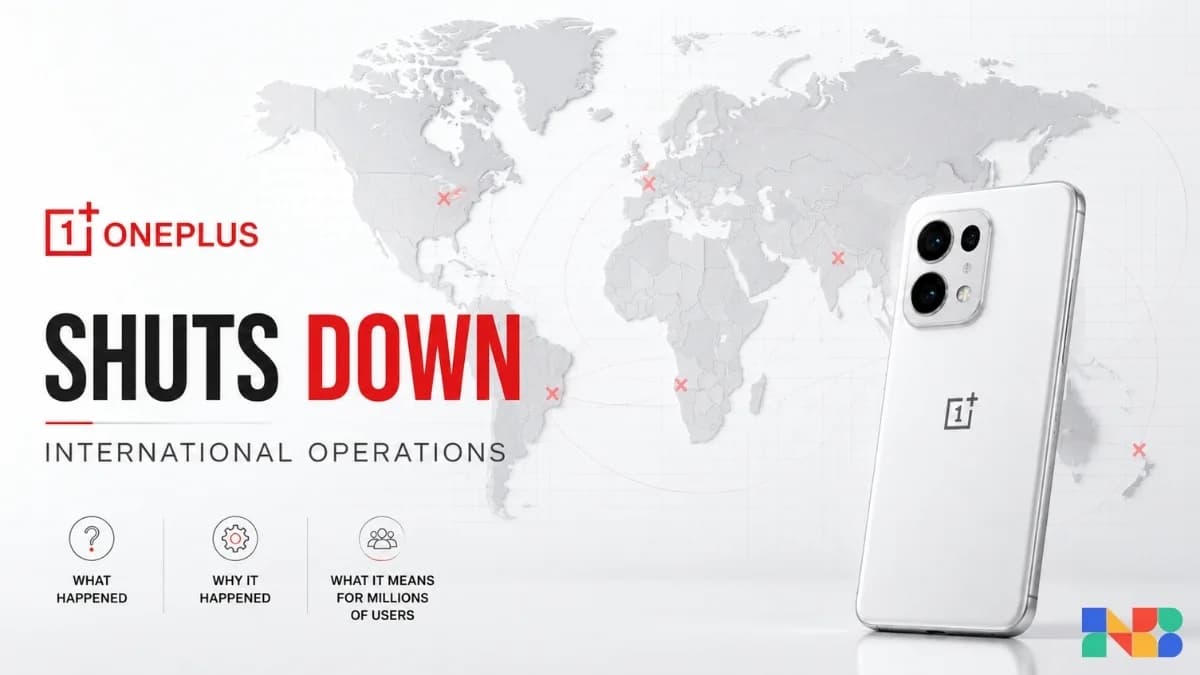
For more than a decade, OnePlus represented one of the biggest success stories in the Android smartphone industry. Founded in 2013 with the slogan "Never Settle," the company disrupted the premium smartphone market by offering flagship specifications at significantly lower prices than rivals like Apple and Samsung.
Today, however, that era has effectively come to an end.
In one of the biggest shake-ups in the global smartphone industry, OnePlus has confirmed that it is withdrawing from North America and Europe, while parent company OPPO restructures its international smartphone business. The move marks the end of OnePlus as an independent global smartphone brand and signals a major strategic realignment within the BBK ecosystem.
Timeline of OnePlus Mobiles
- 2013 → Founded
- 2014 → OnePlus One launched
- 2018 → Global expansion
- 2021 → OPPO integration
- 2024 → Major restructuring
- 2026 → International withdrawal
From "Flagship Killer" to Market Exit
Founded by Pete Lau and Carl Pei in December 2013, OnePlus quickly built a loyal fan base by challenging premium brands with high-end hardware at aggressive prices.
Its rise was remarkable:
- First smartphone launched in 2014
- Expanded to over 50 smartphone models
- Presence in more than 40 countries
- Millions of users worldwide
- Strong community-driven marketing instead of expensive advertising
- Popular OxygenOS software experience
The company became one of the fastest-growing Android brands during the late 2010s before gradually losing momentum amid increasing competition.
What Has Been Officially Announced?
OnePlus has officially confirmed that it will:
- End operations across North America
- Withdraw from Europe
- Stop launching future smartphones in these markets
- Shift focus primarily toward China and selected Asian markets as part of OPPO's restructuring
Existing customers will continue receiving:
- Warranty support
- Software updates (for supported devices)
- Customer service
- Spare parts, where available
However, new flagship launches will no longer arrive officially in these regions.

Is OnePlus Shutting Down Completely?
No.
This is perhaps the biggest misconception circulating online.
The company is not disappearing entirely.
Instead, OnePlus is undergoing a regional shutdown rather than a complete global closure.
Recent reports indicate restructuring may eventually extend further, but there has been no official confirmation that OnePlus is exiting India. Some reports speculate India could be affected in the future, but these remain unconfirmed.
Also Read | OnePlus Shutdown in India? The Truth Behind Store Closures, Falling Sales and Its Risky 2026 Reset
Why Is OnePlus Exiting International Markets?
Industry analysts point to several converging factors.
1. Declining Smartphone Sales
The global smartphone market has become increasingly difficult.
Consumers now upgrade phones less frequently, often keeping devices for four to five years instead of replacing them every two years.
Premium Android brands have struggled against:
- Apple
- Samsung
- Google Pixel
- Xiaomi
- Honor
This intensified competition reduced growth opportunities for OnePlus.
2. Loss of Its Original Identity
Early OnePlus phones earned the nickname "flagship killer" by offering flagship hardware at mid-range prices.
Over time, however:
- Prices steadily increased.
- Product differentiation narrowed.
- Devices became increasingly similar to OPPO smartphones.
- Many enthusiasts felt the brand had lost its unique appeal.
The premium pricing strategy reduced OnePlus' value proposition against Samsung and Apple.
3. OPPO's Global Restructuring
OnePlus has been closely integrated with OPPO since 2021.
The two companies now share:
- Hardware research and development
- Manufacturing
- Supply chains
- Software codebases
The latest restructuring appears designed to reduce overlapping operations between the brands.
Industry reports suggest OPPO will lead premium expansion in many Western markets, while OnePlus' role is significantly reduced.
4. Carrier and Distribution Challenges
OnePlus' growth in North America depended heavily on carrier partnerships, especially with T-Mobile.
Following the end of that partnership and weaker retail distribution, the brand's visibility declined sharply.
According to reports, U.S. shipments fell from around 1 million units in 2019 to approximately 130,000 units in 2025, illustrating how dramatically its presence contracted.
What Happens to OxygenOS?
One of the biggest changes affects software.
For years, OxygenOS was regarded as one of Android's cleanest and fastest user experiences.
Now, OnePlus has confirmed that the software experience will increasingly transition toward OPPO's ColorOS.
Many future software updates will rely on ColorOS as the unified platform, marking the end of OxygenOS as a distinct identity.
Also Read | OnePlus Shuts Most India Stores — Is the Brand Walking Away or Reinventing Itself?
What Does This Mean for India?
India remains OnePlus' largest international market and one of its strongest revenue contributors.
At present:
- Operations continue.
- Devices remain on sale.
- Customer support continues.
- New launches are expected to proceed unless officially announced otherwise.
Some media reports have speculated that India could eventually be affected by OPPO's restructuring, but the company has not confirmed any India shutdown plans.
Industry Impact
OnePlus joins a growing list of smartphone brands that have struggled to maintain global relevance, including LG Mobile and HTC. The withdrawal highlights the increasing concentration of the smartphone market around a handful of dominant players, with Apple and Samsung leading the premium segment while Chinese manufacturers such as Xiaomi, Honor, and OPPO compete aggressively across price points.
The Road Ahead
The future of the OnePlus brand now appears closely tied to OPPO's broader corporate strategy. While the company will continue operating in China and remains active in India for now, its independent global identity has been significantly diminished.
Whether OnePlus eventually returns to international markets or becomes fully integrated into OPPO's ecosystem remains uncertain. What is clear is that the company that once redefined the Android flagship market is entering a new chapter—one shaped more by consolidation than expansion.
