

The Real Reason Why 5 Banking, RBI & IAS Legends Just Joined LIC Board as Independent Directors!
Why is India's largest financial titan changing its top leadership team? What does this mean for your insurance policy? How will it affect the stock market?
India's insurance market just saw a massive shift. The Life Insurance Corporation of India (LIC) has reconstituted its top governing board.
On October 7, 2026, the LIC board approved a major decision. They appointed five heavy-weight independent directors at once.
This is not a routine corporate move. It is a major transformation. LIC is building a modern, tech-focused financial powerhouse.
- Board Approval Date: October 7, 2026
- Term Duration: 4-Year Fixed Tenure (Effective immediately)
- Governing Law: Approved under Section 4(2)(g) of the LIC Act, 1956
- Selection Body: Recommended by LIC's Nomination and Remuneration Committee (NRC)
- Approval Status: Board approved; awaiting member ratification and regulatory filings
Each new director brings a unique skill. Their experience covers central banking, commercial retail scaling, global foreign debt, rural policy, and fintech lending.
Why Is LIC Restructuring Its Governing Board Right Now?
Why is this happening today? The answer comes down to strict market rules and rising competition.
LIC completed its public stock market listing in May 2022. Since then, capital market oversight has grown significantly. The Securities and Exchange Board of India (SEBI) enforces strict LODR rules for corporate governance.
Listed state-owned companies must maintain high board independence. They must protect retail shareholders. They must also manage investment risk prudently.
Scale Of Oversight
Multi-Trillion Rupee Assets
LIC is India's largest single institutional investor across stock and debt markets.
This major board update addresses three immediate priorities:
- 1. Fast Digital Upgrades: Speeding up online policy buying and instant claim payouts.
- 2. Portfolio Protection: Safeguarding massive capital funds against global market shocks.
- 3. Rural Market Expansion: Selling micro-insurance policies deep in rural India.
The Legal Foundation: How the Appointments Worked
How were these leaders chosen? The process followed a strict statutory path.
First, LIC's Nomination and Remuneration Committee (NRC) evaluated industry candidates. They selected experts with clean records and proven track records.
Next, the selection moved to the full board under Section 4(2)(g) of the Life Insurance Corporation Act, 1956. This legal provision allows the insurer to appoint independent experts to guide its strategic vision.
The appointments took effect on October 7, 2026. The directors will serve a fixed four-year term. Formal shareholder approval will follow at the next general meeting.
Who Are the 5 New Directors? Complete Breakdown
The table below provides a full summary of the newly appointed independent directors:
| Director Name | Core Background | Past Leadership Position | Strategic Role at LIC |
|---|---|---|---|
| Shailesh Kumar Singh | IAS / Public Policy | Secretary, Ministry of Rural Development | Rural penetration & government scheme synergy |
| David Paul Rasquinha | Global Trade Finance | MD & CEO, Export-Import Bank of India | Asset-Liability Management & debt risk |
| Shyam Srinivasan | Commercial Retail Banking | MD & CEO, Federal Bank (2010–2024) | Bancassurance sales & branch modernization |
| Ganesh Kumar Sundara Iyer | Central Banking / Tech | Executive Director, Reserve Bank of India | UPI payment systems & cybersecurity policy |
| Gaurav Kumar | Fintech & Debt Markets | Founder & CEO, Yubi Group | Digital debt trading & tech investments |
1. Shailesh Kumar Singh: Public Policy and Rural Reach
Shailesh Kumar Singh is a retired 1991-batch IAS officer of the Jharkhand cadre. He brings over 35 years of administrative leadership to LIC.
He previously served as Secretary to the Government of India in the Ministry of Rural Development. During his tenure, he led massive flagship welfare programs nationwide.
He managed the Pradhan Mantri Gram Sadak Yojana (PMGSY). He directed Pradhan Mantri Awas Yojana-Gramin (PMAY-G). He also ran the Deendayal Antyodaya Yojana (DAY-NRLM).
Rural markets are vital for LIC's business. Millions of rural families rely on LIC for savings. Singh's administrative background helps LIC expand micro-insurance products into small towns.
2. David Paul Rasquinha: Cross-Border Debt & Risk Oversight
David Paul Rasquinha previously served as Managing Director and CEO of Exim Bank of India. He spent three decades managing international trade credit and project finance.
Debt Issuance Expertise: Rasquinha oversaw more than $10 Billion in foreign currency debt issuance between 2012 and 2021.
He also served on the RBI Advisory Board on Banking and Financial Frauds (ABBFF). His deep background in debt capital markets is essential for LIC.
LIC invests hundreds of billions of rupees in corporate and government bonds. Rasquinha strengthens LIC's Asset-Liability Management (ALM). He helps protect portfolio returns against international market volatility.
3. Shyam Srinivasan: Commercial Retail Scaling & Bancassurance
Shyam Srinivasan led Federal Bank as MD & CEO for 14 transforming years (2010 to 2024). He built Federal Bank into a nationally recognized, digital-first banking institution.
He maintained strict credit discipline while expanding retail branch networks rapidly. His retail banking experience directly supports LIC's growth plans.
LIC relies heavily on bank partnerships (bancassurance) to sell insurance policies. Srinivasan's understanding of retail bank networks helps LIC optimize bank sales channels.
His guidance ensures compliance under new regulations, such as the IRDAI policy seller tagging rules.
4. Ganesh Kumar Sundara Iyer: Payments & Cybersecurity Policy
Ganesh Kumar Sundara Iyer served as Executive Director at the Reserve Bank of India. He was a principal architect behind India's electronic payment revolution.
At the RBI, he helped design RTGS, NEFT, and early UPI payment frameworks. He also spearheaded central bank policy on institutional cybersecurity.
LIC processes millions of premium collections and claim payouts every day. These operations require secure payment systems and fast settlement layers.
Iyer's expertise helps LIC build bank-grade cyber resilience. His background protects the insurer against emerging online risks highlighted in the zero-click economy and ambient payments pushback.
5. Gaurav Kumar: Fintech Infrastructure & Debt Markets
Gaurav Kumar brings over 20 years of debt market entrepreneurship to the board. He is the Founder and CEO of Yubi Group (formerly CredAvenue).
He previously co-founded Vivriti Capital and Vivriti Asset Management. He also played a key role in growing Northern Arc Capital.
Kumar is a pioneer in digitizing corporate lending and fixed-income debt markets. LIC is the single largest buyer of corporate debt paper in India.
Kumar introduces modern fintech tools to LIC's investment committee. His appointment mirrors the broader industry focus seen in Prosus India fintech bets and funding talks.
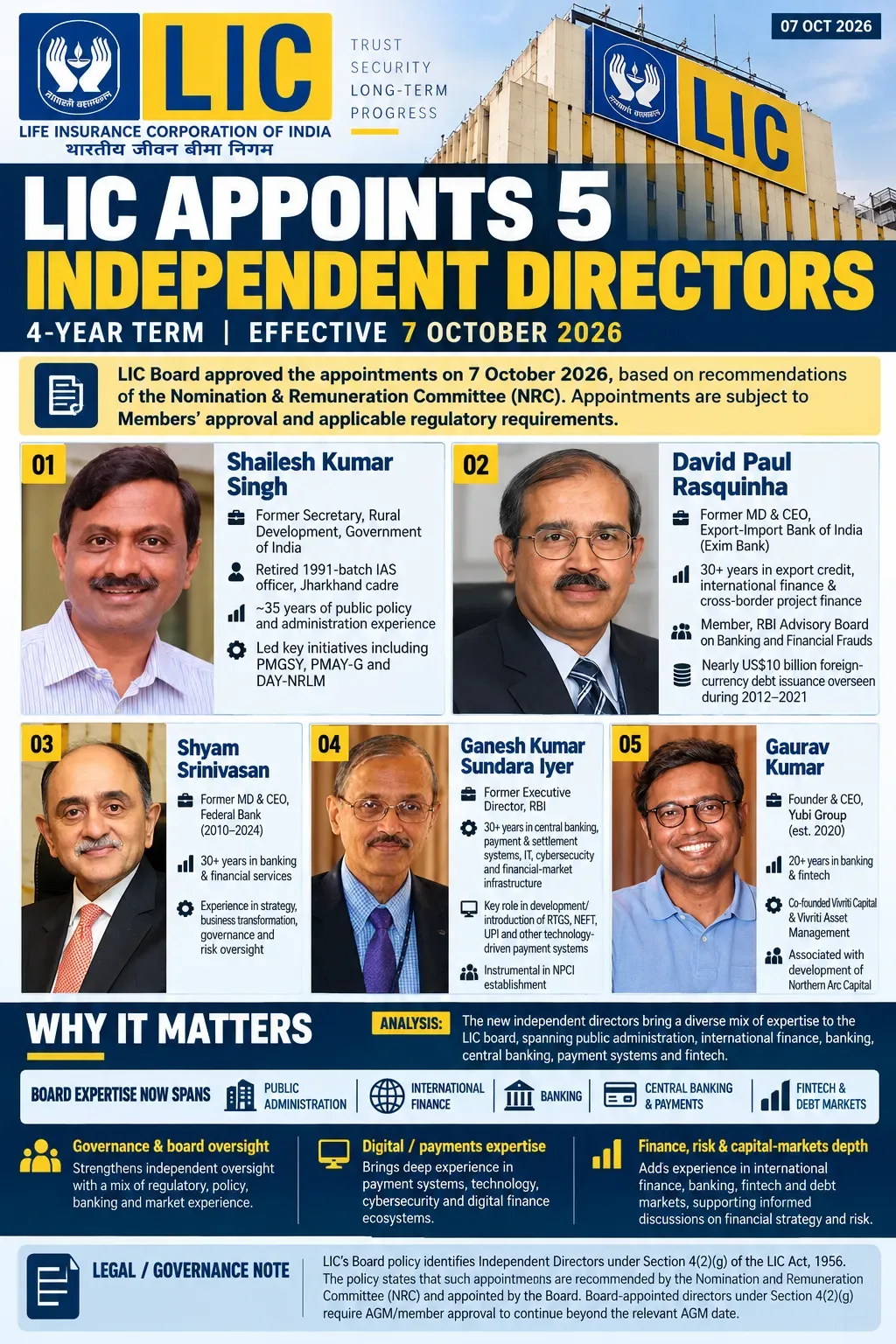
Figure 1: LIC's board reconstitution brings together leaders from public policy, international debt, commercial banking, RBI payments, and fintech.
The News4Bharat Perspective: What This Shift Really Means
What is the big takeaway from this board overhaul?
For decades, LIC operated as a traditional, paper-heavy state insurer. Agents handled policy sales physically across towns and cities. But today's market demands speed, transparency, and digital simplicity.
Public equity investors expect high operational efficiency. Private insurance rivals are competing aggressively for young buyers. This new board acts as an executive task force designed to accelerate transformation.
By combining central bankers, fintech founders, and commercial bank leaders, LIC is positioning itself as a modern financial titan.
In addition, veteran central bankers provide crucial guidance during interest rate cycles. They help LIC navigate macroeconomic challenges, such as the RBI repo rate hike in October 2026 and its EMI impact.

Figure 2: LIC strengthens corporate governance and digital capabilities through its five new independent directors.
What Should Policyholders and Investors Expect Next?
How will this board update impact you directly?
For Policyholders: You can expect faster digital policy issuance, quicker claims processing, and better online app interfaces over the next few years.
For Stock Investors: Stronger board independence reduces risk. It improves investment transparency and protects minority shareholder interests.
Market participants should track upcoming stock exchange filings closely. Shareholder voting will formalize these board appointments shortly.
Subsequent announcements regarding committee allocations—such as the Audit Committee and Risk Management Committee—will mark the next important phase.
Frequently Asked Questions
1. Who are the five new independent directors appointed by LIC?
LIC appointed Shailesh Kumar Singh, David Paul Rasquinha, Shyam Srinivasan, Ganesh Kumar Sundara Iyer, and Gaurav Kumar. Their backgrounds cover rural public policy, trade finance, commercial banking, RBI payment systems, and enterprise fintech.
2. When did the LIC board approve these appointments?
The LIC board approved the appointments on October 7, 2026. The four-year term takes effect immediately from the approval date, subject to formal member ratification.
3. Under which law were these board appointments made?
The appointments were made under Section 4(2)(g) of the Life Insurance Corporation Act, 1956. The selection process was conducted based on recommendations from LIC's Nomination and Remuneration Committee.
4. What is the tenure length for the new independent directors?
Each director has been appointed for a standard four-year term starting October 7, 2026. The appointments comply with SEBI LODR corporate governance guidelines for listed companies.
5. Why did LIC appoint a fintech founder to its board?
Gaurav Kumar (CEO, Yubi Group) was appointed to modernize LIC's enterprise debt investment operations. His expertise helps digitize corporate debt trading and fixed-income capital deployment.