

Imagine walking into a grocery store. You grab your favorite snacks, a gallon of milk, and fresh produce. Then, you simply walk out the front door.
There are no checkout lines. There are no barcode scanners to navigate. You never even pull out a credit card or your phone. By the time you reach your car, an itemized receipt pops up on your screen. You just bought your groceries without ever actively paying for them.
Welcome to the zero-click economy. For decades, paying for goods required deliberate effort. You had to swipe a card, tap a screen, or click a confirmation button. Today, financial technology is rapidly making payments invisible. These automatic transactions happen silently in the background. They are triggered by your physical location, your biometric identity, or your daily behavior.
Making the checkout process disappear fundamentally changes how human beings think about money. The global payments market is projected to reach an astounding $60.35 trillion by 2031. Tech companies are desperately racing to capture a piece of this market. However, as they deploy these systems in the real world, they are learning a harsh lesson.
Completely invisible payments create unexpected financial problems. Now, consumers and regulators are aggressively pushing back.
The Relentless War on "Friction"
Retailers have spent decades fighting a war against "friction." In the business world, friction represents any hurdle that slows down a transaction. Friction is the enemy of impulse buying. It gives a buyer time to pause, reflect, and second-guess a purchase.
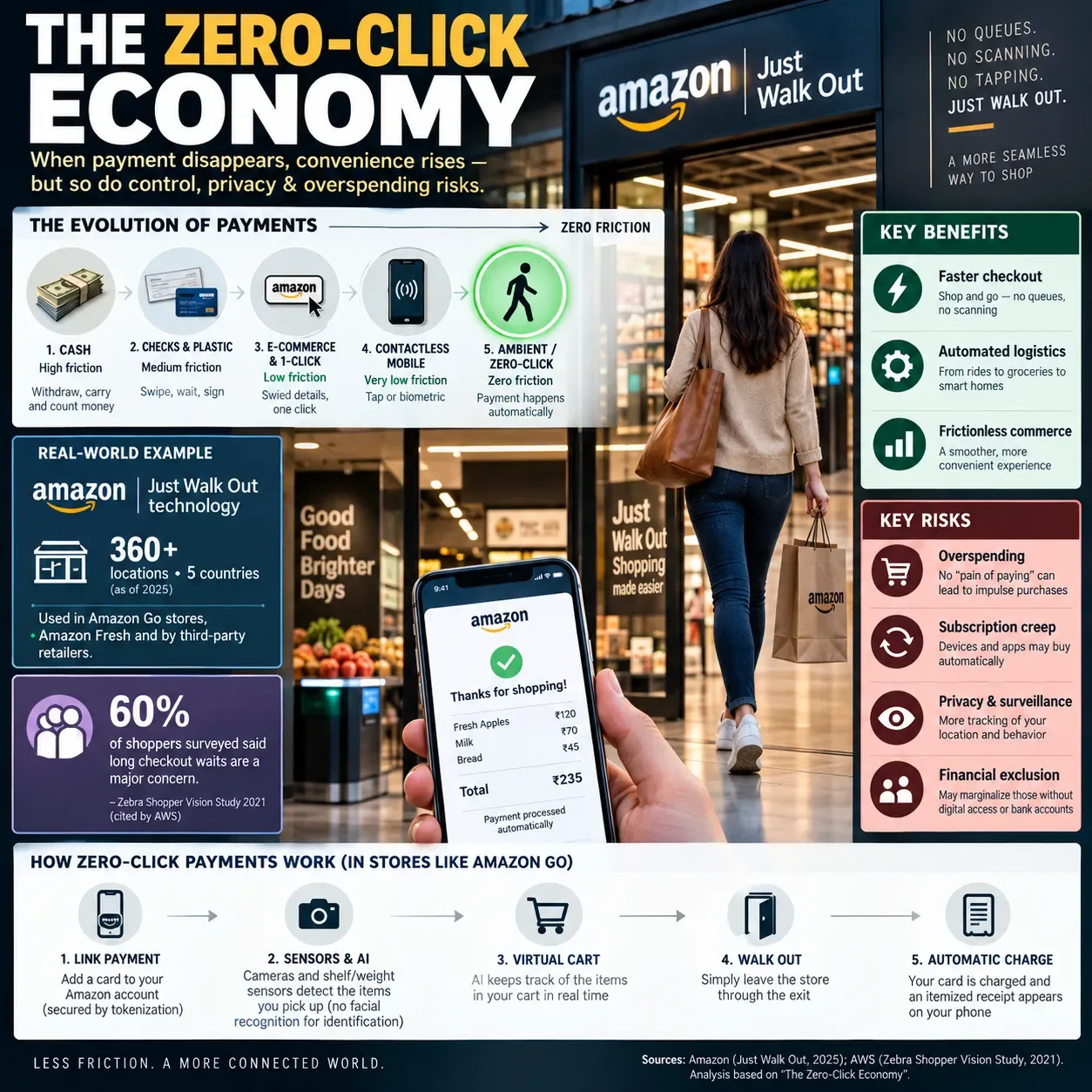
The evolution of commerce is essentially the gradual removal of this friction:
- Physical Cash (High Friction): You must find an ATM. You must count exact change. You physically see your wallet empty out.
- Checks and Cards (Medium Friction): You must carry a physical card. You must wait for a chip reader to process or sign a receipt.
- E-commerce (Low Friction): Websites save your payment data securely. This turns a complex checkout into a single click.
- Contactless Mobile (Very Low Friction): A quick biometric face scan on your phone authorizes a mobile wallet payment instantly.
- Zero-Click Commerce (Zero Friction): The payment is entirely separated from the moment you take the item. You simply consume and leave.
Ride-sharing apps like Uber were the first famous examples of a zero-friction system. You got into the car, took your ride, and got out. The payment happened invisibly. Now, enterprise grocery stores, luxury car makers, and smart home brands want to force that exact same invisible feeling into the physical world.
How the Invisible Engine Actually Works
Removing the checkout line is incredibly difficult. It requires an intricate, perfectly synchronized web of technologies working behind the scenes. Stripped of the heavy tech jargon, four main engines power this zero-click commerce shift.
1. Tokenization
If every retail store saved your actual credit card number, identity theft would destroy the economy. Instead, the global banking system uses "tokenization."
When you link your card to a store's app, your bank creates a unique, encrypted digital code. This is the token. This token only works at that specific merchant. If international hackers breach a zero-click store's database, they only steal useless alphanumeric codes. They never see your real financial data. Advanced API frameworks manage this secure zero-click payment routing instantly.
2. Embedded Finance
In the past, banking was a destination. You physically went to a bank to handle money. Today, banking is built directly into everyday apps. This is called embedded finance.
When you order a ride or food delivery, the app acts like its own mini-bank. It instantly splits your single payment between the restaurant, the driver, and the software platform. You never have to visit a third-party payment page. The app handles the financial clearing internally.
3. The Internet of Things (IoT)
Home appliances are evolving into autonomous financial actors. They are becoming smart shoppers. Modern refrigerators feature diagnostic sensors that know when you are low on milk. They order it automatically. Smart printers monitor their own ink levels and buy replacements.
In these environments, your hardware devices possess localized digital wallets. These wallets are pre-authorized by you to execute small payments up to a specific limit.
4. Biometrics and Spatial Tracking
In physical checkout-free stores, spatial tracking replaces the human cashier. High-tech ceiling cameras and shelf weight sensors track your body as you move through the aisles.
The system knows exactly what you pick up. It logs your choices in real-time. It then charges your ambient payment profile the exact second you cross an invisible geographic boundary at the exit door.
The Psychology of Spending: Eradicating the "Pain of Paying"
To truly understand the zero-click economy, we must look at human psychology. Paying with cash actually causes psychological discomfort.
Behavioral economists call this the "pain of paying." Handing over physical money triggers a mild, negative emotional response in your brain. It registers cognitively as a loss of resources. This pain serves a critical purpose. It forces you to stop and ask: "Do I really need this?"
"Invisible payments remove the pain of paying entirely. When you do not see the money leaving your account, you stop evaluating the explicit cost. You focus only on the convenience."
For corporate balance sheets, removing this pain is a goldmine. Empirical market data consistently proves that reducing checkout friction directly correlates with higher average order values. Without a checkout line to make them pause, shoppers make more impulse purchases.
This psychological abstraction naturally fuels the "subscription of everything." We are already accustomed to paying monthly for digital streaming. But as payments vanish into the background, airlines, rapid-service restaurants, and commercial car washes are aggressively pivoting toward automated, zero-click monthly billing. They want your money to flow like a utility bill.
The Illusion of Automation and Market Pushback
Despite the utopian marketing, completely invisible payments are failing in several massive sectors. The trajectory toward absolute zero-click retail is breaking down. Consumers and regulatory watchdogs are actively pushing back.
They are demanding that deliberate friction be put back into the system.
The most glaring reality check occurred in the grocery sector. In April 2024, Amazon formally removed its highly publicized "Just Walk Out" technology from larger Amazon Fresh grocery stores. The system collapsed under the weight of consumer psychology and technological limitations.
The Problem of "Receipt Shock"
First, consumers actively despised the experience of "receipt shock." When shoppers received their digital bills hours later, they were often stunned by the total. People wanted to see exactly how much they were spending while they shopped.
Consequently, Amazon pivoted to using "Dash Carts." These are smart shopping carts equipped with localized screens that display a running, visible total. This shift proved a massive point: consumers desire a specific degree of financial friction to maintain budgetary discipline.
The Myth of Seamless AI
Second, the retreat exposed the hidden human labor powering the illusion of artificial intelligence. Amazon’s frictionless front-end experience relied heavily on a massive backend workforce.
Reports revealed that roughly 700 out of every 1,000 transactions (70%) required manual review. Amazon utilized approximately 1,000 remote workers in India to manually review video footage. They had to verify ambiguous physical movements to ensure accurate billing. The frictionless ideal actually required intensive, manual intervention.
| Sector | Zero-Click Promise | Market Reality & Pushback |
|---|---|---|
| Grocery Retail | Cameras track items; buyers walk out seamlessly. | Abandoned in large stores (April 2024). Consumers hated "receipt shock." 70% of transactions required manual review. |
| Automotive | Physical hardware features unlocked via monthly fees. | BMW abandoned its $18/month heated seat subscription in Sept 2023 following intense consumer backlash. |
| B2B Logistics | Smart contracts execute instant payments upon delivery. | Highly successful. Removes accounting friction without hurting retail consumer psychology. |
The Automotive Backlash: Owning Your Hardware
Automakers faced a similar, highly publicized consumer revolt. Car companies attempted to transform vehicles into rolling credit cards. They started charging monthly ambient fees for physical hardware already installed in the car.
However, in September 2023, luxury manufacturer BMW officially abandoned its controversial $18-per-month heated seat subscription. Consumers drew a definitive line in the sand.
Drivers proved they will tolerate subscriptions for evolving digital software (like traffic updates). But they aggressively reject zero-click billing for physical utility they already possess. They refused to rent the hardware sitting inside their own cars.
Macro-Economics and B2B Logistics
While consumer retail struggles with ambient payments, the Business-to-Business (B2B) sector is thriving on it. Large-scale infrastructure and logistics rely on removing friction.
Smart contracts—self-executing code operating on blockchain technology—allow a shipping company to be paid automatically the exact second a GPS tracker confirms a pallet of goods has arrived at a warehouse. There are no paper invoices. There are no 30-day payment delays.
This automated trust system is vital for modern supply chains. It removes human accounts payable friction without impacting vulnerable retail consumer psychology.
Regulatory Guardrails and Financial Exclusion
A world where capital moves invisibly carries profound systemic risks. Removing friction simultaneously removes natural financial safeguards. When a checkout line vanishes, the risk of accidental overspending escalates rapidly.
Furthermore, a zero-click physical economy operates intrinsically as a surveillance economy. To facilitate seamless entry and exit, retail environments must blanket their square footage in biometric sensors. The resulting data—tracking hesitation times, physical routes, and precise dietary habits—is immensely valuable for targeted advertising. This raises massive privacy concerns.
The Threat to the Unbanked
Most critically, the zero-click framework threatens mass financial exclusion. It relies entirely on a trinity of digital privileges: persistent internet access, modern smartphone hardware, and integration into traditional banking systems.
According to the FDIC, 4.2% of U.S. households (about 5.6 million) are entirely unbanked. Millions more are underbanked. For populations operating strictly in fiat currency, the digitization of physical stores acts as an invisible wall.
In response, regional governments are enforcing hard boundaries to protect the unbanked. Jurisdictions including Massachusetts, New York, and Colorado, alongside major municipalities like Philadelphia and San Francisco, have enacted strict cash mandates. These laws legally compel brick-and-mortar retailers to accept physical currency. This ensures ambient technology does not economically disenfranchise vulnerable demographics.
Fighting "Subscription Creep"
Simultaneously, regulators are attempting to curb "subscription creep"—the slow, unmanaged accumulation of automated charges.
The Federal Trade Commission (FTC) aggressively pursued sweeping "Click to Cancel" rules to ensure consumers could terminate ambient payments as easily as they initiated them. While a federal appeals court vacated that specific rule in July 2025, strict state-level auto-renewal laws in jurisdictions like California and New York continue to force compliance upon digital merchants.
The News4Bharat Perspective: Deliberate Friction
The underlying ambition of the zero-click economy is to commoditize capital movement. The financial tech sector aims to make spending money feel like utilizing a public utility—similar to drawing water from a tap. The billing occurs silently in the background.
While the logistical efficiencies for B2B smart contracts are undeniably transformative, the consumer application requires careful calibration.
The pushback observed across the grocery and automotive sectors indicates that the future of commerce is not entirely frictionless. Instead, it demands "deliberate friction." Consumers are willingly trading the absolute magic of a walk-out checkout for the psychological safety of a visible running total. They are aggressively rejecting opaque ambient charges in favor of transparent, localized data.
As embedded finance scales globally, regulatory bodies and central banks will likely standardize open banking protocols. This will prevent a few tech giants from monopolizing digital identity gateways. Technology firms must learn a vital lesson: while consumers despise the physical mechanics of waiting in line, they will fiercely guard their agency over when, where, and how their capital is deployed.
Follow subsequent regulatory filings and central bank guidelines for updates on how ambient payment frameworks will integrate into broader consumer protection mandates in the coming years.
Frequently Asked Questions (FAQ)
What exactly is the zero-click economy?
It is a financial ecosystem where payments occur automatically in the background without active consumer confirmation. Transactions are triggered by biometric tracking, location data, and pre-authorized digital wallets rather than physical card swipes.
Why did Amazon abandon its "Just Walk Out" technology in large stores?
In April 2024, Amazon removed the tech from large grocery stores because consumers disliked the "receipt shock" of ambient payments. Shoppers preferred smart carts that display real-time running totals. Furthermore, the system relied heavily on manual offshore video review rather than pure AI.
How does tokenization secure zero-click payments?
Tokenization replaces raw credit card data with a unique, encrypted digital string. This token is restricted to a specific merchant. If a retail database is breached, hackers steal useless alphanumeric strings rather than actionable financial data.
What is the "pain of paying" in behavioral economics?
It is the quantifiable psychological discomfort a person experiences when handing over physical money. Ambient payments eradicate this feeling by separating consumption from the transaction, which consistently leads to higher discretionary impulse spending.
Are there laws preventing stores from going completely cashless?
Yes. To prevent the financial exclusion of unbanked populations, several jurisdictions, including New York, Massachusetts, Colorado, and San Francisco, enforce mandates legally requiring brick-and-mortar stores to accept physical cash.