

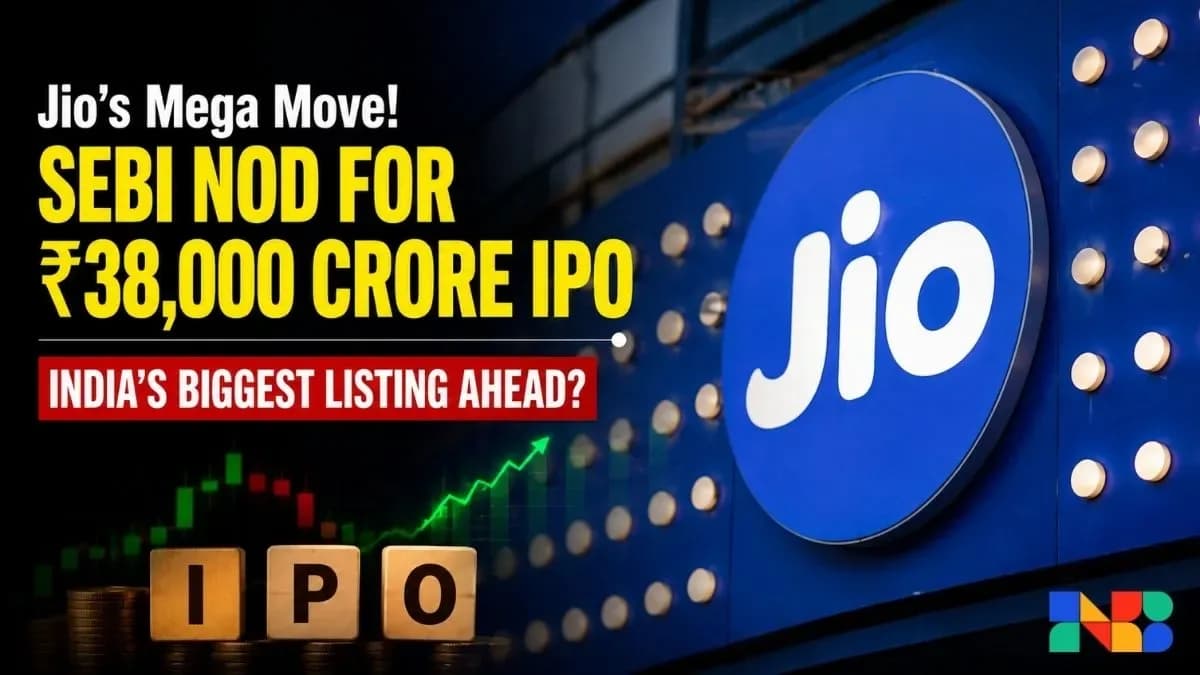
The long-anticipated Jio Platforms IPO has crossed its most decisive regulatory checkpoint to date. The Securities and Exchange Board of India (SEBI) has officially issued its observation letter on the Draft Red Herring Prospectus (DRHP) submitted by Jio Platforms.
In practical market terms, receiving an observation letter signifies that the market regulator has concluded its scrutiny and cleared the company to move ahead with its public listing. This pivotal green light shifts the narrative from a speculative corporate intention into an actionable, live market event.
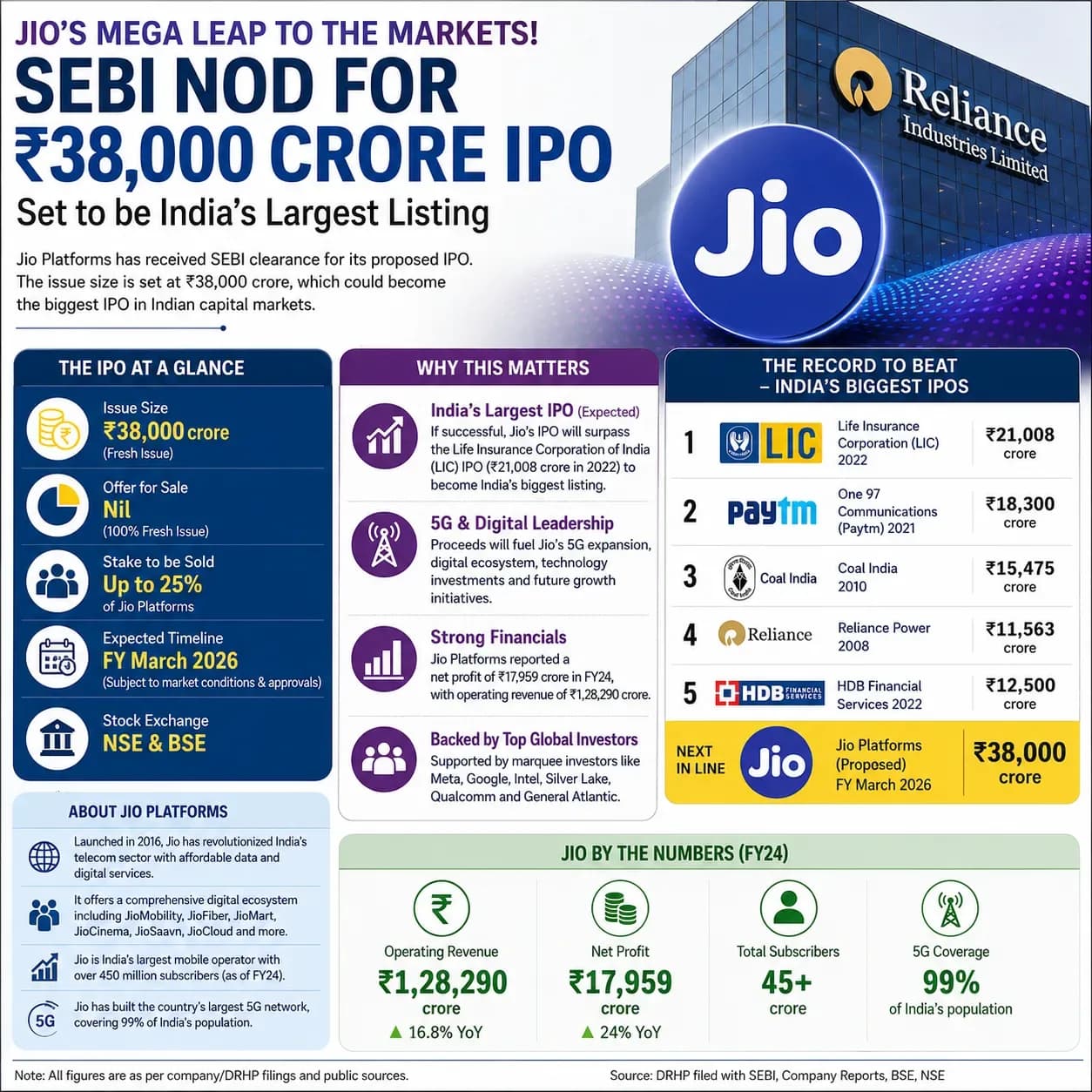
Market estimates indicate the offering could raise approximately ₹37,700 crore (roughly $3.8 billion). If completed at this scale, it will surpass Hyundai Motor India's 2024 offering to establish itself as the largest initial public offering in the history of Indian capital markets.
Understanding the Significance of SEBI Clearance
While headlines frequently summarize this milestone as formal regulatory approval, the precise technical procedure involves SEBI issuing observations on the draft offer document. This distinction is vital for capital market participants and institutional investors tracking the timeline.
Once SEBI issues an observation letter without demanding major structural revisions, the issuer has a one-year window to launch the public offering. The company can now finalize its syndicate, coordinate with merchant bankers, conduct international roadshows, and determine the exact pricing band.
The clearance validates the governance standards, financial disclosures, and shareholding mechanics detailed in the prospectus. It transitions Jio Platforms from the pre-filing compliance phase into active primary market execution.
The Evolution of an Empire: How Jio Reached the Bourse
To comprehend why this public listing carries such extraordinary weight, one must examine the decade-long transformation of Reliance Industries’ digital ambitions.
Phase 1: The Telecom Revolution of 2016
When Reliance Jio Infocomm commercially launched services on September 5, 2016, it initiated an unprecedented disruption across the Indian telecommunications landscape. By offering free voice calls and deeply discounted high-speed 4G data, Jio dismantled legacy pricing models.
The speed of consumer adoption shattered global records, with Jio crossing 50 million subscribers in just 83 days. The fierce price competition triggered rapid consolidation, transforming a fragmented market of over a dozen regional operators into a stable three-player private structure led by Jio and Bharti Airtel.
Phase 2: Architecting the Digital Platform
Reliance recognized early that pure telecommunications infrastructure risks becoming a commoditized utility over time. To capture exponential value, the parent conglomerate established Jio Platforms as an overarching digital and technology holding entity.
Jio Platforms was structured to encompass not only physical mobility towers and fiber, but also a vast ecosystem of cloud infrastructure, digital consumer applications, enterprise connectivity, fintech services, and proprietary artificial intelligence tools.
Phase 3: The Historic 2020 Global Capital Influx
In mid-2020, amidst global economic uncertainty, Jio Platforms executed one of the most successful fundraising programs in corporate history. Global technology powerhouses and sovereign wealth funds invested heavily to secure strategic minority stakes:
- Meta (Facebook): Invested ₹43,574 crore for a 9.99% equity stake, establishing commercial synergies via WhatsApp and digital commerce.
- Alphabet (Google): Invested ₹33,737 crore for a 7.73% stake, partnering on affordable smartphone software and enterprise cloud.
- Private Equity Giants: KKR, Silver Lake, Vista Equity Partners, General Atlantic, and sovereign funds from the UAE and Saudi Arabia contributed billions more.
This investment wave established an international valuation benchmark of around ₹4.62 lakh crore in 2020, reinforced the company's tech-platform identity, and strengthened the broader Reliance balance sheet.
Phase 4: From Conglomerate Asset to Public Entity
At the Reliance Industries Annual General Meeting in August 2025, Chairman Mukesh Ambani formally committed to preparing Jio for a domestic public listing. The strategic dialogue shifted permanently from whether Jio would list to how the transaction would be executed.
On June 19, 2026, the board of Jio Platforms approved and filed the DRHP with SEBI, leading directly to the regulatory clearance issued on August 28, 2026.
- Dissecting the IPO Structure: The Power of a Fresh Issue
- One of the most defining characteristics of the Jio Platforms DRHP is the structural format of the capital raise.
Unlike many recent high-profile mega-IPOs that functioned primarily as an Offer for Sale (OFS)—where existing promoters and early-stage venture investors cash out their holdings—Jio Platforms has filed for an entirely fresh issue of up to 27 crore (270 million) equity shares with a face value of ₹10 each.
Fresh Issue vs. Offer for Sale
In an OFS structure, capital flows directly into the bank accounts of selling shareholders, leaving the operating company's balance sheet unchanged.
In a fresh issue, newly minted shares are distributed to public investors, and the entire net proceeds flow directly into the corporate treasury of the company. Existing institutional partners like Meta, Google, and Reliance Industries are not offloading their stakes in this vehicle, demonstrating long-term institutional alignment.
Capital Allocation: Why Debt Reduction Is a Game Changer
According to prospectus filings and market disclosures, Jio Platforms intends to allocate approximately ₹27,500 crore of the total proceeds directly toward the prepayment or scheduled repayment of outstanding borrowings accrued by its primary operating subsidiary, Reliance Jio Infocomm.
Financial and Operational Advantages of Deleveraging
Using primary proceeds to retire debt alters the investment thesis for fundamental equity analysts in several positive ways:
- Drastic Interest Expense Reduction: Retiring high-value debt immediately lowers annual finance costs, allowing more operating profit to drop straight to the net profit line.
- Enhanced Cash Flow Conversion: Lower interest obligations free up operating cash flow, boosting free cash flow margins across subsequent quarters.
- Capital Expenditure Flexibility: A deleveraged balance sheet provides headroom for aggressive capital deployment into nationwide 5G-Advanced networks, fiber-to-the-home expansion, and hyperscale AI data centers.
- Standalone Valuation Multiple Expansion: Public market investors routinely assign higher price-to-earnings and EV/EBITDA multiples to companies that possess clean, low-leverage balance sheets.
Operational Scale: Up-to-Date Subscriber Metrics
Accurate operational metrics are essential when evaluating a network operator of this magnitude.
While earlier historical draft filings highlighted 524.4 million subscribers as of March 31, 2026, recent operational data reveals that the subscriber base exceeded 533 million active users by the end of June 2026.
This sustained customer growth demonstrates that Jio continues to capture market share in both rural mobile connectivity and urban fixed-wireless broadband (JioAirFiber), sustaining steady average revenue per user (ARPU) expansion through tariff revisions and 5G upgrades.
The Great Valuation Debate: Telco Utility or Tech Giant?
The core question that institutional fund managers will debate during upcoming roadshows centers on valuation methodology. How should Jio Platforms be priced?
The Conventional Telecom Valuation Approach
If evaluated strictly as a traditional telecommunications carrier, Jio would be benchmarked against domestic and international telecom operators using metrics like:
- Monthly Average Revenue Per User (ARPU) growth.
- Total mobile data and voice traffic volume.
- Spectrum holding amortization costs.
- EBITDA margins and recurring network maintenance capex.
The High-Multiple Technology Platform Approach
However, Jio Platforms has intentionally constructed a portfolio that mirrors international technology ecosystems rather than simple pipeline providers:
- Cloud and Enterprise Solutions: Comprehensive cloud services, leased line infrastructure, IoT networks, and unified enterprise software suites for small-to-medium businesses.
- Consumer Digital Services: Proprietary platforms spanning digital entertainment streaming, cloud PC capabilities, storage, and smart home automation.
- Artificial Intelligence and Sovereign Compute: Direct development of indigenous AI applications, language models, and enterprise AI tools distributed directly across its 533-million-user base.
Preliminary market projections suggest a potential standalone valuation range between $130 billion and $137 billion. Whether the market awards Jio a premium valuation multiple depends on how successfully management demonstrates revenue contribution from non-connectivity digital and enterprise services.
Pre-IPO Shareholding Structure
Prior to the issuance of new public equity, the ownership distribution of Jio Platforms remains closely held among its founding promoter and premier global strategic partners:
- Reliance Industries Limited (Promoter): ~66.4%
- Meta Platforms (Facebook): ~9.9%
- Alphabet Inc. (Google): ~7.7%
- Global Financial Investors (KKR, Silver Lake, PIF, Mubadala, etc.): ~16.0%
The public offering will introduce retail investors, domestic mutual funds, insurance companies, and global foreign institutional investors (FIIs) to the share register for the first time.
Strategic Ripple Effects Across the Market
The successful public debut of Jio Platforms will generate widespread implications across India's corporate and financial landscape.
Unlocking Value for Reliance Industries Shareholders
Currently, the vast earning power of Jio is embedded inside Reliance Industries Limited (RIL). Conglomerates often trade at a structural holding-company discount because individual business units cannot be valued cleanly by specialized sector funds.
A liquid, standalone market price for Jio Platforms eliminates this ambiguity. It allows institutional investors seeking pure digital and telecom exposure to allocate capital directly, unlocking substantial value for existing RIL shareholders.
Setting Benchmarks for Dalal Street and Global Emerging Markets
A $3.8 billion domestic listing reinforces India’s stature as one of the most vibrant primary capital markets in the world. It provides deep liquidity for global funds requiring large-cap assets and establishes an institutional template for other multi-industry Indian conglomerates seeking to spin off high-growth retail, green energy, or digital subsidiaries.
Also Read | Shiprocket Becomes a $1 Billion Company on Listing Day: What Investors Are Betting On
Intensifying Competitive Transparency with Bharti Airtel
With Jio operating as a fully listed reporting company, public market scrutiny between Jio and Bharti Airtel will reach parity. Analysts and investors will receive identical quarterly disclosures regarding subscriber quality, 5G monetisation velocity, enterprise revenues, and return on capital employed (ROCE), intensifying operational competition across the sector.
Key Risk Factors for Prospective Investors
While the growth trajectory remains strong, fundamental analysis requires a balanced assessment of operational, technological, and market risks:
- Intense Capital Expenditure Requirements: Next-generation communications networks require continuous capital outlays for spectrum auctions, optical fiber laying, and regular technology upgrades.
- Execution Risk in Software and AI: Competing in enterprise software, cloud storage, and AI requires world-class developer talent and pits Jio directly against entrenched global software giants like Microsoft, AWS, and Google Cloud.
- Regulatory and Tariff Sensitivity: Telecom operations in India remain sensitive to statutory levies, spectrum usage charges, and regulatory rulings regarding interconnection and quality-of-service mandates.
- Infrastructure and Cybersecurity Exposure: Managing critical national digital infrastructure carrying petabytes of sensitive consumer and financial data exposes the organization to escalating cyber threats and technical outage risks.
The Final Countdown: What Happens Next?
With SEBI's formal observation letter secured, the primary market machinery now shifts into its operational execution phase.
Market observers and potential investors should monitor the following sequence of milestones over the coming weeks:
- Filing the Updated Red Herring Prospectus (RHP): The company will incorporate recent financial updates, audit figures, and regulatory disclosures.
- Announcement of Price Band and Floor Price: Management and lead investment bankers will specify the bidding range per equity share.
- Anchor Investor Bidding: Leading sovereign wealth funds, domestic mutual funds, and global asset managers will commit large-scale anchor capital 24 hours prior to public opening.
- Public Subscription Window: The three-to-four-day bidding period across retail, non-institutional (HNI), and Qualified Institutional Buyer (QIB) categories.
- Basis of Allotment and Demat Crediting: The formal distribution of shares based on subscription multiples.
- Listing Day on BSE and NSE: The official commencement of public secondary market trading.
Jio Platforms has completed its transition from an industry-disrupting startup into a systematically important digital powerhouse. The upcoming market debut represents the ultimate test of how the investing world will value India's digital future.