

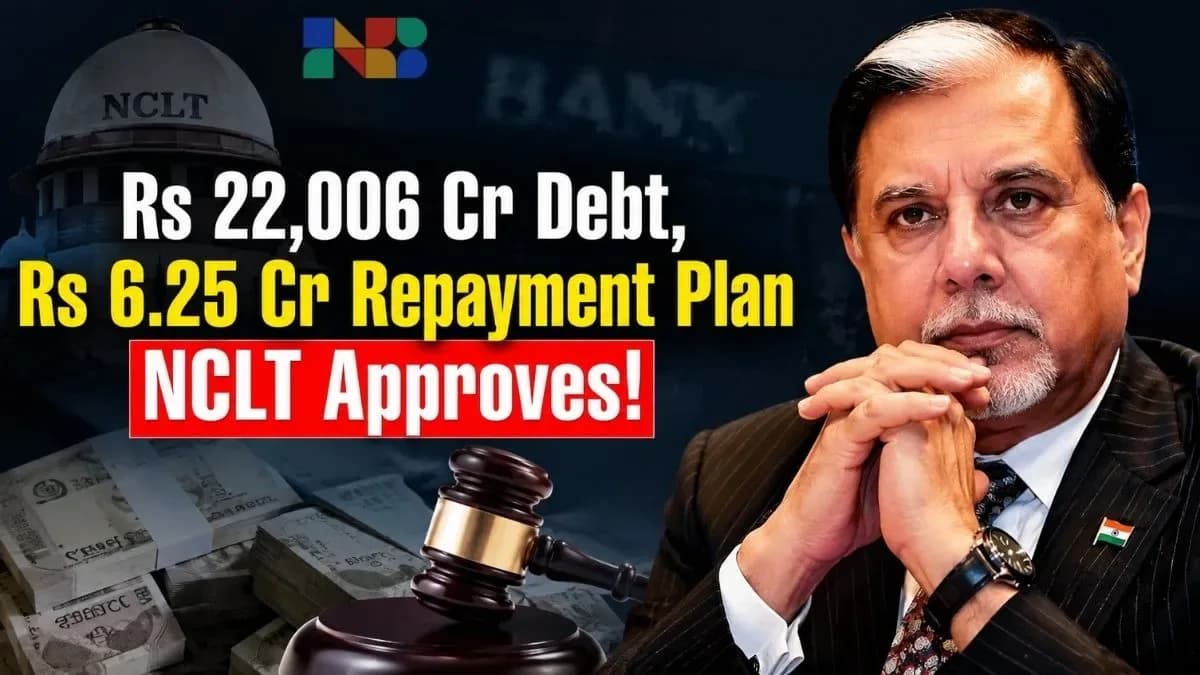
The financial and corporate worlds are buzzing with intense debate following a landmark legal ruling in India. Recently, the National Company Law Tribunal (NCLT) officially approved the highly controversial Subhash Chandra repayment plan.
For the average observer, the headlines surrounding this case look absolutely baffling. The numbers involved represent one of the most extraordinary recovery gaps in modern Indian corporate history.
However, to truly grasp what happened, we need to look past the sensational headlines. We must dive deep into the specific legal mechanisms of the Insolvency and Bankruptcy Code (IBC).
In this comprehensive guide, we will break down exactly how this plan was approved, why the traditional banking sector is furious, and what this means for the future of personal insolvency in India.
The Massive Gap: ₹22,000 Crore vs. ₹6.25 Crore
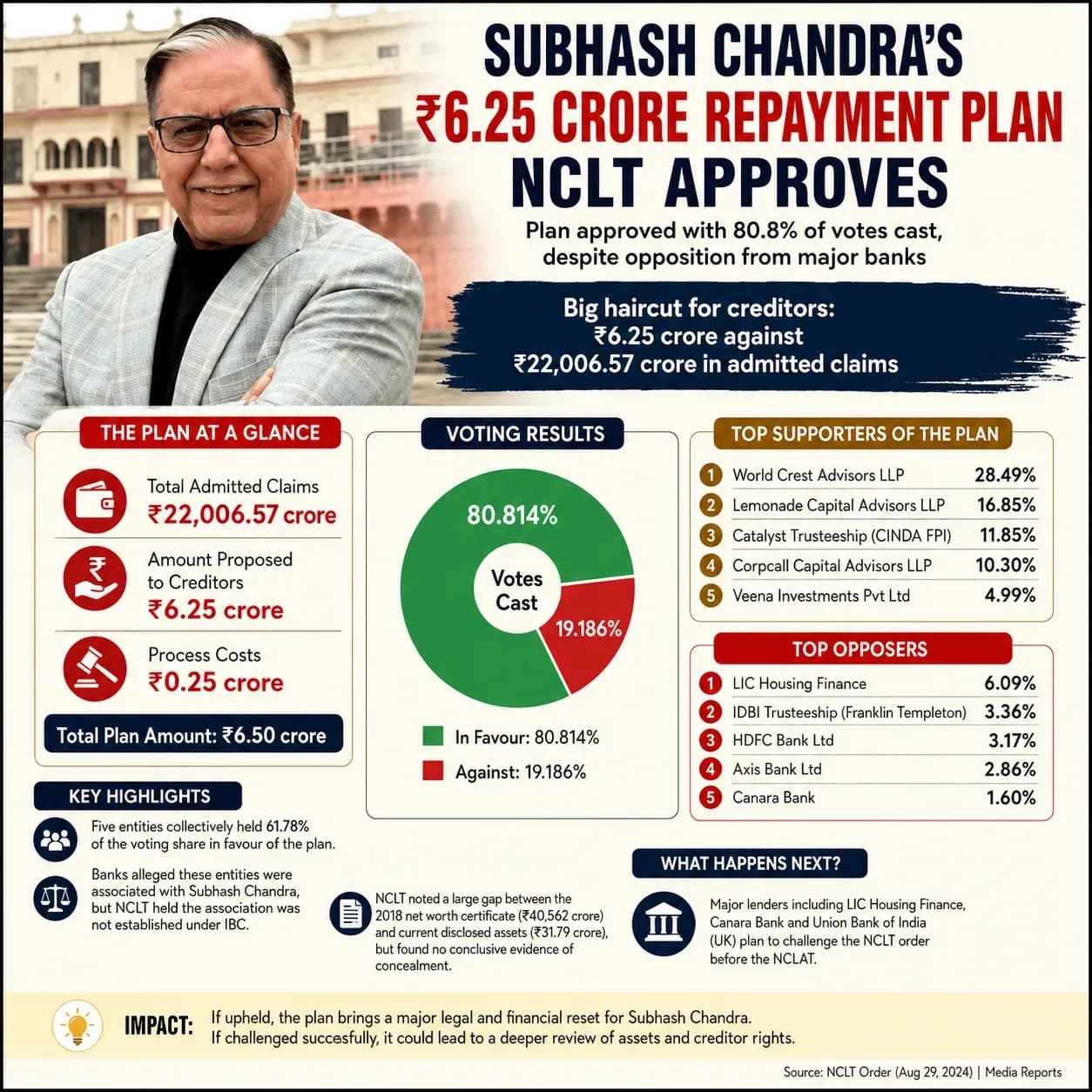
To understand the sheer scale of this controversy, you first need to look at the money on the table. The admitted claims against Subhash Chandra amounted to an astonishing ₹22,006.57 crore.
Yet, the NCLT's Third Member, Nilesh Sharma, approved a final repayment plan that requires Chandra to pay just ₹6.25 crore to his creditors. Additionally, he will pay a mere ₹25 lakh towards the administrative costs of the insolvency process.
This results in a total plan amount of just ₹6.50 crore. When you do the math, creditors are recovering roughly 0.03% of their admitted claims.
In financial terminology, this equates to a monumental 99.97% "haircut." However, it is crucial to understand how this debt was formed in the first place.
Personal Guarantor vs. Direct Borrower
A common misconception is that Subhash Chandra personally borrowed ₹22,000 crore and spent it. This is factually incorrect.
These admitted claims arose against him in his capacity as a "personal guarantor." Think of a personal guarantee like co-signing a massive loan for a friend or family member.
Various companies linked to the Essel Group borrowed heavy funds from major banks. Chandra provided a personal guarantee that if those companies failed to pay, the banks could come after him.
When the underlying companies defaulted, the liability triggered. Therefore, while Chandra is personally on the hook for this ₹22,000 crore under his guarantees, the original corporate borrowers remain legally distinct entities.
This means that while the banks are taking a 99.97% hit on Chandra's personal repayment plan, they may still have separate legal avenues to recover money from the primary corporate borrowers or their secured assets.
Understanding the IBC Voting Math
Under India's insolvency laws, a repayment plan isn't simply forced upon creditors by a judge. It goes to a democratic vote among the admitted creditors.
For a plan to become legally binding, it must secure approval from a requisite majority of the voting share. Once that threshold is crossed, dissenting minority creditors are legally forced to accept the outcome.
In this specific case, the official voting record closed with 80.814% of the votes cast supporting the repayment plan.
Because the plan crossed the required legal threshold, the NCLT had the statutory runway to approve it. But how did a plan offering a 99.97% haircut get nearly 81% approval?
The 61.78% Controversy: Who Actually Voted?
This brings us to the structural heart of the entire controversy. Traditional banking institutions overwhelmingly voted against this repayment plan.
Major lenders like LIC Housing Finance, HDFC Bank, Axis Bank, and Canara Bank strongly opposed the settlement. However, their combined opposition only represented 19.186% of the total vote.
They were heavily outvoted by a concentrated bloc of non-bank entities. Banks alleged that five specific creditors collectively represented a massive 61.78% of the total voting share.
These five critical entities were:
- World Crest Advisors LLP (28.49%)
- Lemonade Capital Advisors LLP (16.85%)
- Corpcall Capital Advisors LLP (10.30%)
- Veena Investments Private Limited (4.99%)
- Direct Media Distribution Ventures (1.15%)
If you remove this 61.78% bloc from the "yes" column, the entire political and economic reality of the vote changes instantly. Without them, the plan would have never passed.
The Legal Battle Over "Associates"
The dissenting banks did not just complain about the vote; they mounted a fierce legal challenge. They alleged that these five entities were connected to Subhash Chandra.
Under Section 109(4)(b) of the IBC, an "associate" or related party of a personal guarantor is strictly forbidden from voting on a repayment plan. The logic is simple: you shouldn't be allowed to use friendly entities to vote away your own debt.
Read More - This Article Might Save You A Ton Of Money
The banks argued that these entities shared commercial proximity, family relationships, and indirect influence with Chandra.
However, the NCLT explicitly rejected the banks' allegations. The tribunal ruled that the banks failed to establish that these five entities were "associates" under the very specific statutory definition of the IBC.
According to Section 79(2)(g) of the IBC, proving an entity is an associate requires establishing direct ownership exceeding a certain threshold, or direct legal control over the company's governing board.
The tribunal effectively stated that mere suspicion, family business history, or commercial proximity is not enough. Without proof of legal ownership or board control, the NCLT could not legally disqualify their massive 61.78% vote.
The Missing ₹40,000 Crore Question
Another massive point of contention during the hearings involved Subhash Chandra's personal net worth.
Objecting creditors produced a historical net-worth certificate from 2018. This older document showed Chandra's net worth at an eye-watering ₹40,562 crore.
In stark contrast, the repayment plan presented to the NCLT declared the current market value of his personal assets as merely ₹31.79 crore (as of July 2024).
Naturally, the banks demanded to know where tens of thousands of crores had vanished. They strongly pushed the tribunal to order a deep forensic audit to track the missing wealth.
Why the NCLT Denied a Forensic Audit
The NCLT acknowledged that the dramatic reduction in wealth justified the creditors' questions. The massive discrepancy was openly noted in the official order.
However, the tribunal pointed out that the 2018 certificate was based on provisional, management-provided information. It did not conclusively prove that those assets still existed today in the same form or value.
More importantly, the NCLT stated that the IBC does not make a forensic audit a mandatory precondition for approving every personal insolvency plan.
The tribunal noted that no conclusive legal evidence was presented to establish that Chandra had actively concealed, diverted, or fraudulently transferred identifiable assets.
Procedural Lapses and Excluded Claims
It is also vital to note that the NCLT's approval was not a flawless victory. The tribunal openly admitted that certain statutory timelines under the IBC were not strictly followed.
For instance, the repayment plan was submitted in mid-October, the resolution professional's report followed a day later, and the voting meeting happened just a week after that.
Despite these procedural irregularities, the Third Member concluded that the creditors still had a practical opportunity to participate. Because no actual prejudice was demonstrated, the tribunal refused to throw out the entire plan based on timeline technicalities.
However, the NCLT did exclude two specific creditors from the final list. Sunil Jain and Anil Kumar, who claimed to represent 1,260 unverified workers without proper documentation, were removed.
Their allocated funds were ordered to be redistributed pro-rata among the remaining eligible lenders.
What This Means for the Banks
The direct financial impact on the dissenting banks is severe when looking solely at this specific legal proceeding.
Take LIC Housing Finance as a prime example. They held an admitted claim of approximately ₹1,322.39 crore.
Under this newly approved plan, their proposed recovery is a staggering low ₹38.09 lakh. This perfectly illustrates why institutional lenders consider this repayment plan to be commercially unacceptable.
While the banks may still chase the principal corporate borrowers, they have effectively lost their leverage against the personal guarantor.
The Next Battleground: The NCLAT Appeals
If you think this story is over, think again. The NCLT's approval is merely the end of chapter one.
Major lenders have already announced their intentions to challenge the NCLT decision before the National Company Law Appellate Tribunal (NCLAT).
Institutions like Canara Bank, Union Bank of India (UK), and LIC Housing Finance are preparing their legal appeals. HDFC Bank is also reportedly exploring similar appellate action.
The NCLAT will now have to answer massive legal questions. Can acknowledged non-compliance with statutory timelines be ignored? Did the NCLT interpret the definition of an "associate" too narrowly?
Furthermore, the NCLT explicitly noted in its order that this approval does not grant Chandra permanent immunity. If credible evidence of fraud or material suppression of assets emerges later, the order can potentially be recalled.
Final Thoughts on India's Insolvency Laws
Ultimately, this case serves as a massive stress test for India's personal insolvency framework.
It highlights a critical policy debate: Does the legal definition of an "associate" under the IBC need to be broadened?
Also Read | India FDI April June 2026: Record $30.7B Inflow Explained
The NCLT took a highly textual approach. They strictly followed the letter of the law regarding ownership and board control. The banks, however, are begging for a broader interpretation that accounts for modern corporate influence and complex holding structures.
If this 99.97% haircut survives the appellate courts, it may force Indian lawmakers to revisit and tighten the personal guarantor statutes within the Insolvency and Bankruptcy Code.