

Indian IT stocks staged a recovery on Friday, October 9, 2026, despite fresh US immigration restrictions affecting some of India's largest technology companies. Shares of Tata Consultancy Services (TCS), Infosys, Wipro and HCLTech advanced as investors weighed TCS's September-quarter earnings against the latest action by the US government on employment-based immigration.
The Nifty IT index rose 3.3% during Friday's trading, while TCS gained as much as 5.4%, according to Reuters. The broader market also recovered, with the Nifty 50 and BSE Sensex rising after sharp losses in the previous session.
The timing was significant. On October 8, the administration of US President Donald Trump suspended several technology companies, including TCS, Infosys, Wipro, HCL Technologies, Cognizant and Capgemini, from participating in the Permanent Labor Certification programme, commonly known as PERM. American technology companies Microsoft and Adobe were also affected.
PERM is an important step in the employment-based green card process. The action creates uncertainty for employees seeking permanent residency, although it does not amount to a blanket prohibition on these companies delivering IT services to American clients.
The contrasting developments reveal how India's IT outsourcing business has changed. For decades, the industry's expansion depended partly on sending engineers and technology consultants to client locations in the United States. That arrangement has gradually given way to a workforce spread across Indian delivery centres, locally hired overseas teams and other international locations.
Artificial intelligence is now influencing which services companies provide, how they staff projects and how much work can be completed remotely.
But Friday's stock market rally should not be mistaken for evidence that American immigration policy has become irrelevant. The United States remains the largest market for several Indian technology exporters, and their ability to recruit, deploy and retain specialised employees there continues to matter.
Why Indian IT Stocks Rose Despite the US Immigration Crackdown
The immediate reason behind the recovery was TCS's financial performance for the second quarter of FY2026-27, covering July to September 2026.
According to the company's official quarterly results released on October 8, TCS reported revenue of $7.64 billion, representing 2.4% year-on-year growth in US dollar terms.
Revenue from international operations increased 1.2% sequentially in constant currency, while the company reported annualised AI-related revenue of $3.1 billion. This was the first quarter in which AI crossed 10% of its revenue.
TCS Q2 FY27 Results: Key Financial Numbers
| Financial indicator | Q2 FY27 performance |
|---|---|
| Revenue | $7.642 billion |
| Revenue growth, year-on-year | 2.4% in USD |
| Revenue growth, quarter-on-quarter | 0.5% in constant currency |
| International revenue growth | 1.2% QoQ in constant currency |
| Annualised AI revenue | $3.1 billion |
| Total contract value | $9.6 billion |
| Operating margin | 24.0% |
| Net profit | $1.45 billion |
| Total employees | 598,056 |
| IT services attrition | 13.3% |
Source: TCS Q2 FY27 financial results, October 8, 2026. AI revenue is an annualised measure, not revenue earned during the quarter alone. The numbers offered investors two reasons for optimism. First, demand from international clients was improving. Second, AI-related services were becoming a more measurable source of business, rather than remaining confined to announcements and pilot projects.
Growth was not uniform. The banking, financial services and insurance segment recorded 2.5% sequential constant-currency growth, while manufacturing and technology services each grew 3.1%. Consumer business revenue declined 0.7% on the same basis.
TCS's overall sequential growth was still modest, and its 24% operating margin showed that profitability remained an important issue alongside revenue expansion.
Investors were responding to signs of improvement, not a return to rapid industry-wide growth.
What Is the US PERM Suspension and How Does It Affect Indian IT Companies?
The latest American action concerns the Permanent Labor Certification programme administered by the US Department of Labor.
PERM generally requires an employer seeking certain employment-based green cards to demonstrate that sufficient qualified and available American workers cannot be found for a particular position at the prevailing wage, and that employing a foreign worker will not adversely affect comparable American workers.
It is separate from the H-1B visa programme.
An H-1B visa allows eligible foreign professionals to work temporarily in specialised occupations in the United States. PERM, by contrast, is generally part of the process through which employers sponsor qualifying foreign workers for permanent residence.
The distinction is important because the suspension of PERM participation does not automatically cancel an existing employee's H-1B visa or prevent an Indian technology company from carrying out an American client's project.
However, the restrictions can interfere with a company's ability to sponsor employees for permanent residence. Depending on an individual's immigration circumstances, delays in employment-based green card processing can also complicate longer-term workforce planning and certain H-1B extensions.
The US Department of Labor's Office of Foreign Labor Certification provides official information about labour certification, processing rules and programme statistics.
According to Reuters, the Trump administration announced the suspensions as part of a broader effort to scrutinise the employment of foreign skilled workers. Administration officials raised allegations concerning the replacement of American workers and the use of employment-based immigration programmes.
Those allegations should not be treated as judicial findings against every affected company. The publicly reported action also leaves questions about the duration of individual suspensions and how pending applications will be handled.
How the PERM Suspension Differs from H-1B Restrictions
| Issue | H-1B restrictions | PERM suspension |
|---|---|---|
| Main purpose | Regulates temporary employment of qualifying foreign professionals | Affects an employer's ability to obtain labour certification for certain permanent-residence applications |
| Workers most directly affected | Professionals seeking qualifying H-1B employment or entry | Employees whose green card sponsorship requires PERM |
| Immediate business concern | Recruitment, travel, deployment and compliance costs | Employee retention, immigration continuity and long-term staffing |
| Impact on offshore work in India | No direct prohibition | No direct prohibition |
| Does it automatically cancel existing H-1B status? | Depends on the particular rule or action | No |
The PERM action follows an earlier tightening of H-1B rules.
On September 18, 2026, the White House extended restrictions on the entry of certain H-1B workers for another year, through September 21, 2027. The proclamation maintained the framework introduced in September 2025, including a $100,000 payment requirement for certain covered petitions, subject to exceptions.
The official White House proclamation on H-1B restrictions specifically criticised practices associated with some IT staffing and outsourcing businesses.
For Indian IT companies, the combined policy environment makes workforce mobility a more complicated part of doing business in the United States.
It also adds pressure to a change that was already underway: reducing the need to relocate employees from India for every major international contract.
Also Read | How India's SaaS Companies Are Scaling Globally in 2026
TCS Says PERM Suspension Will Not Affect Its Workforce Strategy
TCS has indicated that the latest suspension is unlikely to disrupt its existing workforce or customer operations.
According to a Reuters report published on October 9, the company said its use of PERM applications was limited and that the restrictions would not materially affect its workforce strategy or client engagements. The company's response supports the view that PERM sponsorship is no longer central to the operations of every Indian technology exporter.
Reuters also reported that analysts at ICICI Securities expected limited near-term revenue disruption, while cautioning that restrictions could create problems with employee retention over a longer period.
That is an important difference.
News4Bharat has examined these changes in its report on how AI is transforming India's banking and financial services sector.
Artificial Intelligence Is Becoming a Revenue Source for Indian IT Companies
The growth of artificial intelligence is another reason investors are reassessing India's technology services sector.
For much of the industry's history, business growth was closely associated with increases in headcount. Winning more contracts often required hiring more engineers, programmers, testers and support professionals.
AI is beginning to change that relationship.
Businesses are using AI tools to develop software, review code, test applications, analyse information and automate routine processes. Indian technology exporters are also helping clients introduce AI into banking systems, manufacturing operations, supply chains and customer service.
TCS's latest results provide a measure of this demand.
The company reported annualised AI-related revenue of $3.1 billion in the September quarter, compared with approximately $2.6 billion in the preceding quarter. That indicates growth of roughly 19% on the company's reported annualised revenue measure.
However, it would be incorrect to treat the $3.1 billion figure as revenue earned from AI services during the three months ending September 2026. It is an annualised run-rate figure.
The distinction is relevant for investors evaluating how much AI currently contributes to the company's financial performance.
TCS also reported that AI accounted for more than 10% of its revenue on this basis. The development suggests that AI has become part of its commercial operations, rather than simply an area of future investment.
For a wider assessment of how these technologies are affecting businesses, read News4Bharat's India Technology Trends 2026: AI, UPI, Data Centres, Cybersecurity and Semiconductors.
Global Capability Centres in India: An Opportunity and a Competitive Threat
The expansion of global capability centres, or GCCs, is another development affecting the future of Indian IT services.
A GCC is a centre established by a multinational company to handle business functions such as technology development, engineering, data analysis, finance, customer operations or research.
Unlike a traditional outsourcing arrangement, where an Indian IT services provider performs work under a client contract, a GCC is generally owned or controlled by the multinational company itself.
This distinction makes the growth of GCCs important for both Indian technology employment and the outsourcing industry.
According to the Nasscom-Zinnov India GCC Landscape Report, India had more than 1,700 GCCs in FY2024. They generated an estimated $64.6 billion in revenue and employed more than 1.9 million people.
The report also found that many GCCs were moving beyond support functions into engineering, product development, analytics and AI.
TCS revenue by geography, Q2 FY27
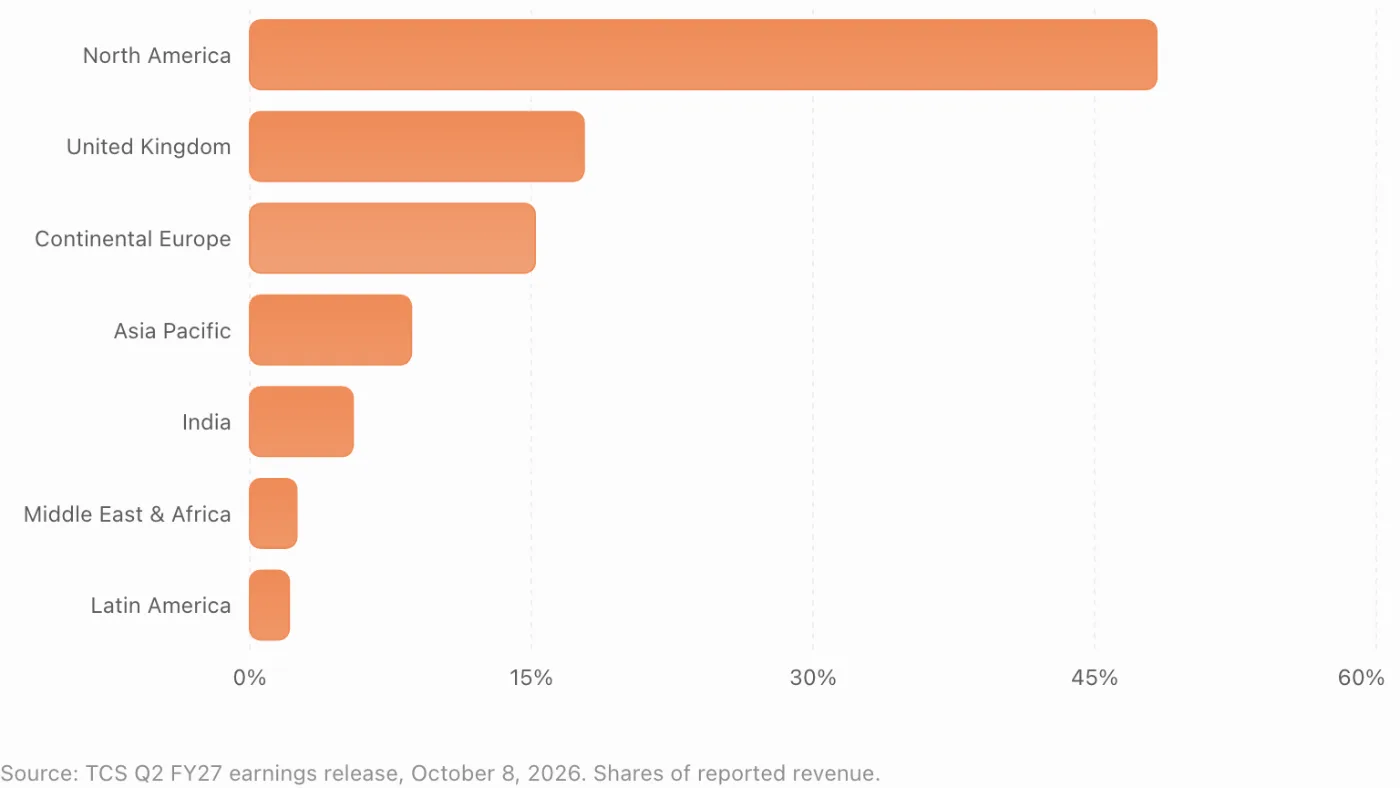
These figures underline a basic reality. Indian technology companies can reduce their dependence on US visas without reducing their dependence on American customers.
A US recession, cuts in technology budgets, tighter outsourcing rules or changes in how American corporations buy software services could still affect their revenue.
The distinction is especially important when interpreting stock market gains. Investors may believe a particular immigration restriction will have little immediate effect on earnings. That does not mean they expect every risk associated with the US market to disappear.
Greater international diversification can reduce some exposure. In the latest quarter, TCS recorded 3.5% sequential constant-currency growth in the UK, compared with 0.4% in North America.
But one quarter is not enough to establish a lasting shift away from the American market.
What Friday's Rally Says About the Future of Indian IT
The Indian IT industry's dependence on the United States has two parts: dependence on American business spending and dependence on moving employees to America.
These are not the same problem. Offshore delivery centres, local recruitment and AI-assisted work have given Indian technology companies more options for serving international customers. They may also help limit the effect of restrictions affecting specific immigration programmes.
TCS's latest financial results, including growing international revenue and an annualised AI business exceeding $3 billion, provide evidence of changes in the services companies are selling.
The Best Buy GCC agreement also shows how traditional IT providers are finding opportunities within India's growing network of multinational capability centres.
Yet the PERM suspensions create uncertainty for workers seeking permanent residency, and the wider US immigration environment continues to influence staffing costs and business planning.
For India's IT exporters, the challenge is no longer simply to send more engineers overseas or add more employees for every new contract. It is to retain customers, deliver technology services from different locations, invest in skills and convert AI-related demand into earnings.
Friday's rally suggests investors see the industry becoming less dependent on some routes for employee relocation. Whether that shift can support sustained revenue growth and protect margins remains to be demonstrated.