

Artificial intelligence in India is entering a decisive phase. The conversation is no longer only about who can adopt AI fastest, but about who can build technology that solves complex, real-world problems reliably, responsibly and at scale.
In this exclusive News4Bharat interview, Abhinandan Kumar, Founder of into3.ai, brings a perspective shaped by an unusual journey spanning defence avionics, artificial intelligence, entrepreneurship and education technology. Drawing on years of building technology for demanding real-world environments, Kumar discusses why the next generation of AI-native and DeepTech companies in India will need to go beyond simply adding an AI layer to existing products.
From scaling Ginnie AI to around ₹100 crore in ARR with a 12-member team to building into3.ai around personalised learning and intelligent educational interventions, Kumar offers a candid perspective on what it takes to build capital-efficient AI businesses, develop defensible intellectual property and solve problems that existing foundation models cannot adequately address.
From Defence Avionics to AI in Education: Abhinandan Kumar’s DeepTech Journey
Q1. From defence avionics to artificial intelligence and now education, how has your DeepTech journey shaped the way you build technology that must perform reliably in the real world?
Growing up in Bokaro, I would look up at the sky just to catch a glimpse of an aircraft. That fascination became such a part of me that, after Class 12, aeronautical engineering felt like the only path I wanted to pursue. Defence avionics was my chance to get close to the technology that had captivated me as a boy.
What I hadn’t anticipated was how profoundly it would shape my mindset. It taught me to respect what’s at stake when someone trusts the technology you’ve built. You question your assumptions, pay attention to the smallest details, and take responsibility for how a system behaves outside the lab. That discipline has stayed with me through AI and now into3.
Education, though, touches something very personal. I think about a child who is curious and capable, but begins to believe, “Perhaps I’m just not good at this.” If our technology misunderstands their struggle, we could reinforce that belief.
That’s where my engineering experience meets my purpose today. I want into3 to understand where that child needs help and give them the support to discover, “I can do this.” I still recognise that boy looking up at the sky. I want more children to feel that their fascination can lead somewhere.
What Defines a Truly AI-Native and DeepTech Company?
Q2. Everyone is building with AI today. What, in your view, separates a genuinely DeepTech or AI-native company from a conventional product that has simply added an AI layer?
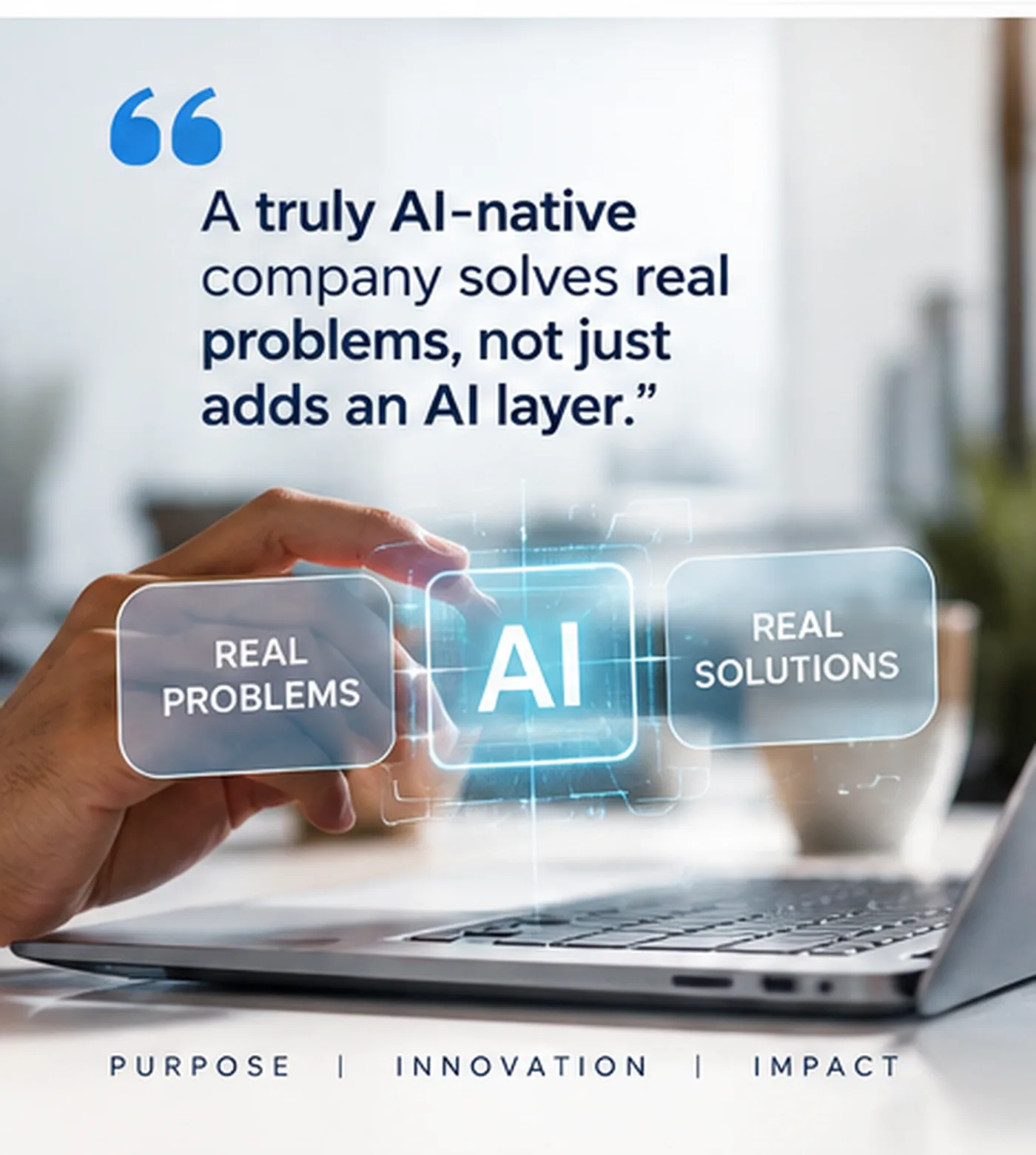
Yes, everyone seems to be building with AI today. But sometimes you wonder whether they have found a problem worth solving, or simply found a technology everyone is talking about. There is a lot of low-hanging fruit, and naturally, people are reaching for it.
The next wave, I believe, will belong to companies that use AI to solve problems we have lived with for years. Look at the interest around AI coding tools: people can see what the technology actually does for them. That matters. We sometimes speak as though AI means language models. LLMs are part of AI; they are not the whole of it.
For me, this comes back to education. We built IITs because engineering mattered to the country. We built IIMs because management mattered. Where is that same ambition for teaching? Where is the institution that makes a young person say, with that same pride, “I want to become a teacher”?
We expect extraordinary teachers. Have we done enough to help people become extraordinary teachers?
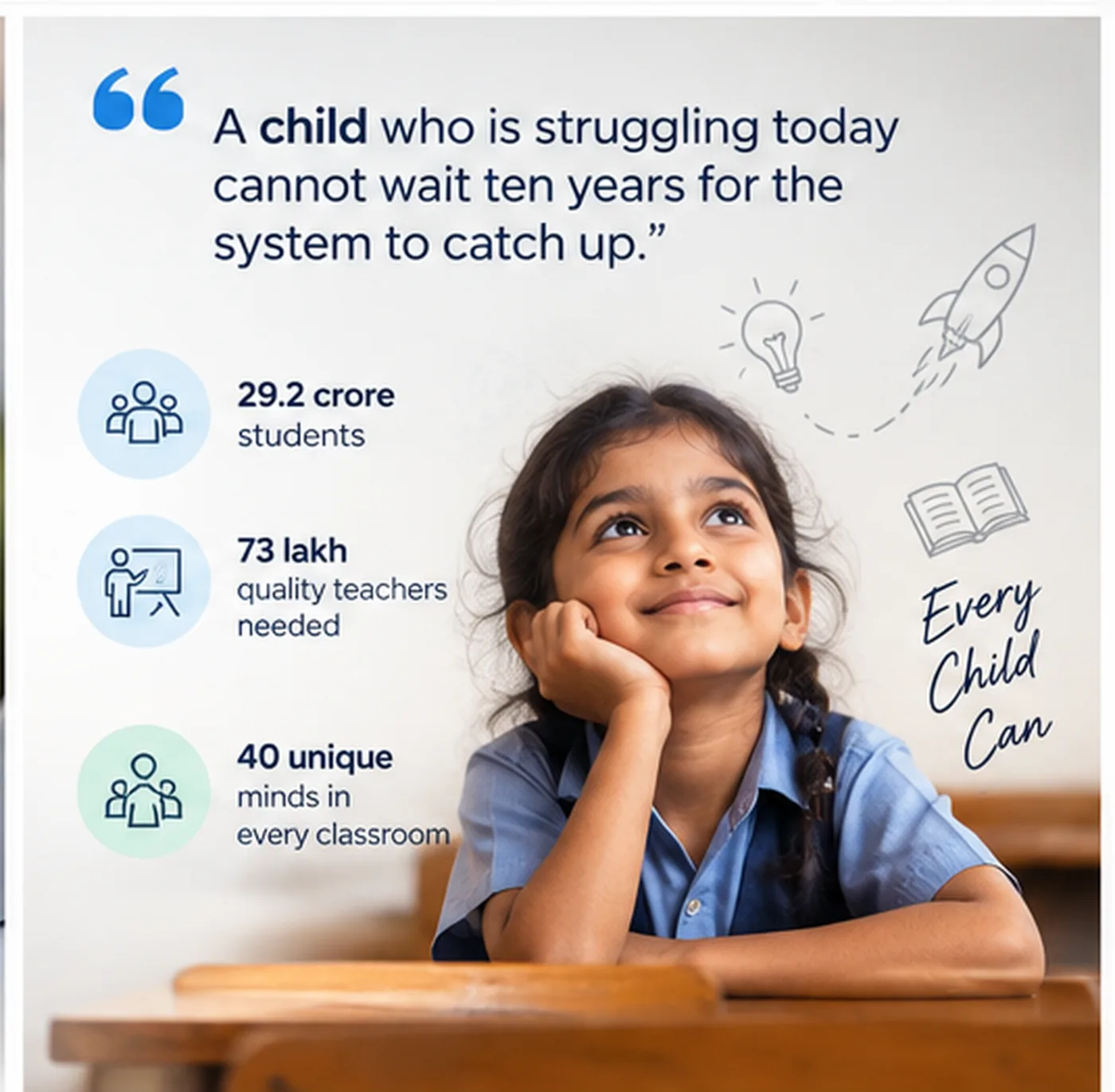
Now consider the scale. For 29.2 crore students, even one teacher for every forty children means 73 lakh quality teachers. And forty children are forty different minds. Having a teacher in the classroom and giving every child the attention they need are two very different challenges.
We should absolutely invest in developing teachers. But that takes time. A child who is struggling today cannot wait ten years for the system to catch up.
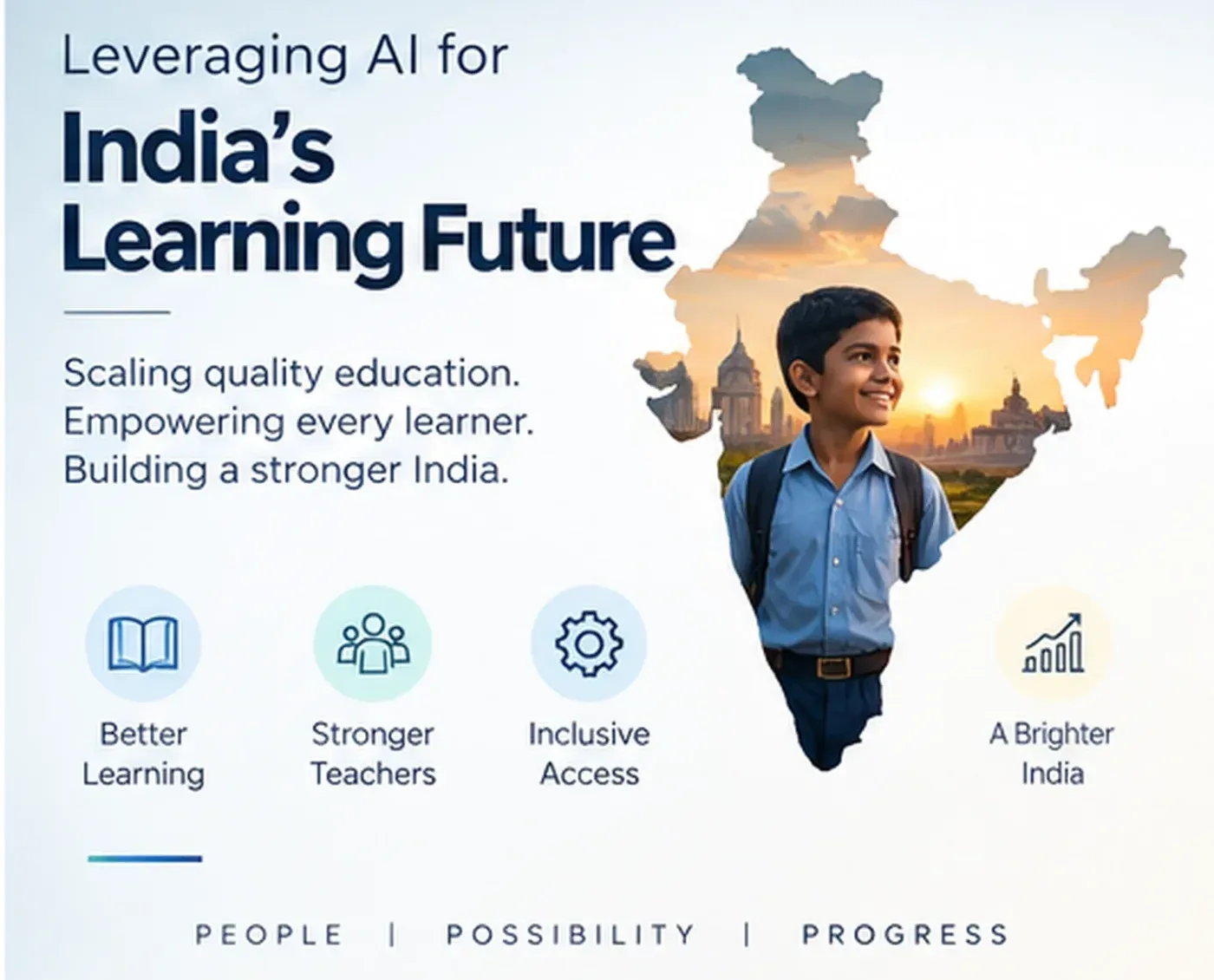
That is why AI matters so deeply here. There is a possibility of taking excellent teaching expertise and extending its reach far beyond what any individual could manage. Making that work, consistently and affordably, is the difficult work behind into3.
And whether we solve it or somebody else does, this problem has to be solved. It is much bigger than into3. I simply cannot see us reaching every child at this scale without AI becoming a substantial part of the answer.
Also Read | “Capital Can Solve Liquidity. It Cannot Solve Denial”: Vijay Sajjanhar | Exclusive
AI Personalisation vs Surveillance: Where Should Education Technology Draw the Line?
Q3. As AI moves from answering questions to interpreting behaviour, engagement and cognitive signals, where should we draw the line between useful personalisation and excessive surveillance?
So we agree on something important already: giving a child an answer is only the beginning. Education asks much more of us.
Now, there are two parts to what you’re asking. AI is exceptionally useful at finding patterns. A child’s mistakes, the time they take to respond, the topics they repeatedly struggle with—all of that can help us understand where support is needed. Naturally, companies began there. Those were the low-hanging fruits: easier to build, quicker to demonstrate, and useful. There is nothing wrong with that.
But while developing into3, we kept coming back to a concern. If we make marks the centre of an AI learning system, are we repeating the very mistake we hoped technology would help us overcome?
Marks can reflect understanding, but a good score does not tell us everything about how a child arrived there. Equally, a disappointing score cannot tell us everything that child is capable of.
That pushed us to explore other sources of information, including physiological signals and cardiovascular measures. The ambition is to learn the learner before teaching—to understand when to slow down, when to change the explanation, and when the child might simply need a break.
The approach we have chosen is to process the raw signals on the learner’s device and discard them there. What comes back is limited numerical analysis. We have also applied for reviews of our practices against DPDP and COPPAf requirements. Those are steps towards accountability, and they need to be examined properly.
Even then, saying “we only receive numbers” cannot be the end of the conversation. Those numbers still concern a child. Families should understand what is being measured, what it can and cannot tell us, and have a meaningful choice about participating.
For me, the line is crossed when we collect more than we can justify, infer more than the evidence supports, or make a child feel they cannot say no.
We want to understand children well enough to help them. That ambition has to come with the restraint to leave parts of their lives alone.
Building a ₹100 Crore ARR AI Business with a Lean 12-Member Team
Q4. You previously scaled Ginnie AI to around ₹100 crore ARR with a 12-person team. What did that experience teach you about building capital-efficient AI startups in an era where many founders equate scale with large teams and large funding rounds?
To understand that, you have to go back to 2017, when we started Ginnie AI. From where I stood, funding was something you read about in newspaper articles. It seemed to belong to another world—usually one where the founder had an IIT or IIM on their résumé. Even understanding how to enter that world felt out of reach.
So I cannot claim that we sat down and devised some brilliant capital-efficiency strategy. We went lean because we had to. Funding never felt like an option available to us.
But necessity taught us something valuable: a strong product can give you the freedom to grow through customers and revenue. You can move at a measured pace, build organically, and still create a substantial business.
And there is something very instructive about having your own money on the line. Every expense becomes personal. You pause before spending, question whether something is necessary, and find ways to make what you already have work better. Efficiency becomes a habit.
As for reaching that scale with twelve people, the credit belongs to every member of that team. A number like ₹100 crore tends to become a founder’s headline, but the work behind it belongs to the people who built the company together.
Sometimes a startup can get a product into customers’ hands while a large organisation is still debating the colour of its logo. There is a real advantage in that.
That is what Ginnie taught me to value: staying close enough to understand, being agile enough to respond, and knowing how to survive. Funding can help enormously. But those instincts have to stay with you even after the money arrives.
Also Read | AI Can Automate BFSI, But Not Trust: Dushyant Sharma on the Power of Human Distribution | Exclusive
How Indian AI Startups Can Build Defensible Intellectual Property
Q5. For Indian AI startups, where do you see the strongest opportunity to build defensible intellectual property instead of becoming dependent on foundation models and technologies developed elsewhere?
There was a time when globalisation was presented as the answer to almost everything. Today, the conversation has shifted towards self-reliance and domestic capability. When tariffs, technology access, and even shipping routes can become instruments of pressure, your question becomes particularly important.
But we have to be careful about allowing apprehension to make our business decisions for us. A technology developed elsewhere is not automatically something to distrust. It may be precisely what allows us to move faster.
Think about how we sometimes approach infrastructure. We plan an eight-lane highway for the traffic we see today. By the time it opens, traffic has grown enough to fill it. We have spent years building, yet the commuter barely experiences a difference.
There is a similar danger in technology. If our entire ambition is to recreate what the leading companies have already built, we could spend years reaching a destination they have already moved beyond.
For India to lead, we have to think ahead of that curve. Where might AI take us in ten years? What could education, healthcare, or industry look like over an even longer horizon? Which difficult problems will need capabilities that do not exist yet? Those questions should influence what we begin researching today.
For a startup, the practical path can be quite straightforward. Use the models and tools already available. Solve something useful, earn revenue, and build a sustainable business. There is no shame in taking the low-hanging fruit. But keep a larger ambition behind it: use that revenue to fund research and develop something original.
That is where defensible intellectual property can emerge—from the methods and technologies you develop to solve problems that existing tools cannot adequately address.
Of course, we should understand our dependencies and preserve alternatives. But we should also use the world’s progress to buy ourselves time to contribute to what comes next.
The ambition over the next three to five years should be to catch the leaders at the next curve, and in areas where we understand the problem deeply, move ahead. We do not have to retrace every step the US or China has taken to make an original contribution of our own.
Will Generative AI Make Rote Learning and Traditional Exams Irrelevant?
Q6. Generative AI has made information instantly available. Does this make traditional examinations and rote learning increasingly irrelevant, and what should schools actually measure in an AI-powered world?
Let me ask you something. When we speak about the education of Rama or Krishna, do we discuss their marks or the class they passed? We remember the stories of their gurus and how they were prepared for life. Think, too, of how we speak about Chanakya and Chandragupta. That is the power we associate with a teacher—the ability to recognise potential and help someone grow into responsibilities they could not have imagined.
Could that preparation have come simply from memorising answers and passing examinations?
Of course, education had to reach beyond the privileged few. Expanding access was an enormous achievement. But as classrooms grew, preserving individual attention became harder. Whether children sit beneath a banyan tree or inside a modern building, we still have to ask: how well are they learning to think?
That question existed long before AI.
I still remember a college visit to the Port of Antwerp in Belgium. Our faculty member told us to go out, observe, and understand. Every evening, he would spend two hours discussing what we had noticed.
On the first day, he asked a question about marketing. I had been concentrating on the infrastructure. I had been looking at the same place, but had missed an entire dimension of it.
When we couldn’t answer, he gave us more questions. Eventually, we asked him for the answers. He said, “I only have questions. If you want answers, go and find them. That is how you will learn.”
That exchange has stayed with me.
Education is not always about making everything smooth. There is value in encountering something you cannot immediately explain, discovering that your first assumption was wrong, and having to look again. A good teacher knows when to help and when to let you wrestle with the question a little longer.
You may have forgotten your Class 3 English marks, yet still remember a question you struggled with and the teacher who helped you understand it. Those moments can become part of how we learn to approach difficulty.
Now, AI can make an answer available before that struggle has even begun. That is what concerns me. If every moment of uncertainty is immediately resolved for a child, when do they practise staying with a difficult question?
So I would want schools to look more closely at what happens between receiving a question and producing an answer. What did the child observe? What did they try? Can they explain their reasoning, recognise a mistake, and use what they learnt in an unfamiliar situation?
Examinations can still serve a purpose if they reveal those abilities. Remembering things matters, too. But reproducing an answer cannot remain our principal evidence of understanding.
For into3, this raises a responsibility as well. We should help a child work through difficulty, giving enough guidance to keep them moving while leaving room for discovery. I would want our technology to recognise the moment my faculty member recognised in Antwerp: sometimes the most valuable thing you can give a student is a question they want to pursue.
Also Read | “Build Institutions, Not Just Unicorns”: Dr Nirmal Bansal on India’s AI Future | Exclusive Interview
The Uncomfortable Truth About India’s AI Startup Ecosystem
Q7. Looking at India’s startup ecosystem today, what is one uncomfortable truth about AI entrepreneurship that founders, investors and policymakers are still reluctant to discuss?
Let me say the quiet part first, and let me include myself in it.
Most of what we call AI entrepreneurship in India today is not artificial intelligence. It is distribution. We take intelligence built elsewhere — models trained in America or China, on infrastructure we don't own, at a cost we couldn't afford — and we build an interface on top of it for an Indian use case. The uncomfortable truth is that everyone in the room knows this.
The founder knows it while pitching. The investor knows it while writing the cheque. The policymaker knows it while counting us in the "India AI" numbers. And we have all quietly agreed not to discuss it, because the valuations, the demo days, and the headlines depend on not discussing it.
Now, I want to be careful here, because I have said before that there is no shame in the low-hanging fruit. Using the world's best tools to solve a real Indian problem is sensible business. I do it too. The discomfort is not in starting there. The discomfort is that, as an ecosystem, we have made it the destination.
Founders dress up integration as invention, because "AI-powered" raises money faster than "we resell an API thoughtfully." Investors want research outcomes on trading timelines — nobody funds the eight-year problem, then we wonder why the eight-year breakthroughs happen elsewhere. And policy counts startups the way we once counted colleges: volume as achievement, while original contribution goes unmeasured.
India does not lack talent. It lacks patience — and the permission to say, out loud, that we are not yet building what we claim to be building. The day we can say that comfortably in a room full of founders and investors, we will have started fixing it.
Also Read | How Ayekart is Building India's AI-Powered Rural Commerce Ecosystem | Exclusive Interview
India’s Next DeepTech Breakthrough: On-Device, Multilingual and Affordable AI
Q8. Over the next five years, which DeepTech breakthrough do you believe could have the biggest impact on India—and where do you see India moving from being an adopter of global AI technologies to becoming a creator of foundational innovation?
If I have to choose one, it is not a bigger model. It is intelligence that becomes cheap enough, small enough, and Indian enough to run everywhere — on a ₹8,000 phone, in a government school with unreliable bandwidth, in a language the child actually dreams in.
Small, efficient models running on the device itself, speaking our languages, working without depending on a distant data centre. That, over the next five years, changes more lives in India than any frontier model ever will.
Why do I say that? Because India's defining constraint has never been ambition; it has been the cost of delivering quality at our scale. A breakthrough that makes one teacher slightly better helps a classroom. A breakthrough that makes intelligence nearly free. We chose on-device processing at into3 for privacy — a child's signals should be analysed and discarded on their own device — but the deeper lesson we learnt is that on-device is also how you serve India affordably. The economics and the ethics point in the same direction. That is rare, and worth building on.
Now, the second part of your question — when does India stop adopting and start creating? I would gently challenge the premise that we haven't. We did not invent the smartphone, the internet, or the card network. Yet UPI — built for an Indian problem, at Indian scale, on Indian assumptions — is today what the world studies. Nobody calls UPI an adaptation. That is what foundational innovation looks like when it comes from us: not retracing the steps of the US or China, but building the reference solution to a problem we understand more deeply than anyone else.
So I look for the domains where the problem itself is ours. Multilingual, voice-first AI — because our next 500 million users will speak to machines, not type. Population-scale learning science — because no one else has 29 crore students to understand, and the country that truly learns how children learn will export that knowledge the way we exported digital payments. Low-cost diagnostics, agricultural intelligence — the same pattern. Where the problem is Indian-scale, the innovation cannot be imported; it has to be created here, and whoever creates it becomes the world's reference.
That is the curve I spoke of earlier. We will not catch the leaders by racing them to larger models. We will catch them where the road bends — and for the next bend, India is not an adopter waiting for a product. India is the problem statement. The five-year opportunity is to be the ones who answer it.
You May also like - NEP Implementation State by State: Changes, Reversals & 2026 Updates
About the author:
Abhinandan Kumar is a technology entrepreneur with eighteen years of experience building companies across defence avionics, renewable energy, AI-powered home security, and education technology. He is the founder of into3.ai — India’s first Learning Infrastructure Platform — which uses real-time computer vision, adaptive AI, and cognitive modelling to personalise education for every child individually.
His previous venture, Ginnie AI, built AI-based home security for US and UK markets, scaling to ₹100 crore ARR with a twelve-person team. Before that, he worked in India’s defence sector — from cockpit displays or Mirage fighter jets at Samtel to munitions manufacturing at The Chemon Group — where he developed an uncompromising approach to engineering quality that now shapes into3’s product philosophy.
Editorial Disclaimer
The views, opinions and observations expressed in this interview are those of Abhinandan Kumar, Founder of into3.ai, and do not necessarily reflect the editorial position of News4Bharat. Statements relating to company performance, business metrics, technology capabilities, research, compliance practices and future projections have been presented based on information shared by the interviewee and/or the organisation. Where relevant, News4Bharat has referred to publicly available and official sources for additional context. Statistics, regulations, technologies and market conditions may evolve over time, and readers are encouraged to refer to the respective official sources for the latest information.
This interview is published for informational and editorial purposes and should not be construed as an endorsement, investment recommendation, legal advice or certification of any company, product, technology or claim discussed herein.