
Key Takeaways
- Dr. Mukesh K. Saini returned to India to apply advanced technical knowledge to farming challenges.
- ANNAM.AI is developing multilingual, explainable and field-tested AI solutions for Indian farmers.
- The platform is designed to work even in rural areas with limited internet connectivity.
- Explainable AI helps farmers understand why a recommendation is being made.
- ANNAM.AI aims to support both male and female farmers through gender-neutral technology.
- AI can play a major role in precision agriculture, crop monitoring, water conservation and soil protection.
- According to Dr. Saini, uncertainty in yield is one of the biggest challenges in Indian farming.
At a time when Indian agriculture is grappling with climate uncertainty, shrinking natural resources, and the urgent need for technology-led transformation, Artificial Intelligence (AI) is emerging as a powerful ally for farmers.
At the heart of this change is ANNAM.AI at IIT Ropar, an ambitious initiative working to bring AI-driven, multilingual, explainable, and field-tested solutions directly to India’s farming communities.
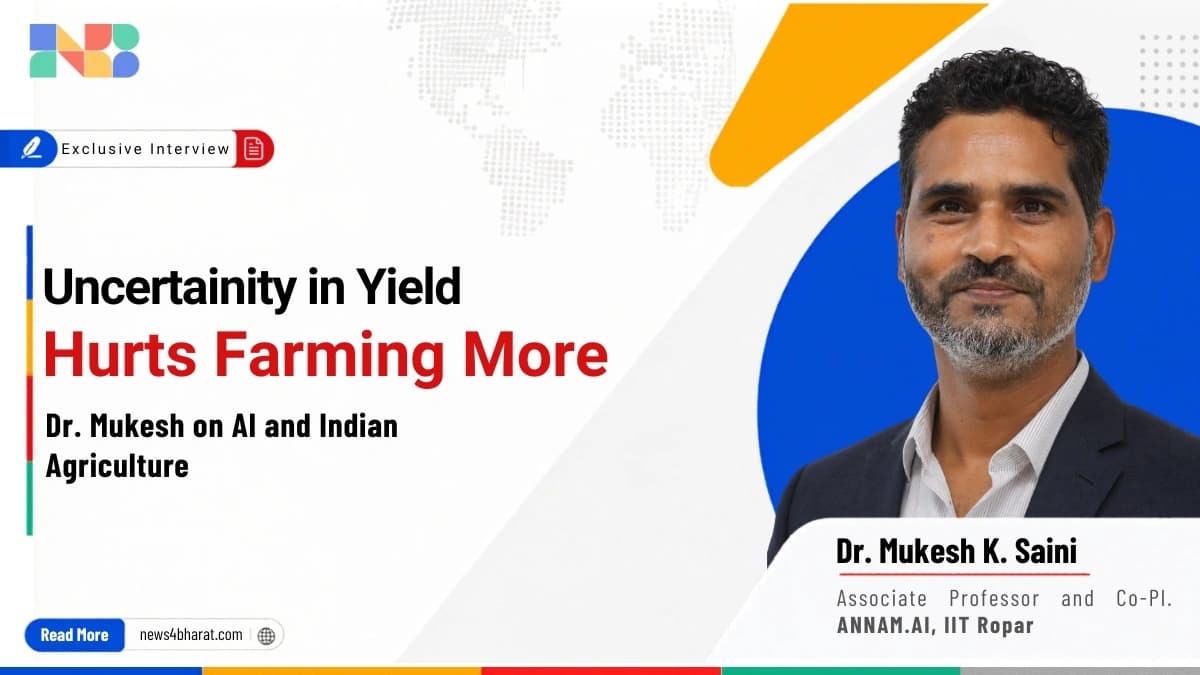
In this conversation with Srajan Agarwal of News4Bharat Network, Dr. Mukesh K. Saini, Associate Professor and Co-PI, ANNAM.AI, IIT Ropar, shares his remarkable journey from IISc Bangalore to Singapore, Abu Dhabi, Ottawa, and back to the fields of Punjab. He speaks about why he chose to apply advanced technology to Indian agriculture, how ANNAM.AI is building trust among farmers, the responsibility of working with public investment, the role of women in farming, and what AI-led agricultural transformation could mean for the future of rural India.
Article Highlights Box
- Interviewee: Dr. Mukesh K. Saini
- Designation: Associate Professor and Co-PI, ANNAM.AI, IIT Ropar
- Interviewer: Srajan Agarwal
- Platform: News4Bharat Network
- Theme: Artificial Intelligence in Indian Agriculture
- Key Focus Areas: Farmer trust, multilingual AI, explainable AI, precision agriculture, women farmers, Punjab farming challenges and sustainable agriculture
“It was always part of the plan to return and work in India.” - Dr. Mukesh K. Saini
You studied at IISc Bangalore, did a PhD in Singapore, worked in Abu Dhabi and Ottawa — the world was your oyster. Why did you come back to a field campus in Punjab to work on farming?
I grew up in a big agricultural family, where we worked on the farms ourselves. I must admit that it was a great time. The only reason to go abroad was to get advanced technical skills. It was always part of the plan to return and work in India.
Since I enjoyed working on the farms, I chose to apply my technical knowledge to solving farming challenges. No place could be better than Punjab for this.
A farmer in rural Punjab may not have reliable internet, may speak only Punjabi, may not trust a chatbot. How does ANNAM.AI actually reach that person?
ANNAM.AI's engagement layer ensures that the farmers can interact with our solutions in their native language. The solutions are field-tested and robust. Yet, we add an explainability layer to win the farmer's trust. Each recommendation comes with the AI model's confidence value. Farmers can use this confidence value to make informed decisions.
The end solutions (apps) are capable of buffering a certain amount of information. When the Internet is slow, information is stored in buffers. Once a better Internet is available, information from the buffers is quickly processed. Even if a better Internet is not available, the buffered data can be slowly sent to the servers, which in turn can send recommendations to the farmer in the same manner. Fortunately, farming does not have time-critical issues like medical science.
We regularly approach farmers in rural regions of Punjab and demonstrate the benefits and working of our solutions.
The Annam Chat Engine (ACE) promises multilingual farm advice. But farmers often distrust advice that doesn't come from someone who has touched the soil. How do you build that trust through a screen?
Unlike black-box solutions provided by some foreign companies; we use explainable AI to build trust with the farmer. Our solutions not only provide the final decision but also explain why they arrived at it. For example, when our model detects a disease, it also highlights the leaf regions that led to that decision.
This additional peek into the model helps the farmer trust our solution. Of course, in the long run, the model's performance will earn trust on its own.
The Government of India has put ₹311 crore specifically into IIT Ropar's ANNAM.AI. That is taxpayer money — largely from farmers and working people. How do you feel that responsibility on a daily basis?
It is a huge responsibility. I feel its weight every day, in each of my decisions. But it is also a great motivation.
There is an immense urge to deliver. I notice this feeling in the whole ANNAM team. In one urgent scenario, my lead AI engineer himself traveled with the team to Haryana to collect data and had to stop on the way back due to fog.
He slept in the car, parked at the roadside, without any complaint. Working late nights or weekends is a usual scene at ANNAM.AI.
In India, nearly 73% of women in rural areas are engaged in farming, but they are rarely counted as 'farmers' in official records. Does ANNAM.AI recognise the woman farmer? How?
ANNAM.AI solutions are gender neutral. None of our solutions presume any user gender. Our interface is equally effective for male and female voices. In fact, we promote women farmers through specific programs and activities.
“It’s not the yield itself, but the uncertainty in yield that hurts Indian farming more.” - Dr. Mukesh
Punjab is ground zero for water depletion, stubble burning, and soil degradation. These are not technical problems — they are political and social ones. Where does AI end and policy begin?
AI is the most powerful tool for addressing these issues. It can be used to detect and rectify these challenges through precision agriculture and predictive analysis.
ANNAM.AI technologies will enable effective crop growth monitoring, ensuring greater farmer yields with minimal water and chemical use, thereby preventing soil degradation and arresting the falling water table.
If ANNAM.AI succeeds 10 years from now — what does that success look like not in data points, but in people's lives?
I imagine better crop diversity, more youngsters taking farming as a profession, better food quality, and overall sustainable growth in the farming sector. People will have easy access to nutrient-rich food.
What is the one thing about Indian farming that the urban population — including people like us at News4Bharat — completely misunderstands?
It’s not the yield itself, but the uncertainty in yield that hurts Indian farming more.
News4Bharat's Exclusives
“Attention Without Meaning Is Just Noise”: Avinash Joshi on Building Trust in Modern Marketing
Three Generations One Workplace Rethinking Leadership in Modern India | Exclusive Article
