

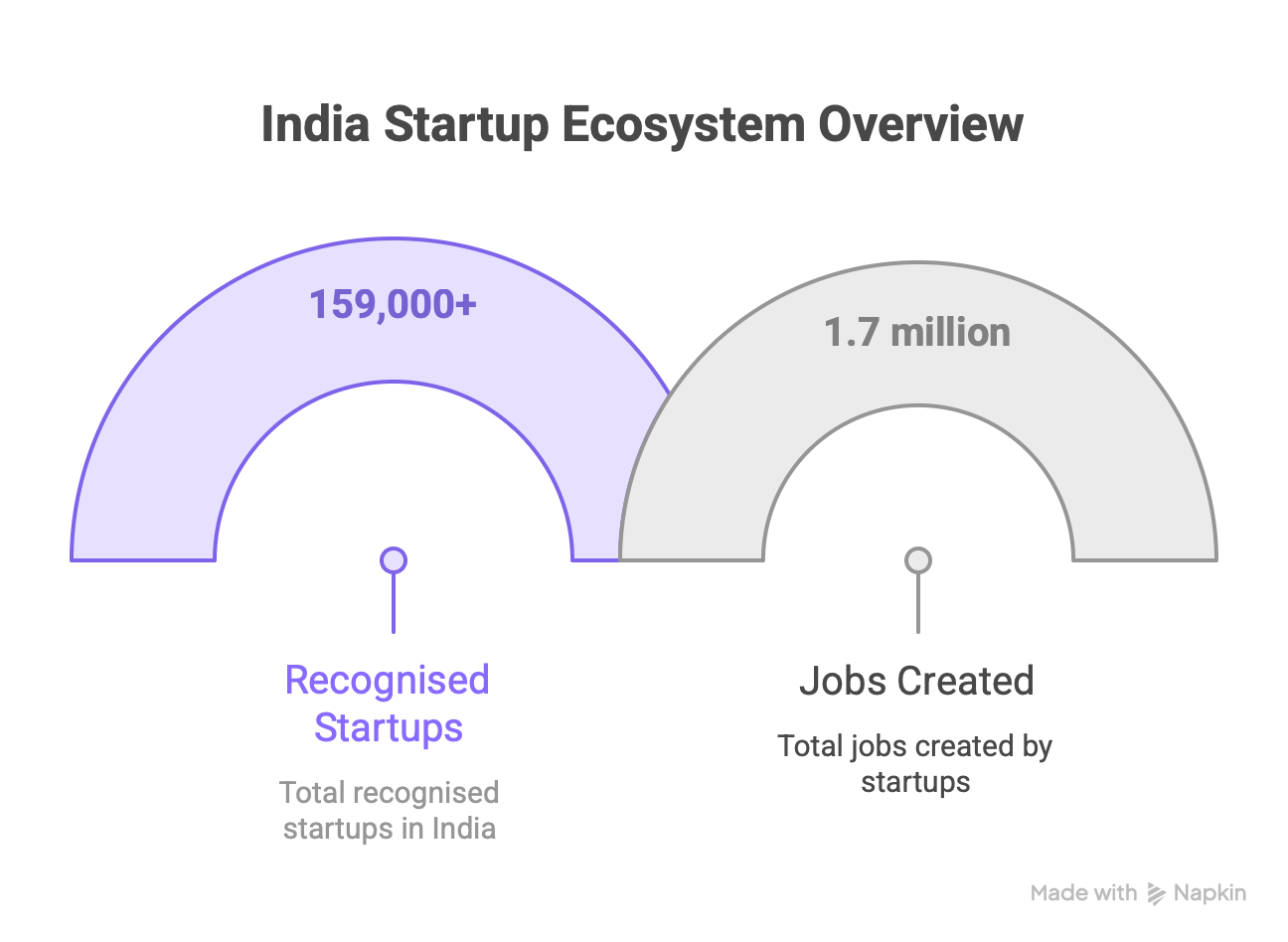
India is home to one of the fastest-growing startup ecosystems in the world, with over 159,000 recognised startups and millions of jobs created in the last decade.
Yet, beneath this impressive growth lies a critical concern — a large portion of these startups are not innovating, but replicating global business models adapted for the Indian market.
As global competition intensifies and technologies like artificial intelligence, semiconductors, and quantum computing redefine economic power, the real question emerges: Can India become a global innovation leader with copycat startups — or does it need to shift toward deep tech innovation?
The answer will define not just the future of startups, but the future of India’s economy itself.
The Limits of Copycat Startups
India has experienced tremendous success in the digital internet space with the creation of several unicorn startups. However, these startups have been operating in a highly competitive environment with thin profit margins as they have been trying to replicate the success of startups in the US and China.
Although these startups have been successful in creating value for the country, they have not been successful in building innovative strategies for the long term.
Recently, the trend in the funding of startups in the country has been low compared to the previous year as the startups in the country raised around $11-13 billion in 2025.
However, the next phase of the Indian startup revolution will not be incremental digital startups but will be based on the success of startups in the fields of AI, robotics, semiconductors, quantum computing, space tech, climate tech, and advanced materials.
The Rise of Deep Tech in India
Fortunately, India’s deep-tech ecosystem is gaining momentum. In fact, according to industry data, in 2025 deep-tech startups raised around $1.55-$1.6 billion in funding.
In addition, AI and advanced computing are becoming the core of this revolution. In fact, according to a 2026 report, AI is now part of almost 84% of India’s deep-tech startups and 91% of the sector's total funding.
In addition, India is moving forward in the domain of research-based entrepreneurship as well. In fact, as per a report, the incubation ecosystem of IIT Madras has been able to support more than 500 deep-tech startups, with a total valuation of ₹53,000 crore and more than 700 patents filed to date.
Why Deep Tech Matters for India’s Future
Deep tech is quite different from consumer internet startups, as it is more focused on scientific breakthroughs and IP creation rather than optimizing delivery logistics and digital payments.
In fact, this has three major advantages:
1. Strategic Sovereign Advantage: Technologies like AI chips, defense systems, and quantum encryption are what decide the world balance of power. In fact, nations controlling these technologies will decide the course of the future economy.
2. High-Value Global Market Opportunity: Deep-tech innovation is usually in multi-billion-dollar industries like healthcare, climate technology, aerospace, and manufacturing.
3. Long-Term Competitiveness in the Economy: Countries with high investments in research and development are more likely to have long-term economic competitiveness. However, India still spends less than 1% of its GDP on R&D, which is significantly lower when compared to many innovation-driven economies.
What Leaders Are Saying
Bill Gates, the Co-Chair at the Bill & Melinda Gates Foundation, has said India has emerged as a global innovation leader in addressing large-scale societal challenges through technology-driven innovation.
Likewise, Ravi Jain, the Investment Director at TDK Ventures, thinks the sector is at the cusp of a growth phase and estimates the funding in the Indian deep tech sector could reach over $5 billion in the next five years.
These opinions show the overall consensus in the industry and the need for the next generation of startups in India to develop original technologies and not just technology-based businesses.
Building India’s Deep Tech Decade
India has the potential to become the next Deep Tech Decade, and it can be achieved by building research-industry collaboration, venture capital for science-driven startups, and university commercialization.
The Government of India has begun initiatives such as investments in Artificial Intelligence, Machine Learning, and startup policies.
However, the real question is whether India will be at the forefront of the next technological revolution or be at the forefront of businesses based on other countries’ innovations.
If India has to be at the forefront and shape the future, then the answer is simple—India needs to build its own deep tech and not copycat businesses.