
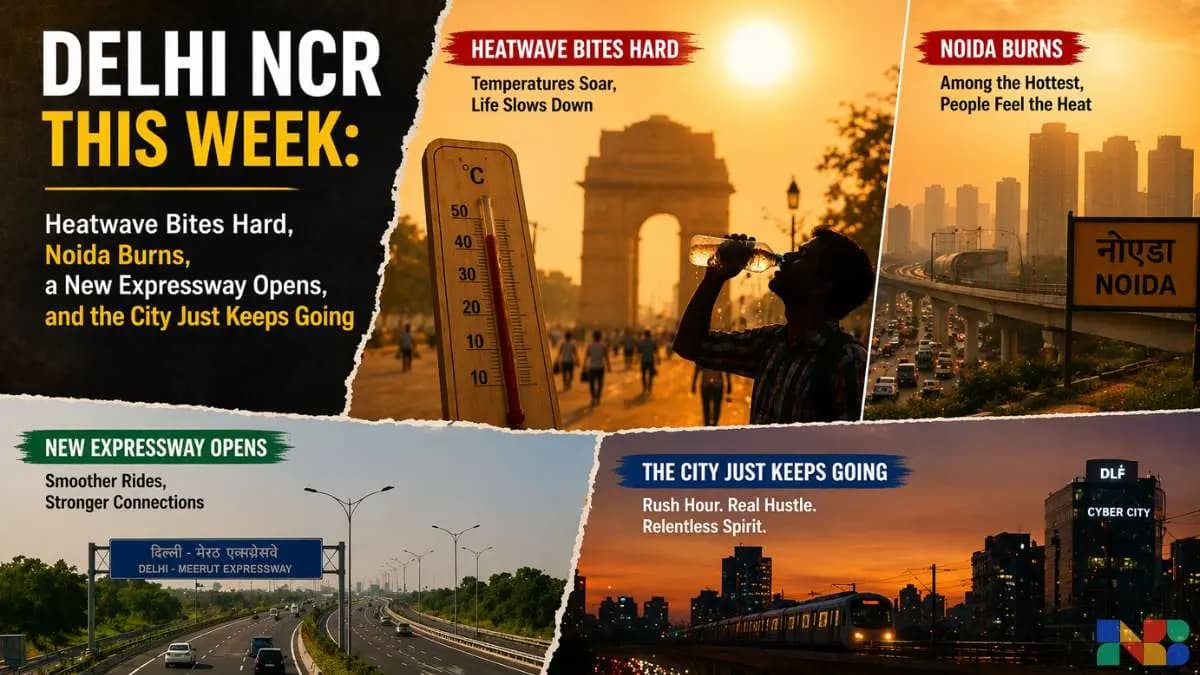
April is always brutal in Delhi. But this week, it got unusually early and unusually serious. On Tuesday, Safdarjung — the city's primary weather station — logged a maximum temperature of 38.2°C, which is roughly two degrees above what April should look like at this point. By the weekend, the India Meteorological Department is tracking a push toward 40°C to 42°C, with some forecasts not ruling out higher if conditions persist.
STATION-WISE TEMPERATURE READINGS — THIS WEEK
- Safdarjung (Base Station): 38.2°C — 2°C above seasonal normal
- Ridge Station: 39.5°C
- Lodhi Road: 38.1°C
- Palam: 37.6°C
- Ayanagar: 37.8°C
No formal heatwave warning has been issued yet — that threshold kicks in when the day's temperature is 4.5°C above normal, or when absolute temperature crosses 45°C. But the trajectory is clear. IMD officials are watching daily. What made this week difficult was not just the raw temperature but the shift in conditions. Western disturbances had been keeping things somewhat manageable through early April. That cover has now lifted. Clear skies, calmer winds, stronger afternoon sun — all of it is accelerating the heat buildup across the plains.
Also Read | Delhi EV Policy 2026: Petrol Two-Wheeler Ban From April 2028 — Check What CM Says
Residents on social media told a familiar but grim story. One person wrote they had lived in Delhi all their life but this year's early heat felt different — 41°C at 10 PM, with air conditioners barely managing. Several others described rooftop water tanks turning warm even by early morning hours. Hospitals across the NCR region have been placed on alert for heat-related cases — dehydration and heatstroke are the main concerns as outdoor workers, daily labourers, and construction site workers bear the worst of it. Power demand has spiked noticeably, pushing grid infrastructure toward peak capacity.
THE LABOUR CRISIS — NOIDA BURNS
The most disruptive story of the week came from Noida. A three-day labour strike in Noida's Phase 2 industrial belt — workers demanding wage hikes, double overtime pay, and better workplace safety — crossed a dangerous line on Monday morning. Groups of striking workers set at least two vehicles on fire in the Sector 1 and Sector 84 cluster. Police deployed from both Delhi and Gautam Buddh Nagar were forced to use what officials described as "mild force" — lathi charges and crowd dispersal — to clear the blockades.
The fallout was immediate. The DND Flyway, one of the most critical arterials connecting Delhi to Noida, came to a near-complete halt during peak office hours. Commuters reported sitting in their vehicles for over three hours without movement. The arterial stretch turned into a long parking lot. By mid-morning, senior officials had arrived at the site. District Magistrate Medha Rupam set up dedicated helpline numbers and a control room specifically for workers to register complaints through official channels — an attempt to pull the protest off the streets and into a formal grievance process.
Also Read | CBSE Class 10 Results 2026 Declared: 93.70% Pass, Over 45,000 Students Score Above 95%
NOIDA LABOUR UNREST — KEY POINTS
- Strike origin: Wage disputes, overtime pay, and safety complaints in Phase 2 industrial sectors
- DND Flyway blocked during peak hours — 3+ hour gridlock for commuters
- Two vehicles set on fire in Sectors 1 and 84
- Police deployed across all industrial sectors under Gautam Buddh Nagar Commissionerate
- DM Medha Rupam established worker helplines and a dedicated control room
- Gautam Buddh Nagar also introduced new labour rules: timely salaries, double overtime pay, formal grievance systems
- Factories across Noida and Greater Noida running at reduced capacity — supply chain impact ongoing
The new labour reforms introduced this week — which require companies to ensure timely salary payments and provide structured grievance redress — are being seen as a direct consequence of the pressure built up by this unrest. Whether they actually get implemented on the ground is a different question. Workers and union leaders have heard promises before. Corporate offices in Noida and Gurugram extended work-from-home policies for the rest of the week to keep employees away from disrupted commutes. Cab services saw fares spike. Delivery operations stalled briefly before resuming.
THE BIG ONE — DELHI-DEHRADUN EXPRESSWAY OPENS
On April 14, Prime Minister Narendra Modi inaugurated the Delhi-Dehradun Economic Corridor at the Forest Research Institute in Dehradun. This is a 213 km, six-lane access-controlled expressway built at a cost of over ₹12,000 crore, connecting Delhi, Uttar Pradesh, and Uttarakhand via Saharanpur. It passes through Baghpat, Baraut, Shamli, and Saharanpur before heading north into Uttarakhand.
The most headline-grabbing feature is travel time. The old Delhi-to-Dehradun journey took five to six hours, longer on holidays or festival weekends. With this expressway open, it is now approximately 2.5 hours. That is a dramatic shift — not just for tourists and second-home buyers but for logistics, warehousing, and commerce across the entire northern corridor.
DELHI-DEHRADUN EXPRESSWAY — FAST FACTS
- Total length: 213 km (6 lanes, expandable to 8)
- Cost: Over ₹12,000 crore
- Travel time reduced: 6 hours → 2.5 hours
- Passes through: Delhi, UP (Baghpat, Shamli, Saharanpur), Uttarakhand
- Wildlife corridor: 12 km elevated passage over Rajaji National Park — one of Asia's longest
- Connects to Eastern Peripheral Expressway at Khekra
- Expected daily traffic: 20,000–30,000 vehicles at 100 km/h average speed
- Solar panels, rainwater harvesting, and street tree planting incorporated
- One exit ramp delayed — land acquisition dispute in UP still unresolved
The wildlife corridor deserves a separate mention. A 12 km elevated section over Rajaji National Park was built specifically to allow elephants and other animals to move freely underneath — with a vertical clearance of 6 metres. This makes it one of only two such corridors in the country. It is not just a road — it is an attempt to get infrastructure and ecology to coexist. Real estate experts from Colliers India estimate that the expressway could trigger 1 to 2 million sq ft of Grade A industrial and warehousing supply in Delhi NCR's northern micro-markets — Ghaziabad, Noida, Greater Noida, and Meerut — over the next few years. Dehradun is also expected to become a more accessible second-home and retirement destination for NCR buyers.
Also Read | PM Modi Innagurated Delhi-Dehradun Expressway: A 210-km Road That Changes How North India Moves
GOVERNANCE, CRIME & CIVIC PULSE
Beyond the big headlines, the week carried several smaller but significant stories across the NCR.
OTHER KEY DEVELOPMENTS THIS WEEK
- CAQM issued new dust pollution rules from April 1 — mandatory scientific rubble disposal, online tracking, and dust control at construction sites; violations attract heavy fines
- Delhi government reviewed metro expansion plans and double-decker flyover projects to reduce congestion
- ₹573 crore approved for two new student hostels at a Delhi medical college
- Elevated Yamuna Road Project (19 km, Wazirabad to DND) gaining momentum
- Greater Noida West residents announced a major protest at Jantar Mantar demanding metro connectivity
- Gangster wanted for 14 years arrested across Delhi-Punjab border — major breakthrough in organised crime
- NGT issued notice over garbage dumping near schools in Delhi
- Sewage overflow crisis reported in multiple Gurugram residential societies
- Delhi court sentenced a man to 20 years imprisonment in a child assault case
- Rising digital fraud cases — UPI scams, social media fraud, and fake investment schemes surging across NCR cities
- Noida celebrates 50 years of establishment — from rural wetlands to India's largest planned urban township
- Uber shut down its Delhi-NCR shuttle service from March 27 — citing low ridership and financial losses; shifting focus to corporate employee transport
- LPG shortage: street vendors across NCR switching from cooking stalls to juice and shikanji setups
- Jan Vishwas Amendment Bill 2026 tabled in Parliament — aims to decriminalise several minor civic violations in Delhi
The Greater Noida West metro demand protest is worth watching. Residents have been asking for years. The population in those sectors has grown significantly, and commute times to Noida and Delhi remain painful. A mega protest at Jantar Mantar — the political pressure point — signals that this is not going to stay a fringe issue for much longer. Meanwhile, the CCTV surveillance expansion by Delhi Police across more city zones is moving forward — integrating additional feeds for real-time monitoring and faster incident response.
Noida's 50-year milestone is a moment for reflection. In 1976, there was almost nothing there. Today it is one of India's most significant urban and industrial hubs — with all the glory and all the dysfunction that comes with rapid, poorly-coordinated growth. The labour crisis this week was, in many ways, a symptom of that exact tension.
