

Imagine waking up tomorrow and finding out that an international landmark thousands of miles away suddenly had a brand-new name. That is essentially what happened when Donald Trump floated the idea of renaming the world's most critical oil chokepoint as the Trump Strait.
The unexpected suggestion immediately set off a storm across social media feeds, television networks, and diplomatic circles. Some supporters cheered the bold assertion of American dominance, while critics and legal scholars dismissed it as political theater. But beneath the noisy headlines lies a serious question about how the world works: Can a world leader actually rename an international body of water by sheer force of will?
To understand what is really happening, we need to separate social media bluster from legal reality. Here is an exhaustive, layman-friendly guide to what Trump said, how geographic renaming works, and why international law treats oceans very differently than office towers.
How the "Trump Strait" Controversy Started?
The drama began with a post on Truth Social on September 2, 2026. President Trump addressed his followers with a rhetorical question that immediately went viral.
"Now that we have it under U.S.A. control, should we change the name Hormuz Strait to TRUMP STRAIT???"
Trump wrote. He went on to add that, much like America itself, the waterway would be "hotter than ever before."
The online reaction was instantaneous. Within hours, news outlets around the globe were debating whether Washington had just declared cartographic war on Middle Eastern geography.
However, the exact language used in that post is vital. Notice that Trump phrased the idea as an open question rather than an official executive proclamation.
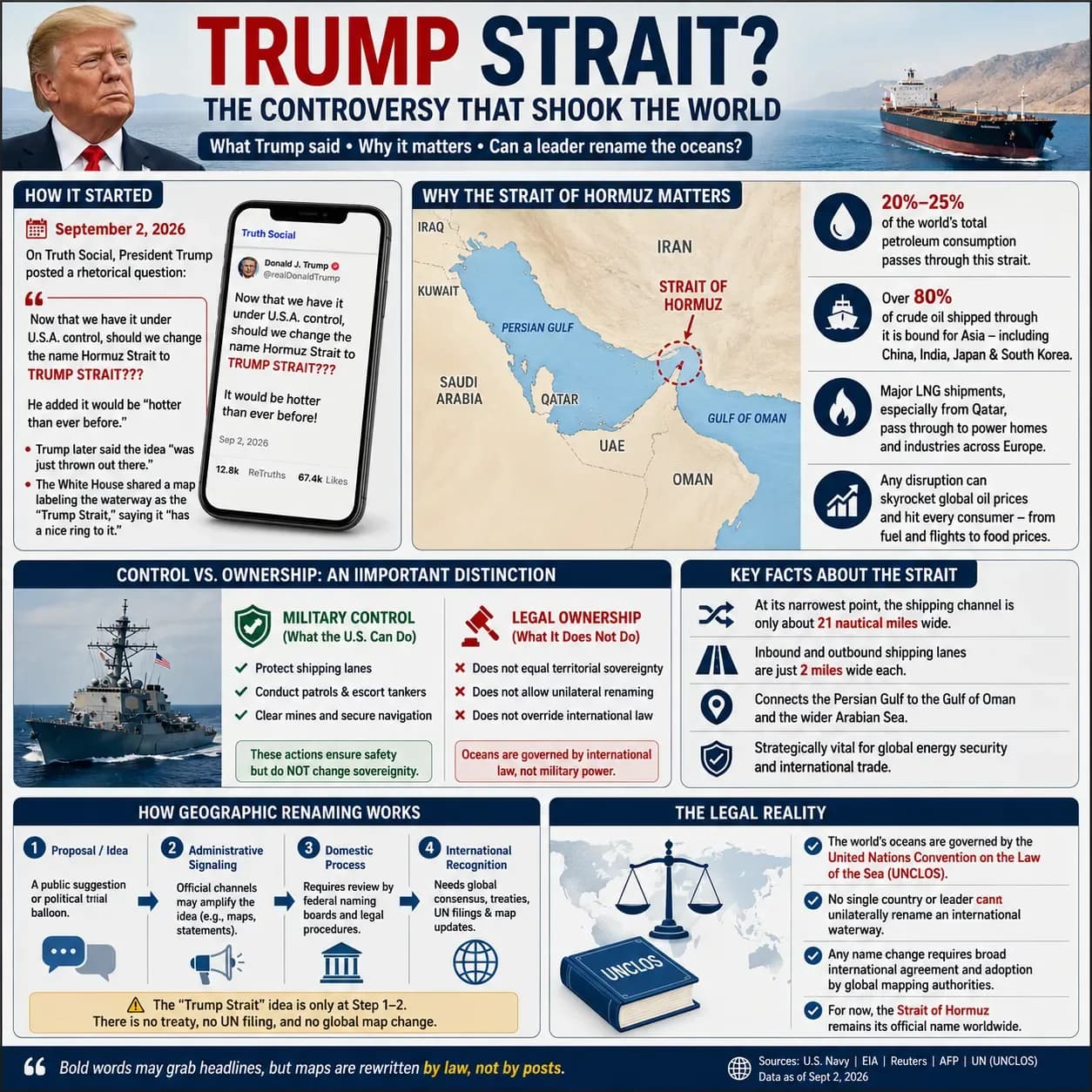
Later that same day, reporters pressed Trump on whether he was genuinely moving forward with an official legal rebranding. According to reporting by Agence France-Presse (AFP), Trump casually shrugged off the immediate seriousness of the move, noting that the idea "was just thrown out there."
Yet, the White House communications team leaned into the buzz shortly afterward. Official administration channels shared a regional map displaying the waterway labeled as the "Trump Strait," cheekily remarking that the moniker had "a nice ring to it."
READ MORE: Trump Holds Crucial Meeting on Iran War, But Final Peace Deal Still Hangs in Balance
Proposal vs. Reality: Tracking the Communication Chain
To keep the facts straight, it helps to break down how political ideas travel:
- An offhand post on social media serves as a public proposal or political trial balloon.
- A follow-up graphic from official press offices represents administrative signaling.
- A formal domestic order requires paperwork through federal naming boards.
- An internationally recognized change demands worldwide diplomatic consensus.
So far, the entire episode sits comfortably in the first two stages. There has been no binding international treaty, no United Nations filing, and no formal global map revision.
Why the Strait of Hormuz Matters to Every Person on Earth
To understand why this issue touches such a raw nerve, you have to look at where this waterway sits and what flows through it every single day.
The Strait of Hormuz is a narrow stretch of ocean that connects the Persian Gulf to the Gulf of Oman and the wider Arabian Sea. At its narrowest point, the shipping channel is only about 21 nautical miles wide, with outbound and inbound shipping lanes measuring just two miles across.
Despite its tight dimensions, this tiny sliver of water is the beating heart of modern global trade.
Mind-Boggling Energy Numbers
- Roughly 20% to 25% of the world's total petroleum consumption passes through this single passage.
- Over 80% of crude oil shipped through the strait is bound for Asian powerhouses like China, India, Japan, and South Korea.
- Vast shipments of Liquefied Natural Gas (LNG), particularly from Qatar, traverse the lane to heat homes and power factories across Europe.
If traffic in the strait halts for even a few days, global oil prices can skyrocket overnight. That ripple effect hits everyday consumers directly, driving up the price of gasoline at local pumps, raising airline ticket prices, and inflating grocery costs due to higher freight rates.
Because of this immense economic weight, any claim that someone "controls" the corridor triggers immediate alarm bells for central banks, energy traders, and heads of state worldwide.
The Military Dimension: Control vs. Legal Ownership
Trump's post tied the naming proposal directly to military capability: "Now that we have it under U.S.A. control..."
This comment came against the backdrop of intense, escalating friction between the United States and Iran. Just days earlier, on August 28, the White House announced that American naval forces had conducted intensive mine-clearing operations and established continuous security patrols to escort commercial oil tankers through contested lanes.
While the United States Navy possesses unrivaled power to protect merchant ships, military protection is not the same thing as territorial sovereignty.
Think of it like an armed security team guarding a busy public highway. The security team might control the flow of traffic, direct cars around hazards, and deter bandits. But that security presence does not give the guards the legal deed to the pavement, nor does it let them rename the street after their boss.
Also Read | What Is Happening in US-Iran Talks? Trump’s Deal, Iran’s Response and Impact on India Explained
What the Reality on the Water Looks Like
- The US military has historically patrolled the region via the Fifth Fleet, stationed out of Bahrain, to guarantee open trade.
- Iran, whose coastline hugs the entire northern rim of the strait, regularly deploys fast-attack boats, drones, and coastal missile batteries to project its own presence.
- Clashes, tanker seizures, and drone interceptions have repeatedly flared up in these waters over recent decades.
Stating that US forces have secured safe transit describes an operational mission. Interpreting that mission as an acquisition of sovereign American territory is legally incorrect.
Can an American President Unilaterally Rename a Foreign Waterway?
The short answer is: No, not on the world stage.
To understand why, we have to look inside the bureaucratic machinery that gives names to hills, rivers, and oceans.
Inside the American government, place names are regulated by a little-known agency called the U.S. Board on Geographic Names (BGN). Created by an executive order in 1890 and codified by Congress in 1947, the BGN exists to make sure that federal agencies do not call the same place by three different names.
If the Department of Defense is planning an operation and the Department of State is drafting a diplomatic cable, both departments need to look at maps that use identical terminology.
How the BGN Operates
- Domestic Names Committee: This group reviews proposals for mountains, lakes, and towns inside the fifty US states and American territories.
- Foreign Names Committee: This team determines how foreign countries, cities, and international landmarks are spelled and indexed across official US government databases.
Here is the crucial catch: The Board on Geographic Names only standardizes terminology for US federal government agencies.
The BGN has zero legal power over foreign mapmakers, foreign ministries, or international atlases. If the BGN decided tomorrow to list the English Channel as the "American Channel" across federal paperwork, map publishers in London, Paris, and Tokyo would simply ignore it.
Furthermore, standard BGN procedures for foreign waterways heavily favor customary, long-established regional titles. While a sitting president can issue an executive order commanding federal employees to write a specific term on official charts, that order stops dead at America's borders.
What Happened with the "Gulf of America"?
If this scenario sounds familiar, that is because Donald Trump tested this exact playbook before.
On January 20, 2025, upon returning to the presidency, Trump signed an executive order titled "Restoring Names That Honor American Greatness." Among other provisions, the order directed federal executive branch departments to replace the term "Gulf of Mexico" with "Gulf of America" on official US federal maps and websites.
That action provides a clear blueprint for how the current dispute functions in practice:
- What the order accomplished: US federal agencies, military branches, and official whitehouse.gov documents updated their style sheets to reflect the new domestic wording.
- What the order could not do: It had no binding authority over Mexico, which continues to recognize the body of water as the Golfo de México.
- How global publishers reacted: Major global cartographers, commercial airlines, foreign governments, and international shipping registers largely retained the historical name "Gulf of Mexico" to avoid navigation confusion.
If changing the label on a gulf directly bordering the southern United States faced international resistance, attempting the same move on a waterway located on the other side of the planet faces an infinitely steeper legal climb.
What International Maritime Law Actually Says
The legal framework governing the world's oceans is laid out in the United Nations Convention on the Law of the Sea (UNCLOS), often referred to as the "constitution of the oceans."
Under international law, the waters of the Strait of Hormuz do not sit in a lawless void. The strait is bounded by two sovereign nations: the Islamic Republic of Iran to the north and the Sultanate of Oman to the south.
Both countries claim 12 nautical miles of territorial waters extending out from their coastlines. Because the strait narrows down to roughly 21 miles wide, there is literally no strip of "high seas" running down the center. Every single drop of water in the narrowest passage falls within the sovereign territorial waters of either Iran or Oman.
The Golden Rule of Transit Passage
You might wonder: If the water belongs to Iran and Oman, why can American, European, and Asian ships sail through it at all?
The answer is the legal doctrine of transit passage:
- UNCLOS stipulates that when a narrow strait connects one open ocean or exclusive economic zone to another, foreign ships and aircraft have an inviolable right of unimpeded transit passage.
- As long as commercial and naval vessels travel continuously and expeditiously without threatening the coastal states, neither Iran nor Oman has the legal authority to close the strait to peaceful traffic.
- Crucially, transit passage guarantees freedom of movement, not a transfer of territory.
The United States, while not having formally ratified UNCLOS due to long-standing Senate debates over deep-seabed mining, treats these navigational articles as customary international law that applies to everyone.
Because American foreign policy relies heavily on defending UNCLOS navigational rights to keep sea lanes open, claiming ownership or naming rights over someone else's territorial strait contradicts the very legal principles Washington relies on to sail its warships there.
How Places Get Their Names Worldwide?
Who actually decides what is printed on commercial globes, GPS systems, and world atlases?
There is no single "World King of Maps." Instead, global geographical naming relies on a loose network of scientific agencies, historical consensus, and international standard-setting bodies:
- The United Nations Group of Experts on Geographical Names (UNGEGN): This body promotes the standardization of geographical names globally, respecting the sovereign authority of nations to name features within their own territories.
- The International Hydrographic Organization (IHO): Based in Monaco, the IHO coordinates international standards for nautical charting to ensure ship captains don't run aground because different nations use contradictory coordinates.
- Commercial Map Giants: Companies like Google Maps, Apple Maps, Garmin, and National Geographic make their own editorial decisions, generally defaulting to recognized local sovereignty or displaying dual names when a border area is disputed.
When an international dispute arises over a water body—such as the perennial argument between Japan and South Korea over the "Sea of Japan" versus the "East Sea"—international bodies rarely take unilateral sides. Instead, they encourage bilateral dialogue and often print both historical variants.
The title "Strait of Hormuz" possesses centuries of deep-seated historical usage. Documented in European, Persian, and Arabic charts since the Middle Ages, the name derives from the ancient maritime island-city of Hormuz. Renaming an ancient, globally acknowledged passage after an individual political figure runs counter to every established cartographic convention.
Why Trump Floated the Name: The Geopolitical Game
If the legal odds are close to impossible, why would Donald Trump propose the idea in the first place?
In international diplomacy, public language is rarely just about semantics. It is a tool of statecraft, deterrence, and media management.
1. Projecting Uncompromising Military Deterrence
By casually suggesting that the waterway could bear his own name, Trump sends an unmistakable signal to Tehran: Washington considers its military dominance in the Persian Gulf total, permanent, and unchallenged. It is the rhetorical equivalent of planting a flag on the water.
2. Framing the Domestic Narrative
For a domestic political audience, framing the crisis around "taking control" and rebranding a hostile adversary's front yard plays directly into themes of American strength and unapologetic leadership. It shifts the media narrative from the costs of foreign naval deployments to an audacious showcase of national swagger.
3. Psychological Warfare and Trolling
Trump has built a career in real estate, branding, and politics by understanding the power of provocative statements to dominate 24-hour news cycles. Floating the term "Trump Strait" forces adversaries, allies, and domestic critics alike to spend days reacting to his words, effectively keeping him at the absolute center of global conversation.
The Takeaway: Navigating Fact vs. Rhetoric
When consuming high-stakes geopolitical news, sorting hard reality from political theater is vital for maintaining an accurate picture of global events.
To summarize the situation clearly:
- The Claim: Donald Trump suggested that because US naval forces are securing shipping lanes, the Strait of Hormuz could be rebranded as the "Trump Strait."
- The Domestic Reality: A US president has the executive power to order American federal agencies to print specific terms on government documents, similar to the 2025 "Gulf of America" directive.
- The Global Reality: Washington does not own the waterway, has no sovereignty over Omani or Iranian territorial waters, and cannot legally force foreign nations, international courts, or global mapmakers to change historical maritime charts.
- The Official Status: For world governments, shipping consortiums, and commercial navigation systems, the vital corridor remains, and will continue to remain, the Strait of Hormuz.