

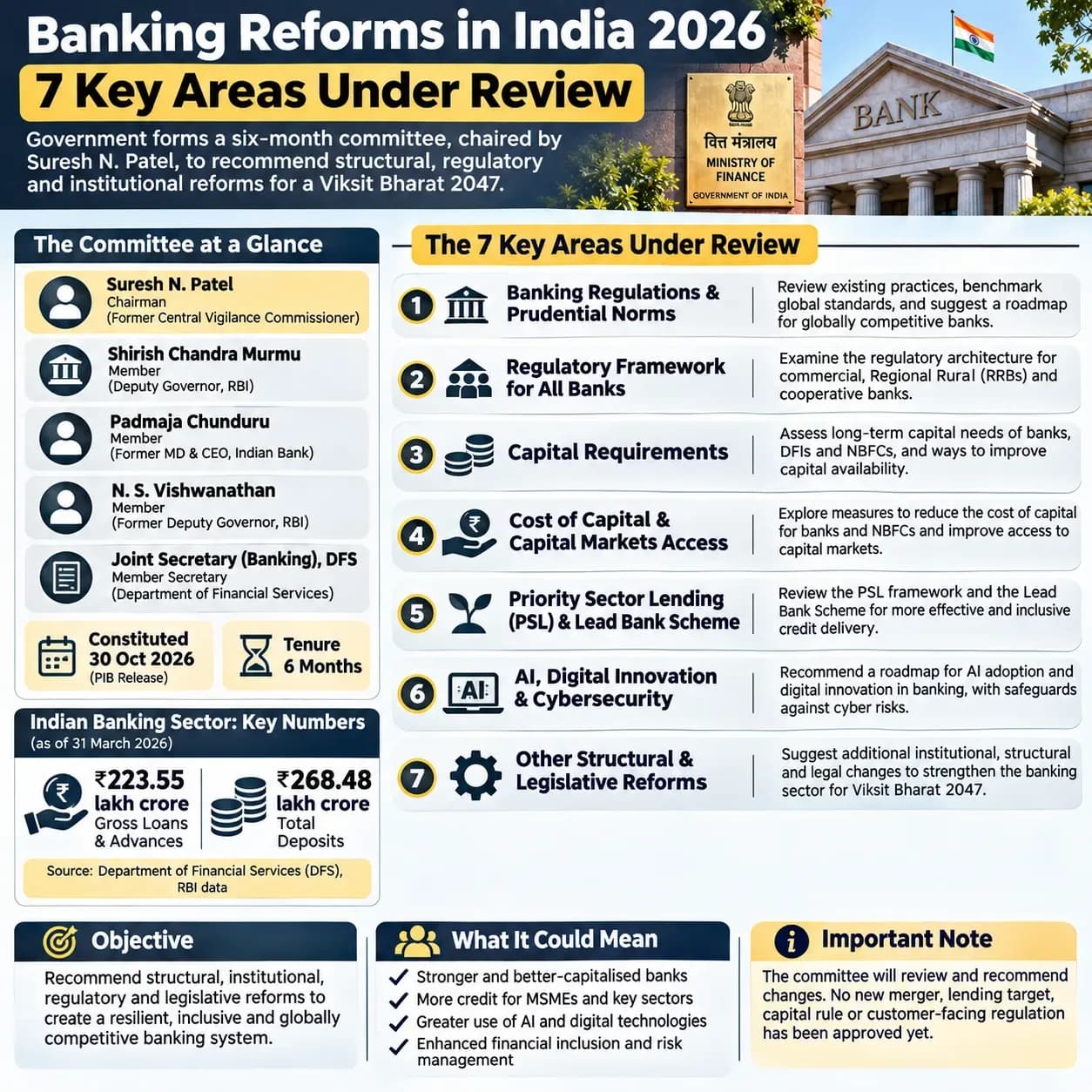
India’s banking system is entering a critical new phase. The government wants to align financial rules with its long-term development goals. To lead this effort, the Ministry of Finance formally formed the High Level Committee on Banking for Viksit Bharat on October 30, 2026. Former Central Vigilance Commissioner Suresh N. Patel will lead the group.
Finance Minister Nirmala Sitharaman first proposed this panel during the Union Budget on February 1, 2026. Now, the team has six months to deliver a clear roadmap. They will assess capital needs, digital safety, and rural credit access. The goal is to build banks that are globally strong and locally helpful.
Key Highlights at a Glance
- Six-Month Deadline: The expert panel must submit its final reform roadmap by April 2027.
- Liquidity Fix: They must address the dangerous gap between 14.9% loan growth and 11.3% deposit growth.
- Tech Rules: The group will draft strict AI adoption rules that align with new data privacy laws.
The panel includes heavyweights from the regulatory world. RBI Deputy Governor Shirish Chandra Murmu and former RBI Deputy Governor N. S. Vishwanathan are key members. Former Indian Bank CEO Padmaja Chunduru adds crucial public sector experience. Together, they will review seven major areas that will define the next twenty years of Indian finance.
1. Fixing the 14.9% Credit vs 11.3% Deposit Gap
The most urgent issue is capital availability. The panel must find long-term funding sources for banks and Non-Banking Financial Companies (NBFCs). Right now, the math is deeply strained. According to the Department of Financial Services (DFS), scheduled commercial banks saw huge jumps in loans, but savings lagged behind.
| Metric / Parameter | March 2025 Baseline | March 2026 Figure |
|---|---|---|
| Gross Loans & Advances | ₹194.49 lakh crore | ₹223.55 lakh crore |
| Total Deposits | ₹241.22 lakh crore | ₹268.48 lakh crore |
| Gross NPAs | ₹4.32 lakh crore | ₹3.86 lakh crore |
Between March 2025 and March 2026, bank credit surged by 14.9%. Total deposits grew by only 11.3%. The RBI calls this the Credit-Deposit (CD) Ratio mismatch. Banks are lending faster than they are saving. If this continues, banks will run out of cheap cash. We have seen early impacts of this cash strain in recent Q2 FY27 BFSI earnings reports, where net interest margins faced pressure.
The panel will also study Development Financial Institutions (DFIs) like NaBFID. These giants need cheap, twenty-year funding to build bridges and ports. Regular bank deposits simply cannot fund these massive infrastructure loans safely.
2. Banking Regulations: The Push for Global Giants
The government wants Indian banks to become "globally competitive." This phrase usually hints at one strategy: consolidation. The panel will review existing prudential norms and capital rules. They want to see if Indian banks have the sheer size to compete with American or Chinese giants.
Reports suggest the panel might lay the groundwork for another round of Public Sector Bank (PSB) mergers. Smaller state-run banks lack the capital to fund giant green energy farms alone. We are already seeing incredible scale in specialized zones, such as the recent $193 billion asset growth in GIFT City. The committee will study if merging smaller banks is the fastest path to achieve this global scale locally.
"The committee will recommend a roadmap for developing globally competitive banks and improving institutional efficiency." — Ministry of Finance Notification
3. Rethinking the Cost of Capital for Businesses
Loans remain expensive for ordinary businesses. The panel must study why policy rate cuts take so long to reach the real economy. There is a persistent gap between the RBI’s repo rate and the actual interest rate banks charge small businesses (MSMEs).
The committee wants to fix this slow policy transmission. If they succeed, factories and builders could access cheaper, long-term debt. This is essential to encourage private investment and create local jobs.
4. AI Adoption and the DPDP Act 2023
Technology is moving faster than the rules. The committee must draft a strategic roadmap for Artificial Intelligence (AI) in Indian banks. AI can speed up loan approvals and spot fraud instantly. However, it also brings massive risks.
Any new AI rule must obey the Digital Personal Data Protection (DPDP) Act of 2023. The DPDP Act forces banks to keep customer data local and private. The panel will likely suggest rules that limit how AI models share personal financial data with third-party vendors. They must prevent algorithmic bias, ensuring a machine does not unfairly reject loans based on zip codes.
Cybersecurity is the other half of this mandate. Hackers are using AI to bypass old defenses. As highlighted in our coverage on NBFC cyber fraud and AI attacks, the threat landscape is evolving rapidly. The panel will suggest stronger safeguards to protect the 24,161 crore UPI transactions processed last year.
5. Reviewing Priority Sector Lending (PSL) Quotas
Banks must lend a specific percentage of their money to farmers, small businesses, and students. This is the Priority Sector Lending (PSL) framework. The panel will check if these old rules still fit today's economy.
The economy has changed since these rules were written. The panel might explore adding climate tech and green transition projects into the formal PSL quota. This would help fund India's Net Zero targets. Innovative models, like FD-backed credit cards for underserved users, show that financial inclusion is evolving past traditional farm loans.
6. Regulatory Frameworks for Cooperative and Rural Banks
India relies heavily on Regional Rural Banks (RRBs) and cooperative banks for local credit. However, these smaller banks struggle with heavy compliance costs and outdated technology. The panel will review their specific legal frameworks.
A uniform rulebook does not work for everyone. A massive public sector bank can handle complex Basel III capital rules easily. A small district cooperative bank cannot. The committee will suggest ways to simplify rules for these smaller entities without risking depositor money.
7. The Lead Bank Scheme in a Digital Age
Introduced in 1969, the Lead Bank Scheme makes one specific bank responsible for the financial health of an entire district. The panel will see if this district-level model still works in a borderless, digital world.
According to government data from July 2026, 99.92% of inhabited villages now have a banking outlet within five kilometers. The infrastructure exists. The challenge now is actual credit delivery. The committee will look at how to use data-driven planning to get loans to the districts that need them most.
What to Watch Next: The April 2027 Deadline
The Suresh N. Patel committee must submit its final report by April 2027. This is roughly six months from the October 30 formation date. The stock market is watching this timeline closely.
NBFC stocks could react sharply depending on the panel's stance on wholesale funding. If the panel suggests easing rules to give NBFCs cheaper bank funds, the sector could rally. Conversely, if they demand stricter cyber audits and higher capital limits, operating costs will rise.
Until the report drops next year, no actual rules will change. However, smart banks are already preparing their balance sheets. They know tighter capital rules, strict AI laws, and a heavy push for deposit mobilization are coming very soon.
Frequently Asked Questions
What is the High Level Committee on Banking for Viksit Bharat?
It is a government expert panel formed on October 30, 2026. The group will review India's banking sector. They will recommend structural, regulatory, and technical reforms to prepare the economy for the Viksit Bharat 2047 vision.
Who leads the new banking reform committee?
Former Central Vigilance Commissioner Suresh N. Patel serves as the chairman. He is supported by three expert members, including current and former RBI Deputy Governors, and a former bank CEO.
Why is the committee looking at NBFCs?
NBFCs are crucial for lending to small businesses and consumers. The committee will study their long-term capital needs. They want to ensure shadow banks have enough safe funding to grow without risking market crashes.
Will the committee force banks to use AI?
No mandate exists yet. The panel will draft a strategic roadmap for AI adoption. They want to ensure banks use AI safely. Any new tech must respect cyber laws and strict data privacy rules like the DPDP Act 2023.
Does this mean my local public sector bank will merge?
Not immediately. The panel will study ways to make Indian banks globally competitive. This goal often implies consolidation. However, no specific mergers have been announced yet. Any merger requires separate government approval later.
Editorial & Legal Disclaimer: This report is published by News4Bharat for general informational and journalistic purposes only and does not constitute financial, investment, legal, or professional advice. All data, figures, and statements are sourced from public filings, regulatory notifications, and attributed third-party reports believed to be reliable at the time of publication; however, figures marked as approximate, provisional, or reported remain subject to official audit and revision. References to ongoing investigations, disputes, or regulatory actions reflect alleged or preliminary positions unless confirmed by a final judicial or statutory order. Readers are advised to verify details independently with certified professionals or primary regulatory records before making any financial or legal decisions.