

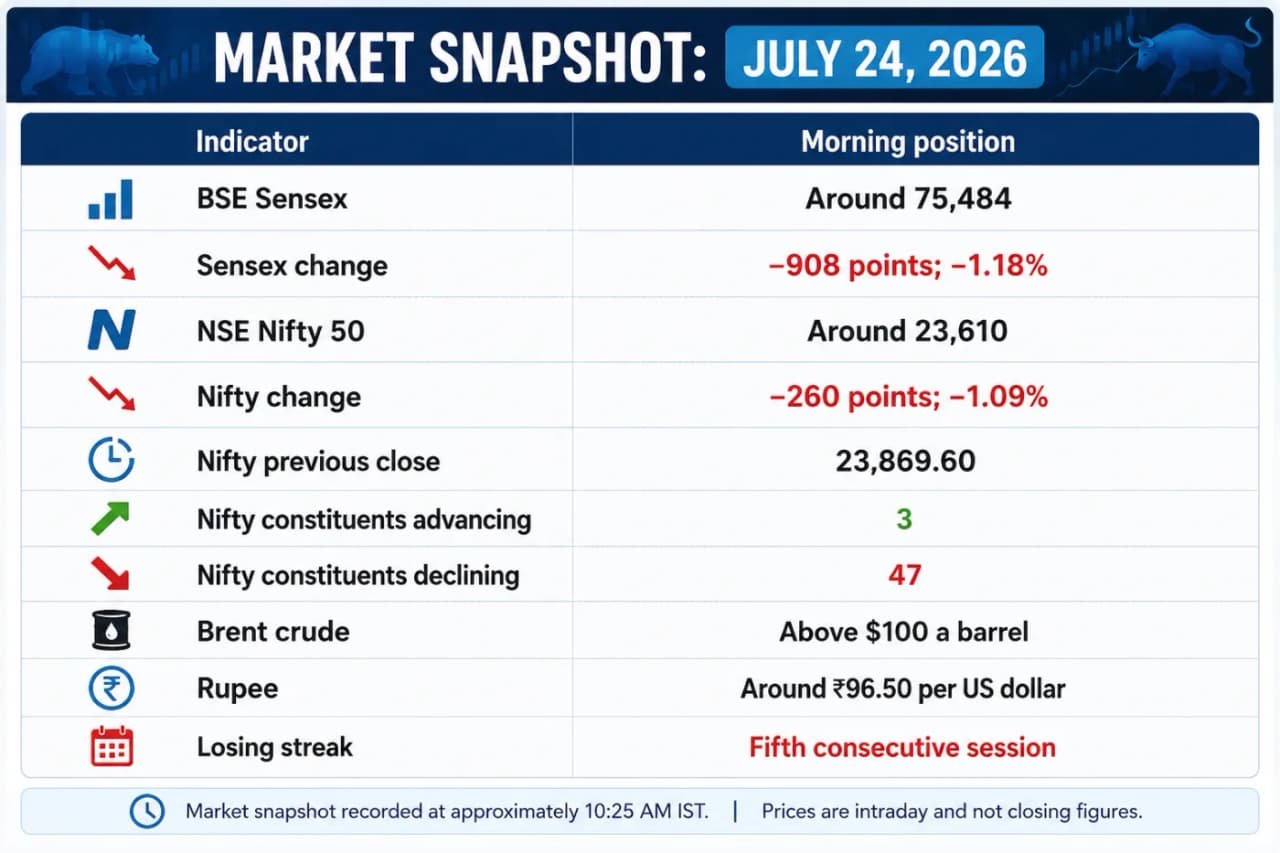
The Sensex and Nifty extended their decline for a fifth consecutive session on Friday, July 24, as Brent crude crossed $100 a barrel, the rupee remained under pressure and weak global markets triggered broad-based selling. Oil-sensitive businesses, technology companies and heavyweight financial stocks remained under scrutiny, while only three Nifty 50 constituents traded in positive territory during the morning session.
At approximately 10:22–10:25 AM IST, the BSE Sensex was trading around 75,484, down nearly 908 points or 1.18%, while the NSE Nifty 50 stood near 23,610, lower by approximately 260 points or 1.09%. The Nifty had opened at 23,666.35, against Thursday’s official close of 23,869.60.
Live values will continue changing during the session; readers should verify the latest figures on the BSE Sensex and NSE Nifty 50 pages.
Indian Stock Market Snapshot - 24th July 2026
Also Read | Indian Stock Market Last Week
Why Is the Stock Market Falling Today?
1. Crude oil above $100 is the central concern
Brent crude jumped about 7% in the previous global session and crossed $100 per barrel after escalating West Asian hostilities raised fears of supply and shipping disruptions. Attacks affecting Saudi tankers, instability around important maritime routes and renewed US-Iran tensions have revived the market’s oil-supply risk premium.
This matters disproportionately for India because the country imports close to 90% of its crude requirement. Expensive oil can widen the trade deficit, weaken the rupee, raise transportation and manufacturing costs and complicate the inflation outlook. It can also reduce the possibility of monetary easing.
The immediate equity-market impact is visible in oil marketing companies, airlines, paint manufacturers, logistics companies and other fuel-intensive businesses. Reuters reported that BPCL, HPCL and Indian Oil were down approximately 2% during the morning trade.
2. Weak global markets intensified risk aversion
Asian equities followed Wall Street lower after oil and inflation concerns overwhelmed positive corporate developments. Japan’s Nikkei and South Korea’s KOSPI recorded sharp falls, while US technology stocks came under heavy pressure.
Tesla plunged more than 14% in the previous US session, while Alphabet dropped around 7%. The Nasdaq Composite closed 2.15% lower, the S&P 500 lost 1.21% and the Dow Jones declined 0.97%, according to ET Now’s global-market report.
Higher energy prices are particularly uncomfortable for equity investors because they can simultaneously weaken economic growth and keep interest rates elevated.
3. The rupee remains close to record-low territory
The rupee recovered towards ₹96.50 per dollar after reportedly touching approximately ₹96.80 earlier in the session. State-run banks were seen selling dollars, suggesting possible Reserve Bank of India intervention, according to Reuters.
A weak rupee raises India’s oil-import bill and can accelerate foreign portfolio outflows. Exporters may receive some currency benefit, but that support can be offset when global demand, earnings guidance or sector valuations are already under pressure.
4. Corporate earnings have not provided enough protection
Infosys and InterGlobe Aviation were among the prominent earnings-sensitive counters.
IndiGo’s parent reported a standalone quarterly loss of approximately ₹382 crore, compared with a profit of ₹2,161 crore in the corresponding period of the previous year. Revenue increased, but higher operating costs and the return to losses overshadowed that growth.
Infosys also traded lower as investors evaluated its quarterly performance and outlook. In a risk-off market, even results that contain positive elements may fail to attract buyers when forward guidance disappoints expectations.
5. Foreign selling and rising bond yields remain overhangs
Persistent foreign institutional selling, a strong dollar and higher global bond yields have reduced investors’ appetite for emerging-market risk. Meanwhile, the oil shock has revived speculation that major central banks may have to keep rates elevated—or even tighten policy further—if inflation reaccelerates.
Also Read | Sensex Jumps 160 Points, Nifty Opens Above 24,050 Despite Weak Global Cues; IT Stocks Lead Rally
Which sectors are worst affected today?
- Aviation
- Oil Marketing
- Paints
- Logistics
- Banking
- IT
Weekly stock-market roundup
Friday’s decline placed the Sensex and Nifty on course for their weakest week in roughly four months. By the morning session, Reuters estimated that the Nifty had lost about 2.8% during the week, while the Sensex was down approximately 3.2%.
The important point is the consistency of the selling:
- Monday: Benchmarks began the week under pressure.
- Tuesday: Selling continued despite pockets of stock-specific strength.
- Wednesday: Weak global cues and heavyweight declines accelerated losses.
- Thursday: Nifty fell 126.65 points to 23,869.60; Sensex declined 363.66 points to 76,391.39.
- Friday morning: A sharp gap-down opening extended the losing streak to five sessions.
The NSE’s official Thursday close placed the Nifty at 23,869.60, down 126.65 points or 0.53%. The breadth deterioration on Friday—47 declining Nifty stocks against only three gainers—shows that the correction is not confined to one or two heavyweight companies.
Commodities market update
Crude oil is currently the most important commodity for Indian equities.
Brent moved above $100 after a 7% surge, while WTI traded above $92. Gold, surprisingly, failed to benefit fully from geopolitical uncertainty. Spot gold slipped approximately 0.4% to $4,030.09 an ounce, as rising oil prices strengthened expectations of higher-for-longer interest rates. August gold futures were near $4,033.20, according to Reuters.
That divergence is significant: gold’s safe-haven demand is being challenged by higher yields and a stronger dollar. For Indian buyers, however, rupee weakness can keep domestic bullion prices elevated even if international gold softens.
Conservative Stocks to Watch Next Week
These are monitoring candidates, not unconditional buy recommendations.

Dividend stocks to track next week
“Dividend stock” does not automatically mean “safe stock.” The share price normally adjusts when it trades ex-dividend, and investors should evaluate the company’s cash flow, payout sustainability and valuation.

Upcoming IPOs next week
The primary market remains active despite secondary-market weakness.
- Cube Highways Trust (InvIT) — a large ₹5,000 crore book-built issue — closes for subscription today, July 24, 2026, with allotment expected on July 27
- Indo-MIM: Subscription closes July 27; price band ₹461–₹485.
- Lohia Corp: Closes July 27; price band ₹404–₹425.
- Xtranet Technologies: Closes July 27; price band ₹120–₹127.
- Silverstorm Parks: Scheduled for July 24–28; price band ₹123–₹133.
- Manipal Health Enterprises: Expected to open July 29 with a ₹560–₹590 price band. The proposed ₹9,275-crore issue could be India’s second-largest IPO of 2026. Reuters reported that the company is seeking a valuation of up to $8 billion.
Investors should verify issue details through the NSE IPO portal and BSE public-issues page. Grey-market premiums are unofficial and should not be treated as exchange-verified evidence.
Disclaimer: This article is for news and educational purposes only. It does not constitute investment, trading or tax advice. Market prices and derivatives data change continuously. Consult a SEBI-registered adviser and review official exchange disclosures before investing.